PTC AI Insights

  • The Local SEO Edge: How AI-Powered Workflow Automation is Helping Wellness Practices Dominate Search

    The Local SEO Edge: How AI-Powered Workflow Automation is Helping Wellness Practices Dominate Search

    For many wellness practice owners: whether you are operating a multi-location physical therapy clinic, a boutique mental health collective, or a specialized medical spa: the digital landscape often feels like a treadmill that never stops. You know that visibility on Google is the lifeblood of new patient acquisition, yet the path to achieving that visibility is usually paved with high agency retainers, fragmented workflows, and the exhausting "SEO agency grind."

    In 2026, the gap between practices that are merely surviving and those that are dominating their local markets is no longer defined by who has the largest marketing budget. Instead, it is defined by who has the most efficient operating model for digital authority.

    At Pure Technology Consulting, we view local SEO not as a series of creative "hacks," but as a data-driven workflow that can be engineered, automated, and scaled. By integrating AI-powered automation into your practice’s growth strategy, you can move from reactive survival mode to a proactive growth trajectory that compounds over time.

    The Friction of the Traditional SEO Agency Grind

    Traditional SEO models are often built on manual labor. An agency assigns an account manager who manually updates business listings, writes one or two blog posts a month, and slowly builds out location pages. For a multi-location wellness practice, this manual approach is inherently flawed. It is slow, prone to human error, and prohibitively expensive to scale.

    When you are trying to grow, you cannot afford to wait six months for a manual citation cleanup or a slow drip of content. This "grind" keeps business owners stuck in a loop of paying for effort rather than outcomes. The risk is high: if your NAP (Name, Address, Phone) data is inconsistent across the web, search engines lose trust in your practice. If your location pages are generic, Google won't prioritize you in the "Local Pack" (the top three map results).

    Digital transformation of manual SEO tasks into organized, automated workflows for wellness clinics.

    Moving from Survival to Growth: The Automation Strategy

    The shift to AI-powered workflow automation changes the fundamental unit of SEO. Instead of thinking in terms of "tasks," visionary leaders think in terms of "systems."

    Automation allows a wellness practice to maintain a dominant presence across dozens of zip codes without increasing their administrative overhead. This is the core philosophy behind our custom builds and frameworks, such as our AI Local Boost (AILB) ecosystem. We don’t just "do SEO"; we build the infrastructure that automates visibility.

    1. Location Page Creation at Scale

    For a wellness practice with five, ten, or fifty locations, creating unique, high-quality content for each neighborhood is a massive undertaking. Manual creation often leads to "content cannibalization" or duplicate content that search engines penalize.

    With automated workflows, we can generate dozens of unique, SEO-optimized location pages using structured data and dynamic templates. These pages aren't just shells; they are populated with localized service language, provider bios, and neighborhood-specific context that signals high relevance to Google's algorithms.

    2. Eliminating the NAP Consistency Barrier

    One of the largest barriers to local search dominance is the "fragmented identity" problem. If your practice moved three years ago, or if a provider changed their name, those old citations still haunt your search rankings.

    AI-driven systems automate the detection and correction of these inconsistencies across hundreds of directories. By strengthening your citation profile automatically, you build a durable local footprint that AI search systems: including Google’s Gemini and OpenAI’s SearchGPT: rely on when making recommendations to potential patients.

    The ROI of Automated Digital Visibility

    When we discuss digital strategy with executive-level clients, the conversation always centers on operating leverage. How much output can we generate for every unit of input?

    The data is clear: wellness practices utilizing AI-driven SEO automation can publish 20–30 optimized pages monthly, compared to the 2–4 pages typically produced by a manual agency. Furthermore, because the automation handles the "heavy lifting" of data entry and technical schema markup, the cost of acquisition typically drops by up to 75% compared to traditional healthcare SEO models.

    Isometric city map illustrating automated search visibility across multiple wellness practice locations.

    Faster Time-to-Market

    In the world of custom software and high-level automation, speed is a competitive advantage. Traditional SEO results are often promised in 6 to 12 months. With an automated roadmap, we typically see measurable movement in search rankings within 4 to 6 weeks. This speed allows practices to capture market share in new territories before competitors can even finish their manual keyword research.

    Focus on High-Value Patient Acquisition

    Automation doesn't just save money; it saves cognitive bandwidth. By removing the "SEO Agency Grind" from your plate, you can focus on high-ticket service lines: such as specialized surgeries, long-term wellness programs, or elective procedures: that drive the highest revenue. Your digital presence becomes an automated engine that feeds the practice, rather than a project that requires constant babysitting.

    Building for the Future: AI-Ready Local Authority

    The future of search is increasingly conversational and intent-based. When a mother in your city asks her phone, "Where is the best pediatric wellness center near me that specializes in holistic nutrition?", the answer isn't determined by who has the most keywords. It’s determined by structured data.

    AI systems look for clear signals:

    • Schema Markup: Technical code that tells search engines exactly what services you offer and where.
    • Sentiment Analysis: Automated monitoring of patient reviews to understand the "vibe" of your practice.
    • Real-time Availability: Integrating your booking systems directly into your search profile.

    At Pure Technology Consulting, we specialize in building these types of complex, bespoke integrations. Whether it is our work in healthcare with matching engines like EHRIO Pro or our local SEO automation via AI Local Boost, our goal is to ensure your practice’s data is the most reliable and accessible in your market.

    A connected digital ecosystem of healthcare data points powering local search authority and growth.

    Taking the Next Step in Your Growth Roadmap

    Dominating local search in the wellness sector is no longer a matter of luck or simply having "good content." It is a matter of engineering. By replacing manual effort with intelligent workflows, you transform your practice from a local business into a dominant market force.

    If you are a growth-focused business owner tired of the traditional agency model and ready to explore how custom automation can scale your visibility, it is time to shift your strategy. We invite you to move beyond the grind and into a model of automated authority.

    How to Begin

    Every successful transformation starts with a clear understanding of the current technical landscape. We recommend a comprehensive workflow audit to identify where manual friction is slowing your growth and where automation can provide the highest immediate ROI.

    To discuss a bespoke development roadmap for your practice, you can schedule a discovery call with our team. We focus on building high-ticket, scalable solutions that integrate seamlessly with your existing operations.

    Amin Said, Founder of Pure Technology Consulting LLC
    https://puretechconsult.com
    +1 (803) 921-0969


    More Resources for Growth-Minded Executives:

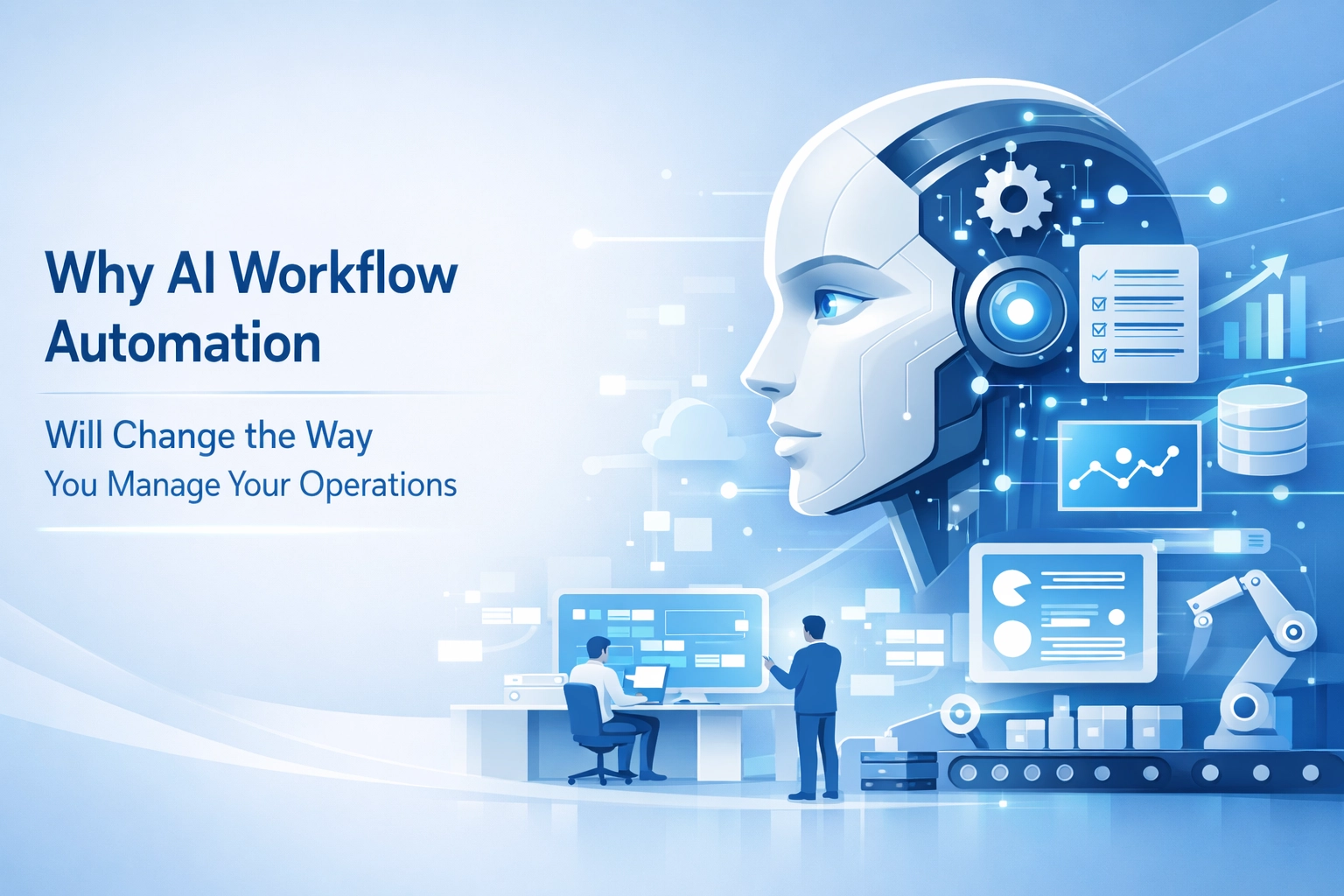
  • Why AI Workflow Automation Will Change the Way You Manage Your Operations

    Why AI Workflow Automation Will Change the Way You Manage Your Operations

    In the current landscape of enterprise evolution, we have moved past the era where digital transformation was a luxury. As of March 2026, it has become the fundamental baseline for survival. For executives and operational leaders, the challenge is no longer about "going digital," but about how to orchestrate a complex web of data, human talent, and machine intelligence into a cohesive, high-performance operating model.

    The traditional approach to operations management: relying on manual oversight, fragmented SaaS tools, and reactive troubleshooting: is reaching its breaking point. This "operational drag" costs companies more than just money; it costs them the agility required to pivot in a volatile market. At Pure Technology Consulting, we view AI workflow automation not as a replacement for human ingenuity, but as the high-tensile framework that allows your team to scale without the friction of traditional growth.

    The End of Operational Drag

    Operational drag is the invisible tax on your productivity. It is found in the hours spent reconciling invoices, the delays in client onboarding, and the inevitable errors that occur when high-value employees are forced to perform low-value data entry. Research consistently shows that companies integrating AI into their process automation can reduce operational costs by 20% to 30%. However, the true value lies in the reallocation of human capital.

    When routine, rule-based tasks are offloaded to an intelligent automation layer, your workforce is liberated to focus on strategic initiatives, relationship building, and high-level problem solving. This isn't just about speed; it's about accuracy. In industries like manufacturing or healthcare, where we have deployed advanced matching engines, the precision of AI-driven inspection and data validation often exceeds human benchmarks by significant margins.

    Human silhouette stepping into light, representing liberation from manual tasks through AI automation.

    From Reactive Management to Predictive Orchestration

    Most operational models are reactive. A bottleneck occurs, a report is generated, and a manager intervenes. AI workflow automation flips this script. By leveraging vast datasets and predictive analytics, an automated system can identify potential disruptions before they manifest as crises.

    Consider the complexity of inventory management or professional service scheduling. AI-powered tools can analyze historical patterns, market trends, and real-time inputs to adjust workflows dynamically. This proactive stance reduces forecasting errors and minimizes downtime, transforming the operations manager from a "firefighter" into an architect of efficiency.

    At Pure Technology Consulting, we specialize in building these bespoke architectural layers. We understand that your business doesn't fit into a one-size-fits-all SaaS box. You need custom software that mirrors your unique logic and governance requirements.

    Case Study in Complexity: EHRIO Pro

    To understand the power of high-level automation, one only needs to look at our proprietary work with EHRIO Pro. Originally designed for the complex healthcare sector, EHRIO Pro serves as a testament to what is possible when you combine custom web development with sophisticated matching algorithms.

    The platform handles intricate, 70-question intake processes and matches them against specific healthcare criteria with surgical precision. This isn't simple data collection; it is a HIPAA-adjacent workflow that manages compliance, data integrity, and stakeholder communication in a single, automated stream.

    We are now bringing this same level of sophisticated engineering to the legal and accounting sectors. For a high-ticket law firm or a multi-state accounting practice, the "matching engine" logic of EHRIO Pro can be adapted to manage case assignments, audit trail verifications, and client-vendor matching. It is proof that a custom-built solution can handle the "heavy lifting" of operations, ensuring that the right data reaches the right person at exactly the right time.

    Centralized data hub with glowing rings illustrating scalable architecture for custom business operations.

    The Architecture of Scalability

    A common fear among growing businesses is that scaling operations requires a linear increase in headcount. AI workflow automation breaks this correlation. Through custom-built web applications and integrated AI agents, a business can double its output without doubling its staff.

    This scalability is achieved through:

    • Seamless Integration: Connecting disparate legacy systems into a unified dashboard.
    • Dynamic Resource Allocation: Using AI to route tasks based on urgency and team capacity.
    • Automated Communication: Utilizing sophisticated bots to handle routine inquiries, such as those integrated via FTP Inform for data movement notifications or client updates.

    By building a custom "operating system" for your business, you create an asset that grows in value as it accumulates data, becoming more efficient with every transaction it processes.

    Governance, Risk, and Compliance

    In highly regulated fields like fintech, legal, and healthcare, the stakes of operational failure are high. Manual processes are not only slow; they are risky. A missed step in a compliance workflow can lead to significant legal exposure.

    Automated workflows provide a transparent, immutable audit trail. Every decision made by the system is logged, and every data point is validated against pre-set governance rules. This level of oversight is nearly impossible to maintain manually at scale. Our work in fintech: specifically regarding telephony integrations and call attribution for debt agencies: demonstrates our ability to build systems that prioritize both performance and rigorous compliance.

    Stacked digital plates with a light beam showing an immutable audit trail for automated compliance systems.

    How to Begin Your Transformation

    The transition to an AI-augmented operating model does not happen overnight. It requires a visionary approach and a strategic roadmap. At Pure Technology Consulting, we don't start with code; we start with a discovery.

    We work with your leadership to map your current workflows, identify the points of highest friction, and design a custom solution that integrates with your existing tech stack. Whether you need a bespoke web app to manage field operations: similar to our GPS-logging work in D2D tracking: or a complex data-matching engine, our goal is to deliver a premium, high-impact solution that justifies your investment within months, not years.

    Your Strategic Roadmap Includes:

    1. Workflow Audit: Identifying the manual bottlenecks that are currently throttling your growth.
    2. Architectural Design: Creating a blueprint for a custom web application that centralizes your operations.
    3. AI Integration: Layering intelligent automation onto routine tasks to ensure precision and speed.
    4. Scaling & Governance: Ensuring the system is robust enough to handle growth while maintaining strict data compliance.

    Digital bridge connecting fragmented data to a structured monolith, symbolizing operational transformation.

    The Future of Your Operations

    The companies that thrive in the coming decade will be those that view technology not as a utility, but as a strategic lever. AI workflow automation is the key to unlocking that lever. It allows you to move faster, decide better, and grow without the traditional pains of expansion.

    If you are ready to move beyond the limitations of off-the-shelf software and build a bespoke operational powerhouse, we are ready to guide you. Our team specializes in the high-ticket, high-complexity builds that define modern business success.

    To begin the conversation and explore how a custom automation strategy can transform your specific operating model, I invite you to reach out to my assistant, Emily, to schedule a discovery call. We can discuss your current challenges and provide a roadmap for a solution that fits your vision.

    You can also reach our office directly at +1 (803) 921-0969 to start your journey toward operational excellence.

    Amin Said, Founder of Pure Technology Consulting LLC

    https://puretechconsult.com

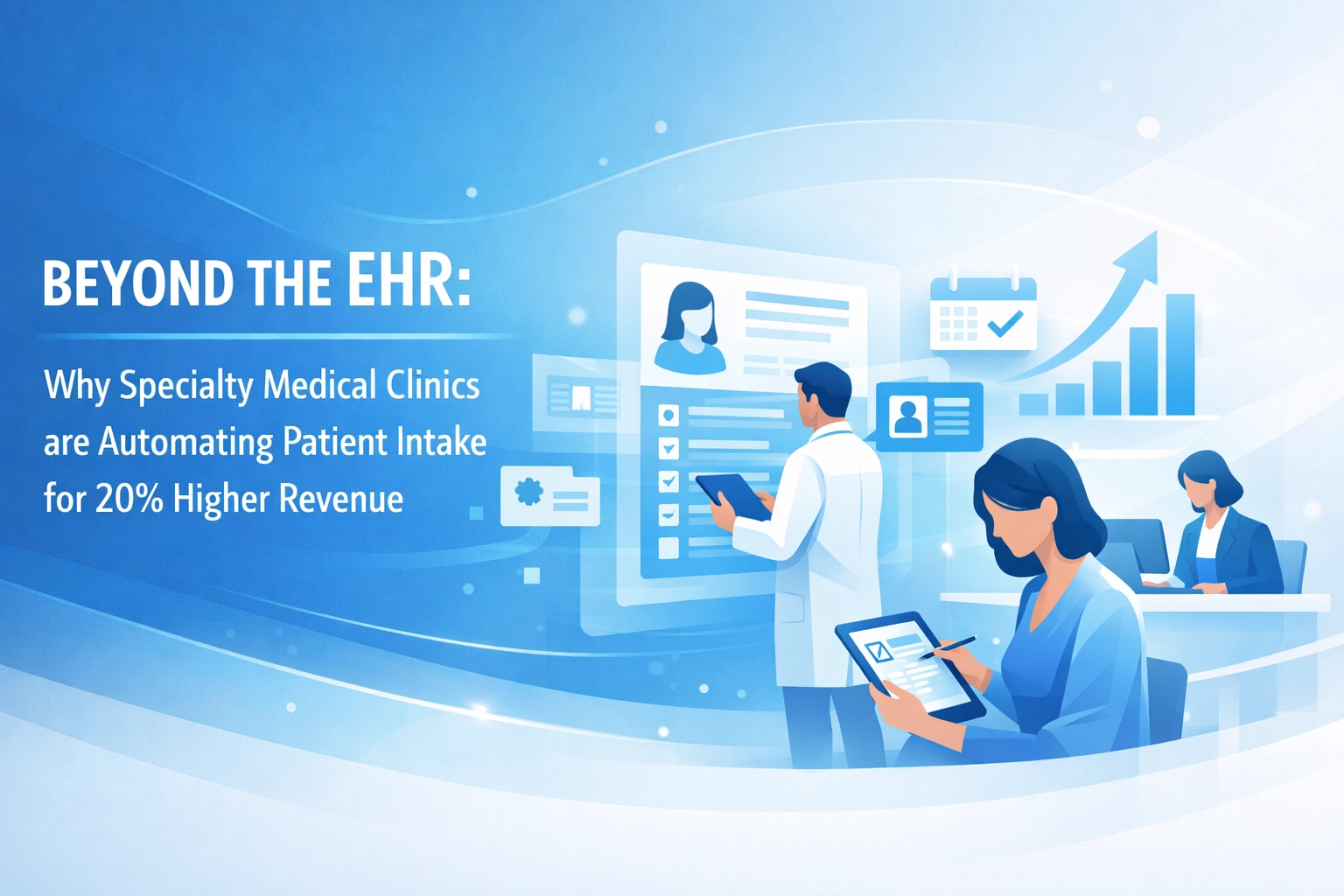
  • Beyond the EHR: Why Specialty Medical Clinics are Automating Patient Intake for 20% Higher Revenue

    Beyond the EHR: Why Specialty Medical Clinics are Automating Patient Intake for 20% Higher Revenue

    For the modern specialty clinic: the high-growth chiropractic practice, the bustling physical therapy center, or the cutting-edge wellness boutique: the Electronic Health Record (EHR) system was supposed to be the "Great Liberator." It promised a paperless office, streamlined charts, and a frictionless patient journey.

    Yet, for many practice owners, the EHR has become a digital filing cabinet that requires a small army to maintain.

    While the EHR excels at clinical documentation and meeting regulatory compliance, it often fails at the one thing a growing business needs most: operational efficiency. We see it constantly at Pure Technology Consulting: brilliant clinicians and savvy business owners are losing 15 to 20 minutes of staff time per patient just to move data from a clipboard (or a clunky web form) into the clinical record.

    When you scale that across 40 patients a day, you aren’t just losing time: you’re losing an entire salary’s worth of productivity and a significant chunk of your potential revenue.

    The most successful specialty clinics are now looking beyond the EHR. They are building custom, automated intake layers that act as a high-speed bridge between their marketing, their front desk, and their clinical records. The result? A documented 20% lift in revenue driven by increased patient throughput, reduced no-shows, and a vastly improved patient experience.

    The Invisible Cost of Administrative Friction

    In a specialty clinic, the "front desk" is the engine room of your revenue. When your staff is buried in manual data entry, they aren't doing the things that actually grow the practice: following up on leads, re-engaging past patients, or ensuring the waiting room environment is premium.

    Research shows that manual transcription of patient forms takes between 10 and 15 minutes per patient, with an error rate that can reach 5%. In a high-volume chiropractic or PT clinic, those errors lead to billing denials and delayed payments: the silent killers of cash flow.

    Digital transition from chaotic manual patient intake to a streamlined, efficient medical office workflow.

    Beyond the internal costs, there is the patient perspective. In 2026, patients expect a "Starbucks-level" digital experience. They want to book a session on their phone and complete their intake while sitting on their couch, not on a physical clipboard in a waiting room. When the intake process is cumbersome, the "no-show" rate climbs. Automation isn't just about saving staff time; it’s about securing the patient's commitment to the appointment before they ever step through your door.

    The Anatomy of an Automated Intake System

    When we consult with medical and wellness practitioners, we don’t just suggest another "app." We talk about an integrated operating model. A truly automated intake system: similar to the architecture we’ve developed for platforms like EHRIO Pro: consists of three core pillars:

    1. The Dynamic Digital Intake

    Standard EHR forms are often "flat" and exhaustive, forcing patients to skip irrelevant sections manually. A custom-built automation layer uses conditional logic. If a patient checks "Lower Back Pain," the system automatically serves the relevant orthopedic questionnaires. This reduces "form fatigue" and ensures that by the time the clinician walks into the room, they have a highly specific, pre-digested data set.

    2. The Bi-Directional Integration

    The biggest mistake clinics make is having "islands of data." Your CRM (where leads live) doesn't talk to your EHR (where patients live), which doesn't talk to your billing software.

    Pure Technology Consulting specializes in building the connective tissue between these systems. Imagine a lead clicking an ad, booking through a custom interface, and having their data automatically populated in the EHR while simultaneously triggering a "Welcome" sequence in your CRM. No manual entry. No data silos.

    3. Automated Verification and Collection

    Revenue leaks often happen at the start. Automated intake systems can include real-time insurance verification and integrated payment gateways. By the time the patient checks in, their co-pay is settled, and their coverage is confirmed. This removes the "awkward" financial conversation at the front desk and guarantees that the revenue for that time slot is secured.

    Medical clinic floor plan with rising bars representing growth and increased revenue from patient intake automation.

    How Automation Drives a 20% Revenue Lift

    It’s easy to call "automation" a buzzword, but the numbers tell a more definitive story. How exactly does a specialty clinic find 20% more revenue through intake automation?

    Increased Patient Throughput

    If your front desk saves 10 minutes per patient and you see 30 patients a day, you’ve just "found" 5 hours of staff time. That time can be redirected toward outbound calling for "lost" patients or managing a higher volume of new appointments without hiring additional administrative help. More patients per hour equals higher revenue per clinician.

    Reduction in "Leaking" Leads

    Many clinics lose potential revenue because the gap between "Inquiry" and "First Appointment" is too wide. Automated scheduling and intake tighten this gap. When a patient can book and complete their intake immediately, the "psychological momentum" is high, and the likelihood of them attending the appointment increases by as much as 30%.

    Lower Billing Denials

    Clean data in means clean claims out. By automating the transfer of patient data into the billing system, you eliminate the "typos" that cause insurance companies to reject claims. Faster reimbursements mean a healthier bottom line and less time spent in "Accounts Receivable" purgatory.

    Moving from "Software" to "Strategy"

    At Pure Technology Consulting, we believe that software should fit your business, not the other way around. Off-the-shelf EHRs are designed for the "average" clinic, but high-growth specialty practices aren't average.

    Whether it’s building 70-question complex intake engines that feed directly into clinical matching algorithms (as seen in our work with healthcare-focused platforms) or integrating telephony and GPS logging for field-based therapy, our approach is always bespoke. We don't just give you a tool; we build a workflow that acts as a competitive advantage.

    Integrated software architecture connecting CRM, EHR, and billing systems for unified medical clinic operations.

    Predictable Growth through Systems

    The transition from a "busy" clinic to a "scaling" clinic happens when the owner moves from being the primary problem-solver to the primary strategist. You cannot strategize if you are constantly putting out fires caused by administrative bottlenecks.

    Automating your patient intake is the first step in building a "predictable growth engine." It allows you to know, with mathematical certainty, that your front office can handle a 20%, 50%, or 100% increase in lead volume without breaking.

    What to Automate First?

    If you’re looking to reclaim your time and boost your margins, start here:

    • The Appointment-to-Intake Bridge: Ensure that every booking immediately triggers a digital intake form.
    • The EHR Sync: Eliminate manual transcription from your web forms into your clinical records.
    • Automated Reminders: Move beyond simple "text reminders" to interactive sequences that allow patients to reschedule or confirm with one click.

    Your Roadmap to an Automated Practice

    The technology to achieve a 20% revenue lift exists today. The challenge for most specialty medical and wellness owners isn't a lack of tools; it's a lack of time to integrate them properly.

    As visionary consultants, our job at Pure Technology Consulting is to audit your existing workflows, identify the points of friction, and build the custom automation layers that turn your EHR from a bottleneck into a powerhouse.

    We’ve brought these capabilities to healthcare, fintech, and professional services, helping leaders move from "surviving the day" to "scaling the vision."

    Ready to see how custom automation can transform your clinic’s bottom line?

    If you are ready to stop fighting your EHR and start leveraging your data for growth, let's have a conversation. We offer a deep-dive workflow audit to identify exactly where your revenue is leaking and how a bespoke automation layer can plug those holes.

    Book a discovery call with our team to explore your custom automation roadmap.

    Amin Said, Founder of Pure Technology Consulting LLC
    +1 (803) 921-0969
    https://puretechconsult.com

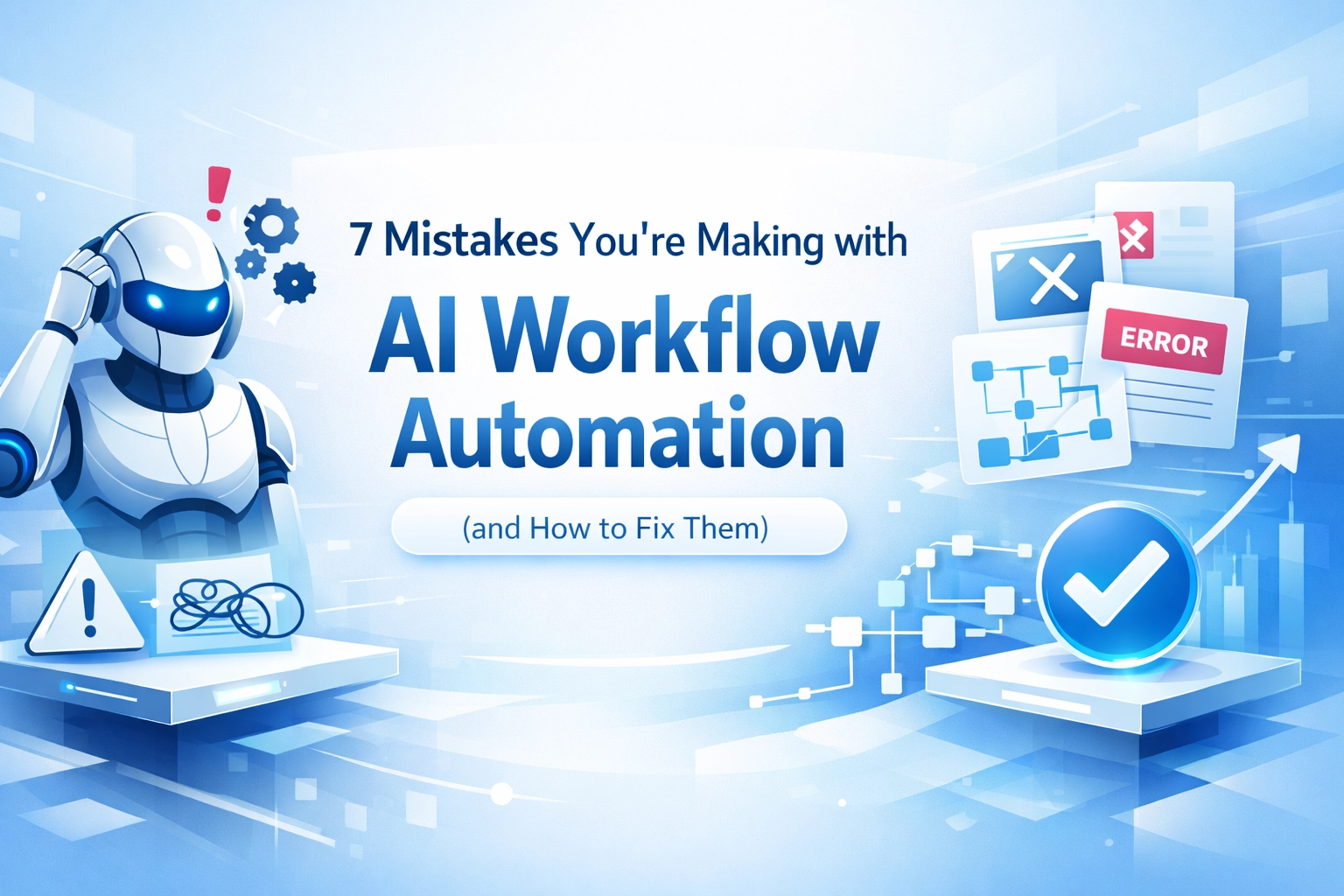
  • 7 Mistakes You’re Making with AI Workflow Automation (and How to Fix Them)

    7 Mistakes You’re Making with AI Workflow Automation (and How to Fix Them)

    The promise of artificial intelligence is no longer a distant vision; it is the current engine of digital transformation. For growth-minded executives and founders, AI-powered automation represents the ultimate leverage: the ability to scale operations without a linear increase in headcount. However, the path from manual struggle to automated excellence is fraught with strategic pitfalls.

    At Pure Technology Consulting, we’ve seen that the difference between a successful deployment and a costly failure rarely lies in the technology itself. Instead, it lies in the strategy, the data architecture, and the human-centric design of the workflow. If your automation initiatives aren't delivering the expected ROI, you are likely falling into one of these seven common traps.

    1. Automating an Inherently Broken Process

    The most fundamental error a business can make is automating a process that is already inefficient or poorly designed. Automation is an accelerant; if you apply it to a broken workflow, you are simply creating "automated chaos." You will produce errors faster, frustrate customers more quickly, and obscure the root causes of operational friction.


    The Fix: Before a single line of code is written or an AI model is trained, you must perform a comprehensive workflow audit. Map every touchpoint, identify redundant approval layers, and remove bottlenecks. We often advise our clients to "simplify, then optimize, then automate." If a process doesn't work on a whiteboard with a marker, it certainly won’t work in the cloud with an LLM.

    2. Lacking Clear, Quantifiable Objectives

    Many organizations rush into AI because of the "Fear of Missing Out" (FOMO). They implement chatbots or automated data entry without a clear North Star. When you implement technology for the sake of technology, you lose the ability to measure success or justify the investment.

    The Fix: Define exactly what "success" looks like. Is it a 40% reduction in customer support response time? Is it a 15% increase in lead conversion? Or perhaps it’s reducing the manual data entry hours for your accounting team. By establishing clear KPIs at the outset, you align your technical roadmap with your business priorities.

    Digital data flowing through conduits representing clear visibility and KPIs in AI workflow automation.

    Bridging the Visibility Gap with FTP Inform

    A clear objective requires clear data visibility. Many of the high-ticket custom solutions we build at Pure Technology Consulting involve complex file transfers and data synchronization between legacy systems and modern web apps. One of the biggest hurdles to clear objectives is the "black box" of data movement.

    To solve this for our clients, we developed FTP Inform. While it serves as a robust standalone tool, it is also a testament to our philosophy of visibility. It provides real-time notifications and monitoring for FTP/SFTP transfers, ensuring that when an automated workflow is triggered by a file arrival, the right stakeholders know instantly. It transforms a silent background process into a transparent, actionable event. In the world of custom automation, knowing exactly when and if your data arrived is the first step toward achieving your strategic goals.

    Explore how we handle data transparency: https://ftpinform.puretechconsult.com

    3. Ignoring Data Quality and Integrity

    AI models are only as good as the data they consume. If your CRM is filled with duplicate records, inconsistent formatting, or outdated information, your AI automation will produce flawed outputs. In the context of high-stakes industries like legal or healthcare, these errors aren't just inconveniences: they are liabilities.

    The Fix: Establish rigorous data governance before scaling your automation. This involves cleansing existing data, implementing validation rules at the point of entry, and ensuring that your various software systems "speak the same language." Investing in a clean data foundation is the most significant way to de-risk your AI projects.

    4. Selecting the Wrong Platform for Your Ambition

    Many businesses reach for "off-the-shelf" SaaS automation tools that offer ease of use but lack depth. While these are great for simple tasks, they often fall apart when faced with complex, industry-specific logic or high-security requirements. Trying to force a bespoke business process into a rigid, low-code platform creates technical debt that will eventually need to be repaid.

    The Fix: Conduct a strategic platform evaluation. If your workflow requires deep integration with legacy databases, custom business logic, or HIPAA-adjacent compliance, a bespoke web application is often the more cost-effective long-term solution. Custom development allows the technology to wrap around your business, rather than forcing your business to wrap around the software.

    A structured node network symbolizing bespoke software architecture and custom AI automation solutions.

    Case Study in Complexity: EHRIO Pro

    The limitations of standard platforms are most evident in the healthcare sector. We developed EHRIO Pro to demonstrate how bespoke automation can handle the most sensitive and complex data environments. EHRIO Pro utilizes advanced matching engines and exhaustive 70-question intakes to ensure that patient data and provider workflows are perfectly aligned.

    By building a proprietary solution that addresses specific compliance and logic needs, we’ve shown that "off-the-shelf" is rarely enough for high-ticket operations. Whether you are in healthcare, law, or fintech, your automation should be as unique as your proprietary processes. EHRIO Pro is a blueprint for how we approach custom web development: prioritizing security, accuracy, and deep integration.

    5. Eliminating the "Human-in-the-Loop"

    There is a common misconception that AI automation should be entirely autonomous. While the goal is to reduce manual labor, removing human oversight entirely is a recipe for disaster. AI can hallucinate, misunderstand context, or fail to account for the nuance of a high-value client relationship.

    The Fix: Implement a "Hybrid Intelligence" model. Use AI to handle the "heavy lifting": data processing, initial drafting, and pattern recognition: but keep humans at critical decision-making nodes. For example, an AI might draft a legal contract based on case data, but a senior partner must always perform the final review. This ensures efficiency without sacrificing professional accountability.

    6. Building Siloed Automation Solutions

    Automation is often implemented department by department. The marketing team automates social media, while the finance team automates invoicing. Without a centralized strategy, you end up with "islands of automation" that don't communicate with each other. This creates new bottlenecks as data has to be manually moved between automated silos.

    The Fix: Adopt an API-first architecture. Every automation you build should be designed to integrate with your existing CRM, ERP, and communication tools. At Pure Technology Consulting, we focus on building unified ecosystems where data flows seamlessly from lead capture to project delivery to final billing.

    A glowing digital grid illustrating local SEO automation and unified ecosystems for business growth.

    Scaling Local Presence: AI Local Boost (AILB)

    One area where siloed data often fails is in Local SEO and reputation management. Many businesses automate their Google Business Profile updates, but they do so in isolation from their actual customer service workflows.

    Our proprietary tool, AI Local Boost, demonstrates how we bridge that gap. By automating local SEO activities and Google Business Profile management through an intelligent, integrated lens, we help businesses maintain a visionary digital presence without the manual overhead. It is a prime example of how bespoke automation can take a time-consuming manual task and turn it into a competitive advantage, all while remaining integrated with the broader digital strategy.

    7. Scaling Too Fast Without Governance or Monitoring

    Success in a small pilot project often leads to a rush to automate the entire enterprise. However, scaling without a governance framework is dangerous. As you add more automated workflows, the complexity grows exponentially. If a single API changes or a data source becomes corrupted, a dozen different workflows could fail simultaneously, often silently.

    The Fix: Start small, but build for scale. Establish a centralized monitoring dashboard that tracks the health of all automated processes. Implement "circuit breakers" that pause automation if error rates exceed a certain threshold. Most importantly, designate an "Automation Lead" or partner with a consultancy like Pure Technology Consulting to provide ongoing oversight and maintenance.

    Orchestrating the Enterprise: ChainHQ

    Managing complex, multi-stage workflows requires a sophisticated command center. We developed ChainHQ as a proprietary platform to showcase our capability in supply chain and complex workflow management. ChainHQ provides the high-level visibility and governance needed to manage intricate operations across multiple stakeholders.

    It represents our visionary approach to digital transformation: creating software that doesn't just "do a task," but provides a strategic overview of the entire business engine. For clients in logistics, manufacturing, or field operations, ChainHQ serves as a testament to the power of custom-built, enterprise-grade automation.

    Moving Beyond the Mistakes

    AI workflow automation is not a "set it and forget it" solution. It is a strategic capability that requires visionary leadership and technical excellence. By avoiding these seven mistakes, you position your firm to capture the true value of the digital age: operational leverage, superior client experiences, and the freedom to focus on high-level strategy rather than low-level tasks.

    At Pure Technology Consulting, we specialize in building the custom web applications and AI integrations that power the next generation of industry leaders. Whether you are in legal, accounting, healthcare, or fintech, we bring proven expertise to your most complex challenges.

    Ready to audit your workflows and build a bespoke automation roadmap?

    Let’s turn your operational drag into a competitive engine.

    Book a discovery call with our team or call us at +1 (803) 921-0969 to start the conversation.

    Amin Said, Founder of Pure Technology Consulting LLC
    https://puretechconsult.com

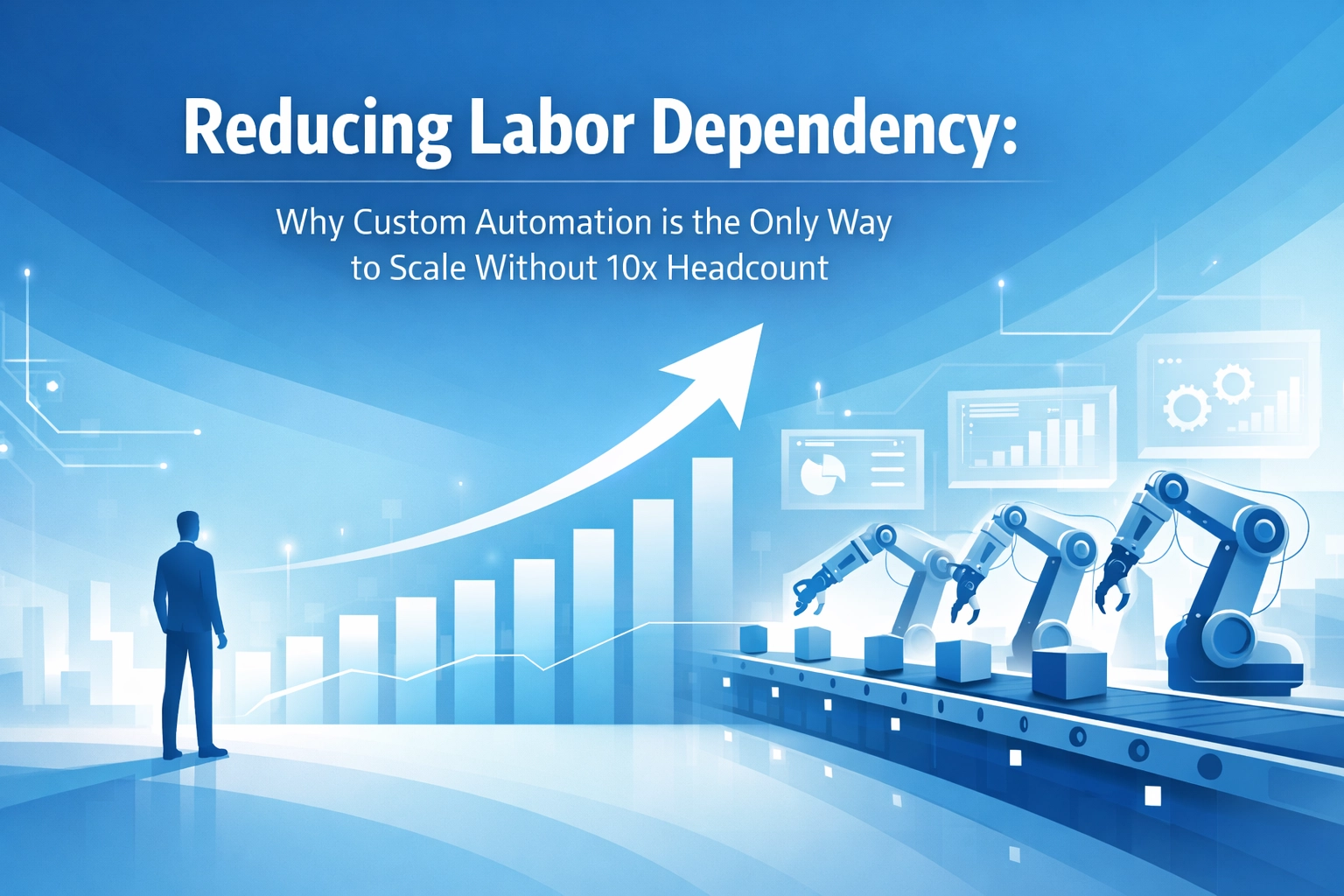
  • Reducing Labor Dependency: Why Custom Automation is the Only Way to Scale Without 10x Headcount

    Reducing Labor Dependency: Why Custom Automation is the Only Way to Scale Without 10x Headcount

    For many service-based businesses, growth is a double-edged sword. On one side, more clients and higher demand signal a successful market fit. On the other, the traditional model of scaling dictates that to handle more work, you must hire more people. This creates a "linear growth trap": a cycle where your overhead climbs at the exact same rate as your revenue, leaving your profit margins stagnant and your management team perpetually exhausted.

    The reality of the modern operational landscape is that labor dependency is the greatest bottleneck to true scalability. If your business requires a proportional increase in headcount to handle a 20% increase in volume, you aren't just scaling; you’re simply inflating.

    To break this cycle, visionary leaders are shifting their strategy from human-centric operations to technology-first operating models. Custom automation is no longer a luxury for Silicon Valley startups; it is the fundamental infrastructure required for any service business to scale without a 10x increase in headcount.

    The Linear Growth Trap: Why More People Isn't Always the Answer

    When a business hits an operational ceiling, the reflexive response is to open the job boards. However, adding more people to a fragmented system often introduces more friction than it solves. This is known as "operational drag."

    Every new hire adds a layer of management, a new set of communication channels, and a higher probability of human error. As the team grows, the complexity of coordinating that team grows exponentially, not linearly. You spend more time managing people and less time innovating or serving high-value clients.

    Research indicates that businesses adopting deep automation grow significantly faster: often over twice as fast as their manual counterparts: precisely because they have decoupled their output from their headcount. By automating the "boring" but essential tasks, you allow your existing team to focus on high-impact strategic work, effectively multiplying your current talent's value without adding to the payroll.

    A professional overseeing an automated network of digital gears to scale operations without increasing headcount.

    Where Generic SaaS Fails and Custom Logic Prevails

    Many executives attempt to solve these bottlenecks with off-the-shelf SaaS products. While generic tools are excellent for entry-level tasks, they often fall short when faced with the unique nuances of a sophisticated service business.

    Off-the-shelf software forces you to change your processes to fit the tool. This leads to "workarounds": the manual spreadsheets and "glue" tasks that your team performs to make different apps talk to each other. These workarounds are where labor dependency hides.

    Custom automation acts differently. Instead of forcing your business into a pre-built box, custom software is architected around your specific logic.

    At Pure Technology Consulting, we’ve seen this play out across various industries:

    • Healthcare: In complex environments like the Thrive/EHRIO platforms, we’ve built matching engines and 70-question intake systems that handle HIPAA-adjacent workflows. A manual team attempting to process that level of data with the same accuracy would require dozens of coordinators.
    • Field Operations: For organizations like D2D Tracking, GPS logging and rep accountability are automated at the source. This eliminates the need for manual check-ins and audit teams.
    • Fintech & Debt: Our work in debt agency telephony integrations and call attribution proves that complex data flows can be managed by code, rather than by a room full of data entry clerks.

    By building bespoke web applications, you aren't just buying a tool; you are building a proprietary asset that codifies your business intelligence.

    The Foundation of Growth: Custom Logic and Centralized Dashboards

    To scale without 10x headcount, an executive needs a "Nerve Center." This is a centralized reporting dashboard powered by custom logic that provides real-time visibility into every facet of the operation.

    Without this, management relies on "anecdotal data": what the team tells them in meetings or what appears in a delayed monthly report. This creates a dependency on middle management to interpret reality.

    A custom dashboard eliminates the middleman. It pulls data from your various integrations: whether that’s your CRM, your field tracking software, or your financial tools: and presents it through the lens of your specific KPIs.

    What can be automated first?

    When identifying where to deploy custom automation, we look for the "Three Rs":

    1. Repetitive Tasks: Data entry, status updates, and report generation.
    2. Replicable Logic: Decision-making processes that follow a "if this, then that" structure (e.g., lead scoring or service routing).
    3. Reporting: Consolidating disparate data points into a single source of truth.

    When these three areas are handled by custom software, the "labor" required to run the business shifts from manual execution to strategic oversight.

    A centralized digital hub unifying business data streams into a single source of truth for strategic oversight.

    The Economic Case for Technology Partnerships

    Moving from a labor-heavy model to an automation-heavy model requires a shift in how you view technology spending. Hiring a new employee is an ongoing, escalating expense with significant hidden costs (benefits, taxes, training, turnover).

    In contrast, investing in a custom web development project is a capital investment that builds equity in your firm. You are essentially "hiring" a digital workforce that never sleeps, never asks for a raise, and performs with 100% consistency.

    However, building this level of infrastructure isn't a one-time transaction. It requires a long-term technology partnership. As your business evolves, your automation must evolve with it. This is why we focus on high-ticket, bespoke engagements. We aren't just delivering code; we are providing a roadmap for operational excellence.

    Whether it's integrating complex telephony systems or building a custom ERP for a legal or accounting firm, the goal is the same: to make the business run smoother, faster, and with less human intervention.

    Scaling the Unscalable

    The most successful service businesses of the next decade will be those that view themselves as technology companies that happen to provide a service. By reducing labor dependency through custom automation, you gain the agility to enter new markets, the margins to out-compete on price or quality, and the freedom to grow without the weight of an ever-expanding payroll.

    The question for leadership is no longer "Who do we need to hire?" but rather "What process can we codify?"

    If you are ready to audit your current workflows and identify the bottlenecks holding back your growth, the path forward starts with a strategic consultation. We specialize in taking the complex, manual processes of operationally constrained businesses and turning them into streamlined, automated engines of growth.

    Ready to build your digital workforce?

    Don't wait until your team hits a breaking point. Let’s discuss how custom logic and bespoke software can transform your operating model.

    Book a discovery call with our team today


    Amin Said, Founder of Pure Technology Consulting LLC
    https://puretechconsult.com
    +1 (803) 921-0969

  • Are Manual Workflows Dead? The Ultimate Guide to AI-Powered Digital Transformation in 2026

    Are Manual Workflows Dead? The Ultimate Guide to AI-Powered Digital Transformation in 2026

    As we navigate the landscape of 2026, the question for executives is no longer "Should we automate?" but rather "How much of our competitive advantage is being eroded by manual legacy processes?"

    The era of the "drudge work" is ending. We have reached a tipping point where manual workflows are becoming a strategic liability. In the high-stakes worlds of legal, accounting, and healthcare, the friction of manual data entry, physical document routing, and rule-based decision-making is more than an inefficiency: it is a barrier to scale. At Pure Technology Consulting, we view digital transformation not as a buzzword, but as the fundamental re-architecting of how a business generates value.

    The Extinction of the Repetitive Task

    The data in 2026 is clear: manual workflows aren't just slowing you down; they are costing your team approximately 40% of their productive time. When we look at the specific categories of work being eliminated, we see a pattern. Routine approvals, invoice handling, and structured data entry are being transitioned into the background.

    The objective of AI-powered automation is not to replace the human element, but to reposition it. When a finance team no longer spends days on invoice processing, they spend that time on capital allocation and risk strategy. When an HR department automates the 70-question intake process for new hires, they can focus on culture and talent retention.

    A professional silhouette transitioning from manual paperwork to an AI-powered digital data workflow.

    Case Study in Precision: FTP Inform

    At Pure Technology Consulting, we believe that the most visionary solutions often address the "invisible" layers of a business. Consider FTP Inform. In many enterprise environments, FTP (File Transfer Protocol) remains a backbone for secure data exchange, yet it is often a "black box" of manual monitoring.

    We built FTP Inform to demonstrate how legacy protocols can be brought into the era of AI-powered transformation. Instead of having an IT staffer manually verify file arrivals or troubleshoot failed transfers, FTP Inform provides real-time event-driven intelligence. It represents our approach to custom software development: taking a critical business function and adding a layer of autonomous oversight that ensures compliance and operational continuity without human intervention.

    The Three Pillars of 2026 Digital Transformation

    To move beyond the manual, organizations must adopt a roadmap built on three technological shifts that have matured over the last year.

    1. Large-Scale Reasoning Engines

    The Large Language Models (LLMs) of 2026 are no longer just "chatbots." They are reasoning engines capable of handling unstructured data: contracts, complex emails, and nuanced customer feedback: with a level of context-dependent decision-making that previously required a senior associate.

    2. Event-Driven Architectures

    Modern workflows no longer wait for a human to press "go." They are triggered by business events. A new lead enters the CRM, a stock level drops below a threshold, or a server logs a specific error: and the system reacts instantly. This real-time response capability is the difference between a reactive business and a proactive market leader.

    3. Autonomous AI Agents

    Multi-agent systems now break down complex projects into smaller, verifiable steps. These agents operate within tools: your ERP, your custom web app, your accounting software: performing actions and only flagging exceptions for human review.

    An interconnected AI reasoning engine illustrating a sophisticated event-driven digital architecture.

    Scaling Visibility: AI Local Boost

    Digital transformation isn't limited to internal operations; it extends to how a brand communicates with its local market. Many firms, especially in the legal and accounting sectors, struggle with the manual burden of maintaining a consistent digital footprint.

    Through AI Local Boost, we’ve demonstrated our capability to automate high-level marketing operations. By leveraging AI to manage Google Business Profile updates and local SEO signals, we eliminate the need for manual content scheduling. This isn't just about "posting"; it's about using intelligent automation to ensure that when a potential high-ticket client searches for your expertise, your digital presence is optimized and current, all while your team focuses on billable hours.

    Why Custom Architecture Beats "Off-the-Shelf" SaaS

    While the market is flooded with subscription-based tools, visionary leaders are realizing that $10k+ custom web applications provide a higher ROI than a dozen disjointed SaaS subscriptions. Why? Because bespoke software fits your operations, rather than forcing your operations to fit the software.

    When we engage with clients for custom development at Pure Technology Consulting, we look for the "bottlenecks of judgment." These are the places where a manual process exists because "the software can't handle our specific rules."

    Our experience in healthcare: specifically with the EHRIO Pro matching engines and HIPAA-adjacent workflows: has taught us that the most complex logic can, and should, be automated. We bring this same level of rigor to the legal and accounting fields. If your firm requires a 70-question intake process, we don't just give you a form; we build a matching engine that triages those responses and routes them to the correct department with an AI-generated summary.

    A custom blue component fitting perfectly into a structure, representing bespoke software integration.

    Strategic Integration: ChainHQ and EHRIO Pro

    The sophistication of our proprietary builds, such as ChainHQ and EHRIO Pro, serves as a testament to what is possible when you move beyond manual workflows.

    • ChainHQ demonstrates our ability to handle complex supply chain and project management logic.
    • EHRIO Pro showcases our expertise in building high-security, high-logic matching systems for the healthcare sector.

    For an accounting firm or a legal practice, this means we can build custom platforms that integrate with existing telephony (like our work with debt agencies for call attribution) or GPS logging (as seen in our D2D Tracking solutions). We aren't starting from scratch; we are applying proven, enterprise-grade capabilities to your specific operational model.

    The Roadmap to 2027: How to Start

    If you are currently overseeing a team that spends more than 20% of its time on "data movement," you have a transformation opportunity. The transition away from manual workflows is a phased journey:

    1. Workflow Audit: Identify the high-volume, low-complexity tasks that consume the most hours.
    2. Architecture Scoping: Determine where custom software can integrate your existing tools into a single, automated ecosystem.
    3. Deployment of Intelligent Layers: Implement autonomous agents or event-driven triggers to handle the routine.
    4. Governance and Human-in-the-Loop: Establish the oversight protocols where humans review the "exceptions" flagged by the AI.

    The goal is to create an operating model where your staff are supervisors of systems, not manual laborers within them. This shift increases individual worker performance by double digits and allows your organization to scale without a proportional increase in headcount.

    A futuristic light bridge representing the strategic roadmap for AI-powered business scaling and growth.

    Final Thoughts: The Cost of Hesitation

    In 2026, the competitive gap between automated firms and manual firms is widening into a canyon. Those who invest in custom, AI-powered digital transformation are operating faster, cheaper, and with a level of precision that manual processes simply cannot match.

    At Pure Technology Consulting, we specialize in building the custom web applications and bespoke automations that power this transition. Whether it is secure data transfer through FTP Inform or a complex matching engine for a professional services firm, our focus is on delivering high-ticket, high-impact results.

    If you are ready to audit your current workflows and explore what a bespoke automation roadmap looks like for your organization, we invite you to schedule a discovery call. Let’s move your business from manual drag to automated leverage.

    Amin Said, Founder of Pure Technology Consulting LLC
    https://puretechconsult.com
    +1 (803) 921-0969

  • The Hidden Tech Asset: How Industry Vendors are Using ChainHQ to Launch SaaS Products in Weeks, Not Years

    The Hidden Tech Asset: How Industry Vendors are Using ChainHQ to Launch SaaS Products in Weeks, Not Years

    In the current landscape of industrial and commercial enterprise, the line between "service provider" and "technology company" has blurred into non-existence. Whether you are an equipment manufacturer, a large-scale franchise group, or a niche industry vendor, the physical or service-based value you provide is no longer the ceiling of your potential. The real asset lies in the data, the workflows, and the digital ecosystem you control.

    Historically, capturing this digital value meant embarking on a multi-year, multi-million-dollar development journey. It meant hiring expensive in-house teams, navigating the "black box" of software architecture, and often arriving at a finished product long after the market window had shifted.

    At Pure Technology Consulting, we are seeing a radical shift in this trajectory. Forward-thinking industry leaders are no longer building from the ground up. Instead, they are leveraging ChainHQ: our proprietary technical backbone: to transform their industry expertise into scalable SaaS assets in a matter of weeks.

    The Shift from Commodity to Ecosystem

    For decades, industry vendors operated on a transactional model: sell a piece of equipment, provide a maintenance contract, or offer a specialized service. While profitable, these models are inherently limited by physical scale and human hours.

    The most successful vendors today are realizing that their deepest value isn't just the "thing" they sell: it’s the methodology and the data surrounding it. By wrapping their expertise in a custom software layer, they move from being a replaceable vendor to an indispensable platform.

    When you offer a white-labeled SaaS product to your existing client base, you aren't just adding a revenue stream. You are:

    1. Hard-coding your value into their daily operations.
    2. Creating a recurring revenue model that scales without linear headcount growth.
    3. Capturing proprietary data that informs your next decade of product development.

    Industrial equipment transitioning into a digital data web to illustrate industry vendor digital transformation.

    Why the Traditional Build Model Fails Industry Leaders

    Most executives understand the vision of a digital ecosystem, but they are rightfully terrified of the execution. The traditional path to launching a SaaS product is littered with "zombie projects": software that is 80% finished, over budget, and technically obsolete before it hits version 1.0.

    The primary friction points are well-known:

    • The Talent Gap: Finding senior architects who understand both complex backend infrastructure and specific industry compliance (like HIPAA-adjacent workflows or field-ops GPS logging) is nearly impossible in a competitive hiring market.
    • Infrastructure Debt: Building secure, multi-tenant architectures that can handle thousands of users while maintaining data isolation is a massive engineering undertaking.
    • Maintenance Overhead: Launching is only half the battle. Maintaining, updating, and securing a custom build requires a permanent technical tax that many vendors aren't prepared to pay.

    This is where the concept of the "Hidden Tech Asset" comes into play. You don't need to build the engine; you need to own the vehicle that wins the race.

    ChainHQ: The Architecture of Rapid Deployment

    ChainHQ isn't just a tool; it is a battle-tested foundation for high-scale web applications. It serves as the "technical backbone" that allows Pure Technology Consulting to bypass the foundational heavy lifting that typically eats up the first six to nine months of a project.

    By utilizing ChainHQ, we provide our partners with a modular framework that handles the complex "boring" stuff: user authentication, multi-tenant data structures, API integrations, and secure billing logic: out of the box. This allows the focus to remain entirely on the custom business logic that makes your industry solution unique.

    Whether you are looking to create a centralized operational dashboard for a national franchise or a predictive maintenance portal for heavy equipment, the infrastructure is already there. We focus on the "Bespoke" layer: the 20% of the code that provides 100% of the competitive advantage.

    Secure technical backbone architecture showing a protected core for scalable SaaS web applications.

    Strategic Use Cases: Turning Expertise into IP

    How are industry leaders actually using this leverage? We’re seeing a diverse range of applications that all share a common goal: turning operational knowledge into a digital asset.

    1. Equipment Manufacturers: From Hardware to Insights

    Imagine a manufacturer of industrial HVAC systems. Traditionally, they sell the unit and wait for it to break. By launching a white-labeled monitoring SaaS via ChainHQ, they can provide their distributors and end-users with a real-time performance dashboard. They aren't just selling a machine anymore; they are selling "uptime as a service."

    2. Franchise Groups: Standardizing Excellence

    Large franchise organizations often struggle with operational drift. By deploying a custom internal SaaS, the parent company can standardize 70-question intakes, rep accountability, and GPS-verified field logging. This creates a "single source of truth" that increases the valuation of the entire franchise network.

    3. Professional Service Aggregators

    In sectors like legal or accounting, the value is in the workflow. We’ve used our experience in healthcare (matching engines and intake automation) to help professional service vendors build platforms that automate the bridge between client acquisition and service delivery.

    Digital icons for healthcare and legal industries connected to a central hub for industry-specific SaaS solutions.

    Recurring Revenue Without the Dev Team Overhead

    One of the most compelling reasons for industry vendors to adopt this "accelerated SaaS" model is the financial transformation. Transitioning a portion of your business to a software-enabled model fundamentally changes your company's valuation.

    SaaS revenue is valued at a significantly higher multiple than service or hardware revenue. By leveraging Pure Technology Consulting as your strategic partner, you gain the benefits of a world-class engineering department without the $1M+ annual payroll.

    We manage the governance, the integrations, and the roadmap. You manage the market strategy and the customer relationships. It is a partnership designed for operational leverage.

    The Roadmap: From Discovery to Version 1.0

    We don't believe in "endless discovery." Our approach is built for speed and executive clarity. When you work with us to launch a SaaS product through the ChainHQ framework, the process is structured to mitigate risk:

    1. Workflow Audit: We dive into your existing industry processes to identify where automation and data capture will provide the highest ROI.
    2. Architecture Mapping: We map your specific needs onto the ChainHQ backbone, identifying which custom modules need to be built.
    3. Rapid Prototype: Because the foundation is already laid, we can often show a functional prototype in the time it takes most agencies to finish a wireframe.
    4. Deployment & Scaling: We handle the DevOps and infrastructure management, ensuring your platform stays fast and secure as you onboard your first 1,000 users.

    A glowing digital roadmap with circular milestones representing rapid SaaS deployment and scaling.

    The Visionary Path Forward

    The window for "doing things the old way" is closing. Your competitors are likely looking at how to digitize their offerings right now. The difference between those who lead and those who follow will be the speed at which they can turn an idea into a functional, scalable asset.

    At Pure Technology Consulting, we specialize in building the complex web applications and custom automations that high-ticket clients require to dominate their niches. We bring proven capabilities from healthcare, fintech, and field operations into your industry, ensuring you aren't starting from scratch but building on a foundation of success.

    Your industry expertise is a gold mine. It’s time to build the machinery to extract its full value.

    If you are ready to explore how a custom SaaS asset can transform your business model, let’s talk about the roadmap.

    To schedule a strategy session and see a walkthrough of our recent builds, visit:
    https://puretechconsult.com/schedule


    Amin Said, Founder of Pure Technology Consulting LLC
    https://puretechconsult.com
    Phone: +1 (803) 921-0969
    Specializing in bespoke web development and high-level automation for industry leaders.

  • Are Data Silos Dead? Why Forward-Thinking Brands Use ChainHQ for AI Workflow Automation

    Are Data Silos Dead? Why Forward-Thinking Brands Use ChainHQ for AI Workflow Automation

    For decades, the "data silo" has been the persistent ghost in the machine of corporate enterprise. We have been told that as long as we have the data, we have the power. But in 2026, the paradigm has shifted. Data in isolation is not an asset; it is an operational drag. In an era defined by rapid AI maturation, the wall between your CRM, your accounting software, and your project management tools isn't just an inconvenience: it is a barrier to the very intelligence your business needs to survive.

    Forward-thinking brands are no longer asking how to store their data. They are asking how to make it move. They are seeking a fluid ecosystem where information flows autonomously between departments, triggering actions and generating insights without human intervention. This is where the concept of "dead silos" becomes a reality through advanced AI workflow automation. At Pure Technology Consulting, we’ve seen this transition firsthand, and it is the catalyst behind why we developed ChainHQ.

    The High Cost of the "Information Island"

    When departments operate as information islands, the hidden taxes on your business are immense. There is the manual data entry tax, the "I can’t find the latest version" tax, and the most expensive of all: the missed opportunity tax.

    Consider a legal firm or a high-level accounting practice. If client intake data lives in a standalone web form, billing lives in an accounting suite, and case documents live in a secure server, the lack of communication between these systems forces senior partners and high-value associates into the role of data transcribers. This fragmentation limits the ability of AI to provide meaningful assistance. An AI cannot predict a cash flow bottleneck if it cannot see the invoices. It cannot automate a contract renewal if it doesn't know the project status.

    To bridge this gap, organizations need more than just another "integration tool." They need a sophisticated orchestration layer that understands business logic across different platforms.

    Visual metaphor of isolated data silos represented as floating islands in a dark digital space.

    AI as the Universal Translator

    The death of the data silo isn't coming from a single "all-in-one" software solution. History has shown that "all-in-one" platforms usually do many things poorly rather than one thing excellently. Instead, the solution is the "Universal Translator": AI-powered automation that can read, interpret, and move data between specialized, best-in-class applications.

    Modern AI workflow automation does more than just move a file from Folder A to Folder B. It interprets the content of that file. It identifies that a PDF is an overdue invoice, extracts the balance, checks the CRM for the client's preferred contact method, and initiates a personalized, professional follow-up: all while updating the internal dashboard.

    This is the level of sophisticated architecture we build for our clients. We move beyond simple "if-this-then-that" logic into complex, multi-step autonomous workflows that mirror the decision-making process of your best employees.

    ChainHQ: The Architecture of Connectivity

    At Pure Technology Consulting, we don't just consult on automation; we build the engines that drive it. ChainHQ is our proprietary response to the fragmentation of modern business software. While many off-the-shelf tools offer surface-level connections, ChainHQ was designed as a high-level orchestration platform for complex, custom web applications and bespoke automation.

    We use ChainHQ as a cornerstone for clients who require more than a template. Whether it’s integrating fintech telephony with call attribution or connecting GPS logging for field operations, ChainHQ allows us to create a unified nervous system for a business.

    Why Brands are Choosing ChainHQ for Their Automation Roadmap:

    • Intelligent Routing: It doesn't just pass data; it evaluates it. ChainHQ can determine the priority of an incoming lead based on historical data and route it to the specific automation sequence that maximizes conversion.
    • Deep Integration Capabilities: We leverage ChainHQ to connect legacy systems that weren't designed to talk to modern AI, ensuring your existing investments aren't left behind in the digital transformation.
    • Scalable Governance: As your business grows, your automations shouldn't become a "black box." ChainHQ provides the transparency needed to audit workflows, ensuring compliance and operational integrity.

    Central AI orchestration hub connecting data modules to represent ChainHQ workflow automation.

    Beyond SaaS: The Case for Bespoke Automation

    There is a common misconception that "digital transformation" means subscribing to more SaaS products. In reality, adding more disconnected SaaS tools often increases the number of silos. True transformation occurs when you build a custom web application or an automation layer tailored specifically to your unique operating model.

    When we work with high-ticket clients in the legal, accounting, or healthcare sectors, we focus on the "Proof-of-Work" pillars that have defined our success. For example, our work with EHRIO Pro involves complex HIPAA-adjacent workflows and matching engines that require absolute precision. You cannot find that in a $20/month subscription.

    By building bespoke solutions, businesses gain a competitive moat. Your competitors can buy the same SaaS tools as you, but they cannot buy the custom-tailored automation logic that makes your specific team three times more efficient. This is the difference between participating in a market and leading it.

    Strategic Implementation: Where to Begin?

    Transitioning from a siloed environment to an automated one requires a strategic roadmap. We recommend a "Value-First" approach to automation:

    1. Audit the Friction: Identify where your team spends the most time on repetitive, non-cognitive tasks. This is usually the "data bridge" between two systems.
    2. Define the Single Source of Truth: Decide which system should hold the "master record" for your clients or projects.
    3. Prototype the Workflow: Start with a high-impact, low-complexity integration. For instance, automating the flow from a custom intake form to a project management board.
    4. Scale with Intelligence: Once the data is moving, layer in AI to begin making decisions within those workflows.

    Digital blueprint representing the strategic implementation of AI and automation into a business roadmap.

    The Visionary Future of Your Business

    The companies that will dominate the next decade are those that treat their data as a living, breathing asset. They are the brands that understand that human talent should be reserved for high-level strategy and relationship building, while the "plumbing" of the business is handled by intelligent, autonomous systems.

    Data silos are not just dying; they are being replaced by a more holistic view of business intelligence. With tools like ChainHQ and the expertise of a dedicated development partner, you can turn your fragmented data into a streamlined engine for growth.

    At Pure Technology Consulting, we specialize in building these engines. From local SEO automation with AI Local Boost to complex field-service GPS logging, our goal is to provide the technical architecture that allows your vision to scale without the friction of manual operations.

    If you are ready to move beyond the limitations of your current software stack and explore what bespoke automation can do for your bottom line, we are here to guide that journey.

    Request a Workflow Audit

    The path to a silo-free enterprise starts with a clear understanding of your current digital architecture. We invite you to schedule a discovery call to discuss your specific operational challenges and how a custom-built automation strategy can transform your business.

    To explore our portfolio of custom web apps and automation solutions, visit our video walkthroughs or contact our team to start your roadmap.

    Pure Technology Consulting LLC
    Phone: +1 (803) 921-0969
    Office: America/New_York

    Amin Said, Founder of Pure Technology Consulting LLC
    https://puretechconsult.com

  • Stop Guessing: How Custom Reporting Dashboards and Logic Can Help You Scale Without Adding Headcount

    Stop Guessing: How Custom Reporting Dashboards and Logic Can Help You Scale Without Adding Headcount

    For many service-based organizations: whether in debt collection, e-commerce, or multi-location logistics: growth eventually hits a frustrating invisible ceiling. In the early stages, you scale by sheer force of will and manual labor. But as your volume increases, you find yourself trapped in a linear growth model: to increase revenue by 20%, you feel forced to increase your headcount by 20%.

    This is the "Operational Drag" that keeps visionary leaders awake at night. You have the demand, you have the market position, but your internal operating model is buckling under the weight of its own complexity. The solution isn't more people; it's better leverage. By implementing custom reporting dashboards and intelligent assignment logic, you can break the tie between revenue growth and headcount, allowing your business to scale exponentially while your team remains lean and focused.

    The Silent Growth Killer: The Data Silo Problem

    The most significant barrier to scaling without adding staff is the "Data Silo." In a typical operationally constrained business, information is scattered across a dozen different platforms. Your sales data lives in a CRM; your field operations are tracked in a custom app; your financial data is in an ERP; and your communication logs are buried in a telephony system.

    When data is siloed, your managers aren't managing; they are data mining. They spend hours every week exporting CSV files, cleaning spreadsheets, and trying to reconcile conflicting numbers. This manual labor is a massive drain on your most expensive resources.

    According to research by Gartner, organizations that successfully implement advanced performance monitoring and integration tools can reduce operational inefficiencies by up to 35%. For a mid-market service business, that 35% efficiency gain is the difference between needing to hire five new managers and empowering your current two to handle the load.

    Visual representation of integrating fragmented data silos into a unified custom reporting dashboard.

    From Hindsight to Foresight: The Power of Custom Dashboards

    Most businesses operate on "hindsight reporting." They look at what happened last week or last month and try to make adjustments for the future. In a fast-moving environment like debt collection or high-volume e-commerce, hindsight is a luxury you cannot afford.

    Custom reporting dashboards provide real-time clarity. Unlike off-the-shelf SaaS tools that offer generic metrics, a bespoke dashboard built for your specific operating model tracks the KPIs that actually drive your bottom line.

    Strategic Visibility for Every Role

    A visionary reporting strategy doesn't just dump data on a screen; it provides role-based governance:

    • Executives: See high-level trends, capital efficiency, and long-term trajectory.
    • Department Heads: Identify bottlenecks in real-time: such as a sudden drop in call-to-collection rates or a delay in fulfillment cycles.
    • Front-line Staff: See their own performance against targets, creating a culture of self-accountability that reduces the need for heavy-handed supervision.

    By centralizing this data into a single source of truth, you eliminate the "guessing game." You no longer wonder if a department is underperforming; you see the friction point and can address it before it impacts your quarterly goals.

    The Next Frontier: Moving from Reporting to Logic

    While dashboards help you see what is happening, Logic helps your systems decide what should happen next. This is where true scalability is born.

    Consider the challenge of manual scheduling and task assignment. In many multi-location businesses, a human being has to look at a list of tasks and decide which technician or agent is best suited for the job based on location, skill level, and current capacity. As you scale from 50 tasks a day to 500, this manual intervention becomes a bottleneck.

    Custom automation logic removes the human "middleman" from these routine decisions. At Pure Technology Consulting, we specialize in building these types of intelligent engines. Whether it’s a matching engine for healthcare intakes that processes 70-question forms to route patients or a GPS-logged accountability system for door-to-door sales teams, the goal is the same: let the software handle the high-volume, low-context decisions so your people can focus on high-value strategy.

    Glowing clockwork mechanism symbolizing custom automation logic for high-volume business decisions.

    Scaling Without Headcount: The Economic Reality

    The most compelling reason to invest in custom logic and reporting is the impact on your EBITDA. Adding headcount is expensive: not just in salary, but in benefits, training, management overhead, and the inevitable "culture tax" that comes with a rapidly growing team.

    Bespoke software development is a capital investment that pays dividends by lowering your long-term operating costs. When you automate your assignment logic:

    1. Response Times Drop: Decisions happen in milliseconds, not hours.
    2. Errors Are Eliminated: Logic-based systems don't have "off days" or skip steps in a workflow.
    3. Throughput Increases: Your existing team can process more volume because the "administrative friction" has been removed from their workday.

    For instance, in the fintech and debt collection sectors, we’ve integrated complex telephony systems with custom call attribution logic. Instead of a manager manually assigning lead lists, the system routes calls dynamically based on agent performance and debtor profile. The result? Higher recovery rates with the exact same number of agents.

    Why "Off-the-Shelf" Often Falls Short

    You might wonder why you can't just buy a standard SaaS product to solve these issues. While SaaS has its place, it is designed for the "average" business. If your competitive advantage lies in a unique operational process or a specialized way of handling data, a generic tool will force you to change your process to fit the software.

    At Pure Technology Consulting, we believe the software should fit the business, not the other way around. Whether we are building on the foundations of our previous work: like our HIPAA-adjacent healthcare workflows or our fintech telephony integrations: we focus on creating a roadmap that aligns with your specific growth strategy.

    Custom builds are not just about "coding"; they are about automation consulting. We look at your current operating model, identify where the manual "glue" is holding things together, and replace that glue with robust, scalable code.

    Precision-fit software module representing bespoke code integration for scalable business operations.

    Implementation Strategy: Where to Start

    If you are currently feeling operationally constrained, the path forward involves three strategic steps:

    1. Identify the Friction: Where is your team spending the most time on manual data entry or decision-making? Is it scheduling? Assignment? Reporting?
    2. Centralize the Data: Break the silos. Create a unified data layer that allows different systems to talk to each other.
    3. Layer the Logic: Once you can see the data, start automating the decisions. Begin with high-volume, repetitive tasks and move toward more complex workflows.

    This transition from a "people-powered" business to a "platform-powered" business is the hallmark of modern industry leaders. It allows you to maintain the agility of a small firm with the output capacity of a giant.

    Final Thoughts: Leading with Vision

    The decision to invest in custom reporting and logic is a signal that you are moving from a reactive mindset to a visionary one. You are no longer just trying to survive the next surge in volume; you are building an infrastructure that welcomes it.

    When your systems are designed to scale, your team is freed from the mundane and empowered to do the work they were actually hired for. You don't need a bigger team; you need a better engine.

    If you’re ready to explore how custom software can remove your growth bottlenecks and provide the real-time clarity you need to lead effectively, we invite you to take the next step.


    Ready to audit your workflow and identify your scaling bottlenecks?
    Book a discovery call with our team to discuss a custom roadmap for your operations.

    Amin Said, Founder of Pure Technology Consulting LLC
    https://puretechconsult.com
    +1 (803) 921-0969

  • Why AI Workflow Automation Will Change the Way You Lead Your Industry in 2026

    Why AI Workflow Automation Will Change the Way You Lead Your Industry in 2026

    In 2026, the distinction between market leaders and those struggling to maintain relevance is no longer defined by who has the most data or the largest workforce. It is defined by who has successfully transitioned from manual process management to autonomous agentic orchestration. The era of "clicking and dragging" is being replaced by an era of "defining and delegating" to intelligent systems.

    As a Marketing Manager or an executive overseeing digital transformation, you are likely witnessing a fundamental shift in how business value is created. AI workflow automation has evolved from a series of experimental pilot programs into the core operating model for high-performance organizations. At Pure Technology Consulting, we view this shift not just as a technological upgrade, but as a total reimagining of leadership capacity.

    From Reactive Tasks to Autonomous Workflows

    The competitive landscape in 2026 is governed by three converging forces: intelligent AI automation, unified iPaaS platforms, and real-time event-driven workflows. In previous years, automation was largely rule-based: if "A" happens, then do "B." Today, the most resilient organizations utilize context-aware AI that can make nuanced decisions without human intervention.

    Research indicates that by 2026, over 50% of business workflows will operate autonomously. This means that instead of managing individual tasks, leaders are now orchestrating integrated AI agents that coordinate across entire departments. When your systems can react to market volatility, supply chain disruptions, or customer behavior changes in seconds rather than hours, you gain a level of operational leverage that was previously impossible.

    AI workflow automation system organizing data into a structured grid for operational efficiency.

    Demonstrating Capability: AI Local Boost and the Power of Scalable Presence

    To understand how this looks in practice, we can look at our proprietary work with AI Local Boost. While many businesses still struggle to manually manage their local digital footprint, we developed a system that automates the complexities of Google Business Profile management and local SEO.

    By leveraging automation to handle review responses, post scheduling, and local data synchronization, we’ve demonstrated that even high-touch marketing activities can be scaled without a proportional increase in headcount. For our custom development clients, this serves as a blueprint: if we can automate the intricate nuances of local reputation management, we can apply those same logic engines to your specific industry challenges.

    The Economic Reality: Redefining the Cost of Execution

    The financial implications of adopting autonomous workflows are staggering. We are seeing organizations reduce their accounts payable processing costs by 60% to 80%. Cycle times that once took days now take minutes. In the supply chain sector, AI-driven forecasting is reclaiming up to 65% of previously lost sales by accurately predicting demand and automating inventory adjustments.

    For the modern leader, this is about more than just cost-cutting; it’s about reclaiming the most valuable asset in your organization: time. On average, AI tools are now freeing up approximately 40% of a worker’s daily schedule. When your team is no longer bogged down by routine administrative data entry or manual status updates, they are free to focus on high-value strategy and creative problem-solving.

    Bridging the Data Gap with FTP Inform and ChainHQ

    Data silos remain the greatest enemy of automation. A visionary strategy fails if the data cannot move securely and intelligently between systems. This is where our expertise in building custom bridges becomes critical.

    Our work with FTP Inform showcases how we handle the "heavy lifting" of data movement: ensuring that legacy systems can communicate with modern, AI-powered web apps. Furthermore, ChainHQ represents our capability in building centralized hubs that orchestrate these data flows across complex supply chains or multi-departmental structures.

    For high-ticket clients looking for bespoke software development, these platforms prove that Pure Technology Consulting doesn't just build apps; we build the connective tissue that makes an autonomous enterprise possible. We move from the question of "Can we integrate this?" to "How fast can we make this data actionable?"

    Integrating isolated data silos into a central hub for predictive business operations.

    Leading with Predictive Operations and Governance

    Leading an industry in 2026 requires a shift from reactive monitoring to predictive operations. Traditional management relies on reports of what happened yesterday. Modern leadership relies on AI systems that detect issues, identify root causes, and apply fixes automatically before the human team even notices a disruption.

    However, with great autonomy comes the need for rigorous governance. The differentiator for elite organizations today is not just the adoption of AI, but the implementation of a structured governance framework. Leaders must move beyond experimental pilots to "agentic orchestration," where intelligent agents are governed, scaled, and integrated without introducing security or compliance risks.

    At Pure Technology Consulting, we emphasize the importance of AI literacy and operational foundations. We help executives develop updated performance metrics that reflect AI-enabled productivity rather than traditional labor hours. This transition is essential for maintaining service levels even when underlying components or market conditions fail.

    Precision Matching: Lessons from EHRIO Pro

    In highly regulated industries like healthcare and law, the stakes for automation are even higher. Our development of EHRIO Pro: a sophisticated matching engine designed for healthcare intake and HIPAA-adjacent workflows: serves as a primary example of how we handle complexity.

    EHRIO Pro utilizes 70-question intakes and complex matching logic to ensure that patients are paired with the right resources instantly. This isn't just a simple form; it is a custom-engineered decision engine. When we consult with legal or accounting firms, we bring these proven capabilities into their sectors. We understand how to automate a 70-point checklist for a legal case or an accounting audit with the same precision and compliance-first mindset we applied to healthcare.

    Precision matching engine logic interlocking to automate complex legal and accounting workflows.

    The Roadmap to Industry Leadership

    If you are ready to lead your industry, the path forward involves a strategic audit of your current workflows to identify where "operational drag" is slowing your growth. Custom web applications and bespoke automation are not just IT expenses; they are the infrastructure of your future competitive advantage.

    Our approach at Pure Technology Consulting is consultative and visionary. We don't offer off-the-shelf, one-size-fits-all software. We build the specific tools: whether it's GPS logging for field reps, telephony integrations for fintech firms, or GPS-verified accountability systems: that your unique business model requires to thrive in an automated economy.

    Transitioning Your Operating Model

    The transition to an AI-first workflow is a journey of 2026 and beyond. It requires:

    1. Architecture Review: Evaluating how your current data silos can be unified through custom API development and iPaaS platforms.
    2. Workflow Auditing: Identifying high-volume, low-context tasks that are ripe for autonomous agentic orchestration.
    3. Governance Implementation: Setting the rules of engagement for your AI systems to ensure transparency and reliability.
    4. Bespoke Development: Building the custom interfaces and dashboards that allow your leadership team to monitor autonomous operations in real-time.

    Digital transformation roadmap showing the path toward industry leadership and bespoke software.

    As you look toward the remainder of 2026, ask yourself: Is your organization being managed by people doing the work of machines, or by leaders orchestrating a digital workforce? The shift to AI workflow automation is not a distant trend: it is the current standard for those who intend to stay at the top of their industry.

    At Pure Technology Consulting, we specialize in building the custom web applications and high-level automation strategies that empower you to reclaim your time and scale your impact. From healthcare matching engines to local SEO automation, we bring proven expertise to every project, ensuring your business is ready for the future.

    To discuss your specific roadmap and how a custom-built solution can redefine your operations, I invite you to reach out for a discovery consultation. We can explore how our experience in healthcare, fintech, and local SEO can be applied to your specific industry challenges.

    Amin Said, Founder of Pure Technology Consulting LLC
    https://puretechconsult.com
    Phone: +1 (803) 921-0969
    Schedule a Discovery Call