PTC AI Insights

  • The Automation Arbitrage: How Debt Collection Agencies are Reclaiming 40% of Lost Revenue with Custom AI Workflows

    The Automation Arbitrage: How Debt Collection Agencies are Reclaiming 40% of Lost Revenue with Custom AI Workflows

    By Amin Said, Founder of Pure Technology Consulting LLC

    The debt collection industry has long operated on a model of brute-force persistence. For decades, the primary lever for increasing recovery rates was simply hiring more collectors, making more calls, and hoping the law of large numbers would eventually tip the scales in favor of profitability.

    However, we are witnessing a fundamental shift in the economics of recovery. At Pure Technology Consulting, we refer to this as "The Automation Arbitrage." It is the strategic window where the cost of human labor is rising, the complexity of compliance is intensifying, but the capability of custom AI workflows has reached a point where it can perform high-volume recovery tasks with greater precision and significantly lower overhead than traditional methods.

    When an agency can replace manual, error-prone processes with autonomous systems that run 24/7, they don't just save money: they reclaim revenue that was previously written off as "unrecoverable." Current market data and our own implementations show that agencies leveraging digital-first recovery methods are seeing performance increases of up to 40%.

    The Invisible Leak: Why Traditional Models are Failing

    In a typical debt collection environment, revenue isn't lost because the debtors don't have the money; it’s lost because of operational friction. This friction manifests in three primary ways:

    1. Data Silos: Information is trapped in legacy software that doesn’t communicate with telephony systems or modern payment gateways.
    2. Labor Dependency: High-value collectors are spending 60% of their day on low-value tasks like manual dialing, leaving voicemails, or answering basic "how do I pay?" questions.
    3. The Compliance Bottleneck: The fear of regulatory violations leads to overly cautious, rigid strategies that fail to engage the modern consumer where they actually live: on their mobile devices.

    These inefficiencies create a "recovery ceiling." Once your overhead for a specific account exceeds a certain percentage of the debt value, you stop pursuing it. This is where the arbitrage opportunity exists. By using custom AI workflows to lower the cost of pursuit to nearly zero, the previously "unprofitable" tail of your debt portfolio becomes a massive source of reclaimed revenue.

    Defining the Automation Arbitrage

    Arbitrage is traditionally defined as the simultaneous purchase and sale of an asset to profit from a difference in the price. In the context of FinTech and debt recovery, the "Automation Arbitrage" is the profit realized when you replace a high-cost manual process with a low-cost, high-intelligence digital workflow.

    Automated digital core managing thousands of simultaneous omnichannel debtor interactions for debt recovery.

    Instead of a human making 50 calls a day to reach three people, a custom AI agent can manage 5,000 omnichannel interactions: across SMS, email, and voice: simultaneously. This system doesn’t just broadcast messages; it interprets intent, negotiates payment terms in real-time based on your specific business rules, and updates your ledger without a single human keystroke.

    At Pure Technology Consulting, we don’t believe in "one-size-fits-all" SaaS products for this level of operation. To truly capture this arbitrage, the solution must be bespoke. It must integrate with your specific telephony providers, your proprietary scoring models, and your existing reporting dashboards.

    Bridging Data Silos with Custom Integrations

    The foundation of any successful automation strategy is the underlying data architecture. Many agencies attempt to "bolt on" AI tools, only to find that the AI is hindered by fragmented data.

    Our approach centers on building a unified data layer. By implementing custom telephony integrations and sophisticated call attribution, we can track the exact journey of every debtor. When a debtor receives a text, clicks a link, and then calls the agency, the system should instantly present the collector with that specific history.

    For many of our clients, we have built custom middleware that pulls data from legacy systems and pushes it into real-time reporting dashboards. This allows leadership to see recovery metrics as they happen, rather than waiting for month-end reports. To see how these types of integrations function in a live environment, you can view our video walkthroughs which detail our approach to complex system architecture.

    The 40% Reclamation Engine: Predictive Workflows

    The headline figure: reclaiming 40% of lost revenue: comes from the implementation of predictive workflows. These are not simple "if-this-then-that" sequences; they are intelligent systems that adapt based on debtor behavior.

    1. Intelligent Prioritization

    Not all debt is created equal. Traditional systems often work through lists chronologically or by dollar amount. AI-driven workflows rank accounts using dozens of variables: including past payment behavior, income trends, and even the time of day a debtor is most likely to respond to a text. By focusing human collectors on the "high-probability, high-value" accounts while letting AI handle the "high-probability, low-value" accounts, coverage increases by up to 4X.

    2. Real-Time Negotiation

    One of the biggest hurdles in recovery is the delay between a debtor's willingness to pay and the agency's ability to offer a settlement. Custom AI agents can perform real-time calculations, offering dynamic discounts or installment plans based on the debtor's specific profile and your agency’s risk tolerance. This "instant gratification" for the debtor significantly increases the conversion rate of accounts that would otherwise go cold.

    3. Automated Compliance and Governance

    In an era of heighted regulatory scrutiny, manual compliance is a liability. Custom workflows bake compliance directly into the communication protocol. The system automatically enforces contact frequency limits, manages disclosure requirements, and logs every interaction with immutable timestamps. This reduces the legal risk and the "operational drag" of manual audits.

    Secure data layers representing automated compliance protocols and immutable record-keeping in FinTech.

    Moving from Labor-Heavy to Intelligence-Led

    The transition to an automated operating model requires a visionary mindset. It is not about replacing your team; it is about elevating them. When you remove the 72% of tasks that AI can handle more efficiently, your human collectors become specialized negotiators who handle only the most complex cases.

    This shift transforms the agency from a high-turnover "call center" into a high-margin "FinTech recovery firm." The goal is to build a scalable engine where doubling your portfolio doesn't require doubling your headcount.

    Our experience in other high-stakes sectors, such as Healthcare (with our EHRIO Pro matching engines) and field operations, has proven that the most successful companies are those that own their technology stack. They don't just subscribe to a platform; they build a proprietary advantage.

    Measuring ROI: The Roadmap to Implementation

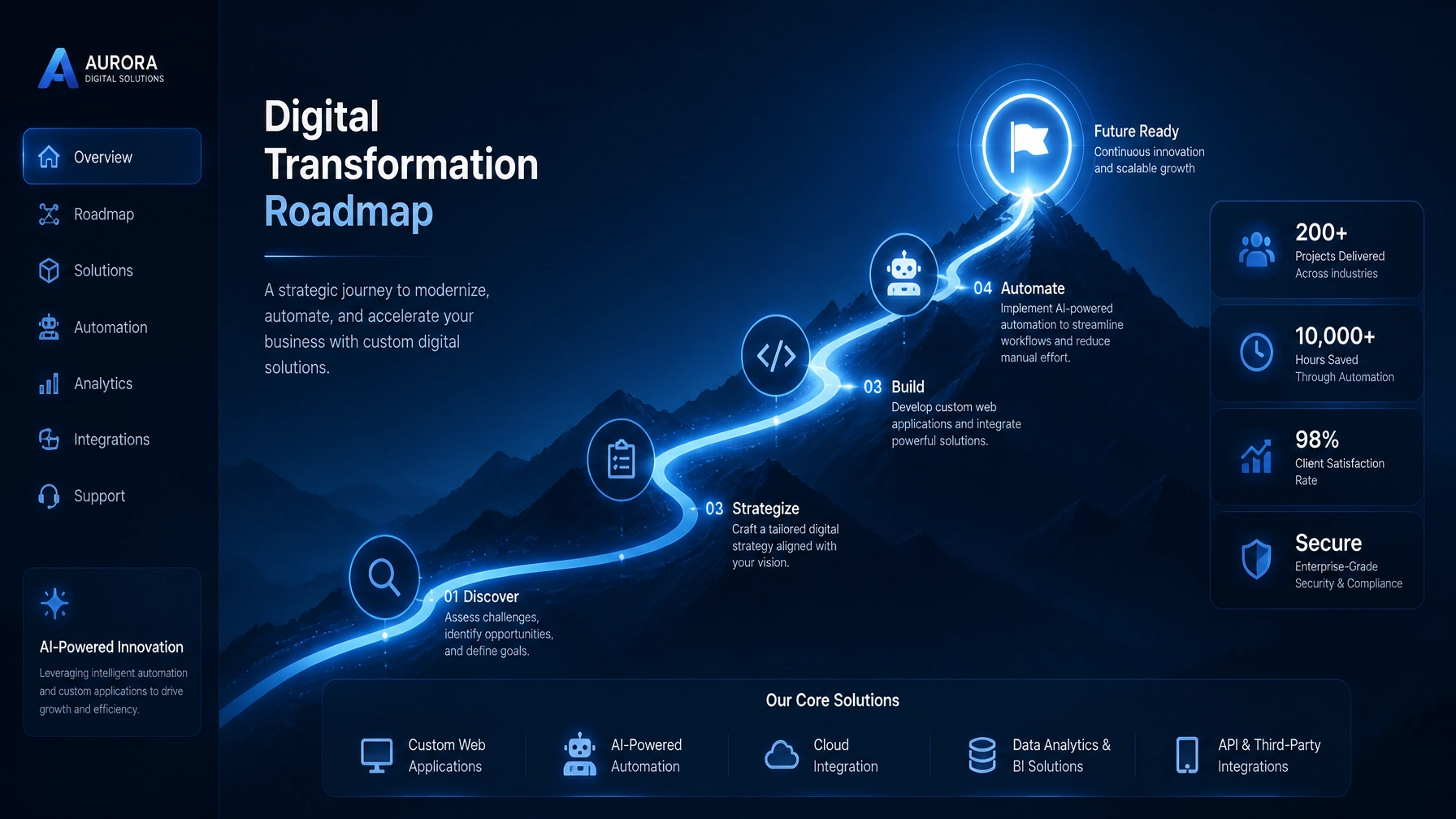
    For an operationally constrained service business, the path to 40% revenue reclamation usually follows a specific roadmap:

    • Phase 1: Workflow Audit. Identify where the data silos exist and which manual processes are creating the most friction.
    • Phase 2: Custom Integration. Connecting the telephony, CRM, and payment systems into a single source of truth.
    • Phase 3: Pilot Automation. Implementing AI agents for high-volume, low-complexity account segments.
    • Phase 4: Scale and Optimize. Using the data gathered in Phase 3 to refine predictive models and expand automation across the entire portfolio.

    The return on investment in these systems is often realized within the first six months. By reducing write-offs by up to 50% and boosting collector productivity by 30%, the technology pays for itself through the very revenue it reclaims.

    Conclusion: Reclaiming Your Competitive Edge

    The "Automation Arbitrage" is not a future possibility; it is a current reality. Agencies that continue to rely on manual processes will find themselves squeezed between rising labor costs and more efficient, tech-enabled competitors.

    At Pure Technology Consulting, we specialize in building the bespoke software and automation workflows that allow agencies to break through their recovery ceilings. We bring proven capabilities from the worlds of legal, healthcare, and fintech to ensure your agency isn't just keeping up, but leading the market.

    If you are ready to explore how custom AI workflows can reclaim your lost revenue and reduce your labor dependency, we invite you to take the next step.

    Book a discovery call with our team to audit your current workflows and identify your arbitrage opportunities.

    Schedule your consultation here or call us directly at +1 (803) 921-0969.

    To learn more about our philosophy on custom development and the impact of visionary technology, visit our main website or browse our latest insights.


    Amin Said, Founder of Pure Technology Consulting LLC
    https://puretechconsult.com

    Visionary Software Development & Automation Consulting

  • 7 Mistakes You’re Making with Manual Workflows (and How Bespoke AI Solutions Fix Them)

    7 Mistakes You’re Making with Manual Workflows (and How Bespoke AI Solutions Fix Them)

    In the modern enterprise landscape, "manual" is often a polite word for "expensive." As we move deeper into 2026, the gap between companies that rely on human-driven administrative cycles and those leveraged by bespoke AI automation is no longer a crack: it is a canyon.

    At Pure Technology Consulting, we don’t just see automation as a way to save a few hours; we see it as a fundamental shift in your operating model. Most businesses are operating with invisible anchors: manual workflows that feel "fine" because they’ve always been done that way, but are actually draining your top-line potential and executive focus.

    If your team is still spending hours on data entry, manual file transfers, or complex client intake, you aren’t just losing time; you are losing the competitive edge that defines a market leader. Here are the seven most common mistakes businesses make with manual workflows and the visionary approach to fixing them with custom software.

    1. The "Email and Spreadsheet" Data Silo

    The most common mistake is treating email as a workflow engine and spreadsheets as a database. When your critical business data lives in static files attached to emails, you create a fragmented landscape where "the truth" depends on who has the latest version of a document.

    Manual data movement is the enemy of scale. We’ve solved this for high-ticket clients by building proprietary bridges like FTP Inform. Instead of relying on a human to check a server, download a file, and notify a team, our custom builds automate the secure movement and reporting of data. This ensures that the moment data hits your ecosystem, the right people: and more importantly, the right systems: are triggered into action.

    2. The Bottleneck of Manual Intake

    Whether you are in healthcare, legal, or accounting, the intake process is often the first point of friction. Relying on a human to review a 70-question intake form or manually verify credentials creates a massive lag in service delivery.

    Our work with EHRIO Pro is a prime example of how we eliminate this. By building complex matching engines and automated intake workflows, we’ve moved organizations from days-long onboarding cycles to near-instantaneous processing. A bespoke AI solution doesn't just "read" the form; it validates the data against external databases, flags risks, and prepares the file for executive review without a single manual keystroke.

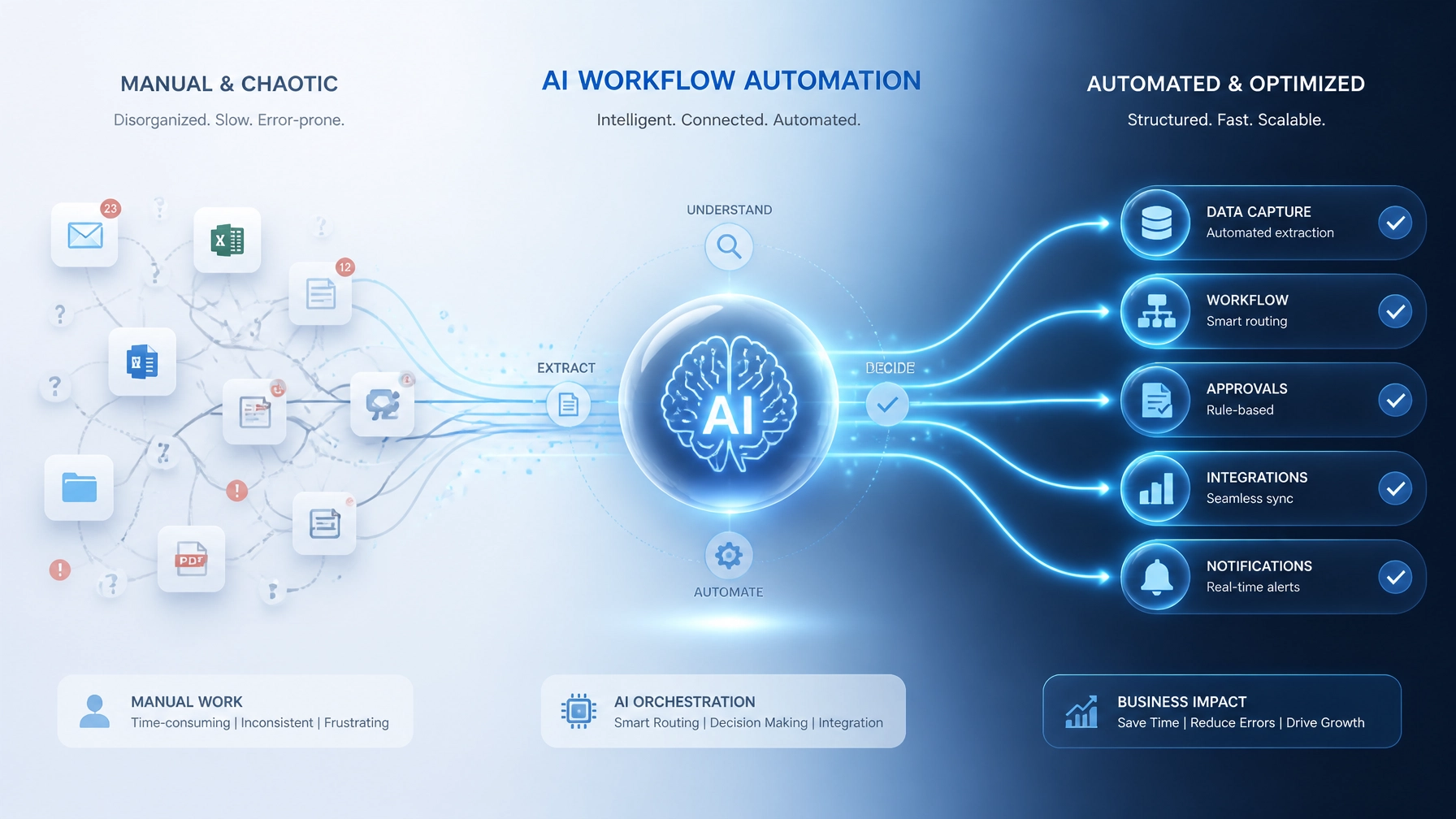
    Abstract visualization of chaotic manual data transforming into streamlined AI workflows.

    3. Zero Real-Time Operational Visibility

    If you have to wait for a "weekly report" to see how your operations are performing, you are flying blind. Manual workflows are notorious for their lack of traceability. When a task is handed off via a phone call or a sticky note, there is no digital breadcrumb trail.

    Executives need dashboards, not descriptions. By building custom web applications that sit on top of your workflows, we provide a "God-view" of your business. We take the logic we developed for platforms like ChainHQ: designed to manage complex, multi-step supply chain and operational logic: and apply it to your specific business needs. This transforms your operations from a black box into a transparent, data-driven engine where bottlenecks are identified before they become crises.

    4. The Human-in-the-Loop Error Tax

    Humans are excellent at strategy, creativity, and relationship building. We are remarkably poor at repetitive data entry. Typos in customer orders, misfiled invoices, or incorrect GPS logging in field operations aren't just "accidents": they are a tax on your efficiency.

    We’ve mitigated this in the field operations sector by implementing GPS-locked, automated rep accountability systems. By removing the "manual" reporting aspect of field work, the data becomes indisputable. When your AI solution handles the data work, your human capital is freed up to do what they do best: close deals and solve high-level problems.

    5. Scaling the Mess

    A manual workflow that works for 10 clients will break at 100 and cause a catastrophe at 1,000. Many founders believe they can just "hire their way out" of an efficiency problem. This is a fatal strategic error. Adding more people to a broken, manual process only increases the complexity and the management overhead.

    Bespoke AI solutions are built to scale infinitely. Whether you are processing ten files or ten million, the infrastructure remains the same. Our approach involves auditing your current roadmap and identifying where custom software can act as a force multiplier. We don't just automate your current process; we re-engineer it for a 10x future.

    Digital network paths illustrating a scalable business architecture powered by custom automation.

    6. Neglecting Local Presence Automation

    For businesses with a local footprint, manual management of your digital reputation is a losing game. Trying to manually update Google Business Profiles, respond to reviews across dozens of locations, and track local SEO metrics is a recipe for inconsistency.

    This is where our proprietary expertise in AI Local Boost comes into play. We demonstrate how AI-powered automation can maintain a dominant local presence without the need for a dedicated marketing army. By automating the "busy work" of local SEO, we allow business owners to focus on the customers coming through the door rather than the data behind the screen.

    7. The Compliance and Security Gap

    Manual workflows are a security nightmare. When data is moved manually, it often lands on unencrypted local drives or is sent over insecure channels. In regulated industries like healthcare (HIPAA) or fintech, a single manual error can lead to a multi-million dollar compliance fine.

    Custom-built software ensures that compliance is "baked into" the code. We bring proven capabilities from our work in healthcare and debt agency telephony to ensure that every piece of data follows a strict, automated governance path. There is no "forgetting" to encrypt a file when the system is architected to make encryption mandatory.

    Protective digital sphere symbolizing secure data governance and automated compliance systems.

    From Manual Drag to Automated Leverage

    The transition from manual workflows to bespoke AI solutions is not just a technical upgrade; it is a strategic repositioning. At Pure Technology Consulting, we specialize in building the custom web applications and high-level automations that allow you to outpace your competition.

    We don't offer off-the-shelf "band-aids." We provide visionary consulting and custom engineering that turns your operations into a proprietary asset. If you are ready to stop managing the "mess" and start leading a streamlined, automated enterprise, it is time to look beyond generic SaaS and invest in a solution that fits your business like a glove.

    Our engagements are designed for high-ticket clients who understand that the most expensive way to run a business is to pay humans to act like machines. Let’s build the machine instead.

    Take the Next Step

    Are you ready to audit your workflows and reclaim your executive time? Let’s map out a roadmap that takes you from manual drag to automated leverage.

    Book a discovery call with our team: https://puretechconsult.com/schedule

    Pure Technology Consulting LLC
    +1 (803) 921-0969
    www.puretechconsult.com

    Amin Said, Founder of Pure Technology Consulting LLC
    https://puretechconsult.com

  • From Idea to Exit: Why Bespoke SaaS Development is the Ultimate Competitive Advantage in 2026

    From Idea to Exit: Why Bespoke SaaS Development is the Ultimate Competitive Advantage in 2026

    By Amin Said, Founder of Pure Technology Consulting LLC

    It’s April 2026, and the software landscape has officially reached a tipping point. For years, the "there’s an app for that" mentality drove businesses to patch together a dozen different off-the-shelf SaaS subscriptions to run their operations. But today, the most successful industry leaders, franchise groups, and entrepreneurs aren't looking for another subscription to add to their monthly burn. They’re building their own.

    At Pure Technology Consulting (PTC), we’ve watched this shift happen in real-time. The era of "renting" your competitive advantage through generic software is ending. If you want to dominate your niche, drive higher valuations, and ultimately prepare for a lucrative exit, bespoke SaaS development isn’t just an option: it’s the strategy.

    The "Off-the-Shelf" Trap: Why Generic Software is Holding You Back

    For a long time, horizontal SaaS (software that tries to be everything to everyone) was the go-to. It was easy, relatively cheap, and solved 70% of your problems. But in 2026, that remaining 30% is where your profit lives.

    When you use the same tools as your competitors, you are essentially agreeing to have the same limitations as them. You’re operating on their roadmap, waiting for features they might never build, and struggling with "Frankenstein" integrations that break every time an API updates.

    Bespoke development changes the math. Instead of fitting your business into a software's constraints, we build the software around your unique workflows. Whether it's a specialized healthcare matching engine like our work with EHRIO Pro or complex telephony integrations for debt agencies, custom code is the only way to achieve 100% operational alignment.

    Custom software assembly representing bespoke SaaS development for precise operational alignment.

    Vertical Specialization: Building the Competitive Moat

    The biggest trend we’re seeing this year is the rise of Vertical SaaS. This is software built specifically for a narrow industry: think legal, accounting, or specialized construction.

    Generic platforms struggle with the nuance of industry-specific regulatory requirements and workflows. By building a bespoke solution, you create a "moat" that horizontal competitors can’t cross.

    For example, when we work with healthcare clients, we don’t just build a database; we build HIPAA-adjacent workflows and 70-question intake systems that automate the heavy lifting of compliance. In the field services sector, we’ve implemented GPS logging and rep accountability tools that generic CRM systems simply don't offer out of the box.

    When your software understands your industry’s "secret sauce," your customer lock-in skyrockets. Once a team integrates their specific daily habits into a platform that feels like it was made just for them, the cost of switching becomes too high. That stickiness is what drives long-term value.

    AI-Native Architecture: From Data Storage to Outcome Engines

    In 2026, the definition of "good" software has changed. It’s no longer enough for a platform to store data and provide a pretty dashboard. Modern SaaS must be an outcome-driven system.

    Bespoke development allows us to bake AI agents directly into the architecture. We aren't just "adding a chatbot" to the corner of the screen. We’re building inference pipelines and vector databases that allow the software to make decisions.

    Imagine a SaaS for franchise management that doesn't just show you sales numbers but identifies a dip in a specific region, analyzes the local SEO performance via tools like AI Local Boost, and automatically suggests a marketing pivot to the local manager. This transition from passive tools to active partners is where the real competitive advantage lies.

    At PTC, we specialize in building these technical backbones, ensuring that your proprietary tech isn't just a digital filing cabinet, but a high-performance engine that reduces time-to-value for your users.

    AI-native architecture illustrating a high-performance outcome engine for proprietary software assets.

    The Economics of Proprietary Tech: Building an Asset, Not an Expense

    Let’s talk about the "Exit" part of "Idea to Exit."

    If you run a service-based business, your valuation is typically a modest multiple of your EBITDA. However, if you transform that business into a tech-enabled powerhouse with proprietary SaaS, your valuation changes entirely. You are no longer just selling a service; you are selling a scalable asset with recurring revenue.

    Bespoke SaaS development turns your operational knowledge into intellectual property. We’ve seen this play out across multiple sectors:

    • Fintech: Custom call attribution and telephony integrations that turn a debt agency into a data-driven powerhouse.
    • Logistics: Proprietary tracking systems that offer transparency competitors can't match.
    • Healthcare: Matching engines that solve the "efficiency gap" in patient care.

    When you own the code, you own the future of your company. You aren't at the mercy of a third-party provider raising their prices or shutting down a critical feature. This independence is a massive green flag for investors and acquisition targets.

    Why PTC is the Technical Backbone for High-Ticket Clients

    Building a bespoke SaaS is a high-stakes move. It requires more than just "coders"; it requires a strategic partner who understands business logic, security, and scalability.

    At Pure Technology Consulting, we don’t just write lines of code. We act as your fractional CTO and development team. We’ve proven our ability to handle complex, high-traffic applications through projects like FTP Inform, where security and reliability are non-negotiable.

    Our approach is visionary but pragmatic. We lead with the business outcome: what does this do for your bottom line?: and then we build the roadmap to get there. We’ve brought these capabilities into the legal and accounting worlds, helping firms move away from legacy systems and into custom-built automation that saves hundreds of hours of manual labor.

    Digital technical backbone supporting custom-built automation for legal, healthcare, and finance industries.

    The Roadmap: From Idea to Execution

    So, where do you start? The journey from a "good idea" to a "market-ready exit" follows a specific path:

    1. Workflow Audit: We look at your current operations. Where is the friction? Where are you losing data? What are you paying three different SaaS companies to do poorly?
    2. Architecture & Scoping: We design a system that scales. This includes everything from the database structure to the AI integration layer.
    3. Bespoke Development: Our team builds the application with a focus on user experience and "stickiness."
    4. Management & Governance: We don't just hand over the keys and disappear. We provide the ongoing technical backbone to ensure your software stays ahead of the curve.

    This isn't about building a "minimal viable product" and hoping for the best. It’s about building a premium, scoped offering that serves as the foundation of your business for the next decade.

    Conclusion: Don’t Just Compete: Redefine the Game

    The window for gaining a "first-mover" advantage with bespoke AI-native SaaS is still open, but it's closing fast. As we move deeper into 2026, the gap between the companies that own their tech and the companies that rent it will become a canyon.

    If you’re an industry leader or a franchise group looking to turn your operational expertise into a proprietary asset, let’s talk. We’re not looking for "small projects": we’re looking for partners who are ready to build the next generation of industry-defining software.

    Ready to see how custom infrastructure can change your trajectory?

    Book a discovery call with our team here to start your roadmap from idea to exit. No obligation, just a high-level strategy session on how we can build your technical moat.


    Amin Said, Founder of Pure Technology Consulting LLC
    https://puretechconsult.com
    Phone: +1 (803) 921-0969
    Specializing in bespoke SaaS development, custom automation, and strategic technical advisory for high-ticket clients.

  • The Ultimate Guide to ChainHQ: Everything You Need to Succeed with Multi-Location Growth

    The Ultimate Guide to ChainHQ: Everything You Need to Succeed with Multi-Location Growth

    Scaling a business from a single successful unit to a multi-location empire is the ultimate test of an organization's operating model. What worked for one location rarely works for ten, and it almost certainly breaks by the time you reach fifty. The transition from a hands-on founder-led operation to a decentralized, digitally managed enterprise requires more than just capital; it requires a sophisticated technological roadmap.

    At Pure Technology Consulting, we view multi-location growth not merely as an expansion of physical footprints, but as a challenge of data synchronization and workflow orchestration. This guide explores the strategic pillars of multi-unit success and how our proprietary platform, ChainHQ, serves as a blueprint for high-performance custom software development.

    The Operational Drag of Fragmentation

    The primary obstacle to scaling is "operational drag": the friction caused by disconnected systems, manual reporting, and inconsistent localized execution. When each location operates as a digital island, leadership loses visibility. Decisions that should be driven by real-time data are instead based on gut feelings or outdated spreadsheets.

    To overcome this, visionary leaders are moving away from off-the-shelf, "one-size-fits-all" SaaS products that offer shallow features. Instead, they are investing in bespoke web applications designed to fit their specific governance and integration needs. The goal is a "Single Source of Truth" that connects the front-of-house experience with back-office automation.

    A central digital core representing a single source of truth for multi-location data and automation.

    Strategic Pillar 1: Centralized Governance and Localized Agility

    One of the most difficult balances to strike in multi-location growth is maintaining brand consistency while allowing for local market nuances. Whether you are managing a chain of clinics, retail outlets, or service centers, your digital infrastructure must support both.

    Centralized governance involves:

    • Standardized Workflows: Ensuring that every location follows the same operational protocols, from opening checklists to inventory audits.
    • Unified Data Architecture: Aggregating performance metrics into a central dashboard for executive oversight.
    • Permission-Based Access: Giving local managers the tools they need to run their units without compromising the security or integrity of the national brand.

    When we developed ChainHQ, our objective was to solve this exact tension. We built a platform that allows for global updates to be pushed across an entire network in seconds, while still providing granular reporting that accounts for regional variations in labor costs, consumer behavior, and local regulations.

    Strategic Pillar 2: Data-Driven Site Selection and Financial Planning

    Scaling to 50 or 100 locations requires a systematic approach to site selection. It is no longer enough to look for high foot traffic. Modern growth strategies utilize AI-powered automation to analyze demographic data, competitor proximity, and historical performance of existing units to predict the ROI of a potential new location.

    Custom software development allows businesses to integrate these external data points directly into their financial planning modules. By automating the "feasibility study" phase, companies can move faster than competitors who are still manually compiling reports. This level of technical sophistication is what separates market leaders from those who plateau.

    ChainHQ: A Case Study in Scalable Architecture

    At Pure Technology Consulting, we don't just consult on strategy; we build the engines that drive it. ChainHQ is our flagship solution for multi-location management, representing our expertise in building complex, high-ticket web applications.

    Rather than a static product, we treat ChainHQ as a proven framework that can be customized to a client’s specific industry: whether that is healthcare, legal services, or accounting. Key capabilities we’ve integrated into the ChainHQ ecosystem include:

    1. Multi-Unit Telephony & Communication: Centralizing inbound inquiries and ensuring lead attribution across various locations.
    2. Automated Compliance Monitoring: Ensuring every location meets industry-specific regulatory standards through automated audits.
    3. Real-Time Labor Optimization: Using predictive analytics to adjust staffing levels based on historical traffic patterns.

    Centralized digital network hub managing multiple business locations with real-time optimization.

    This bespoke approach is why we encourage prospective clients to book a discovery call to discuss how these capabilities can be mapped onto their unique business challenges.

    Strategic Pillar 3: Marketing Without Cannibalization

    A common pitfall in multi-location growth is "brand cannibalization," where nearby locations compete for the same digital real-time estate and customer base. Effective growth requires a sophisticated approach to Multi-Location SEO.

    Each location needs its own digital identity: optimized Google Business Profiles, localized landing pages, and city-specific content: while remaining tethered to the main brand’s domain authority. Our work with AI Local Boost has shown that when you automate the management of local search signals, you significantly reduce the cost of customer acquisition across the entire chain.

    The synergy between a platform like ChainHQ and AI-driven SEO ensures that as you add physical locations, your digital footprint expands exponentially rather than redundantly.

    The Role of AI-Powered Automation in Operations

    The future of multi-location management lies in moving from reactive to proactive operations. AI-powered automation is no longer a luxury; it is the baseline for efficiency.

    Consider inventory management. A centralized system that utilizes machine learning can predict stock-outs before they happen by analyzing regional trends and supply chain disruptions. Similarly, workflow automation can handle the "busy work" of administrative tasks: such as processing invoices or scheduling maintenance: freeing up local managers to focus on customer experience and team development.

    At Pure Technology Consulting, we bring these high-level automation capabilities to sectors that have traditionally been slow to modernize, such as the legal and accounting professions. We use the same matching engines and intake logic developed for healthcare solutions like EHRIO Pro to create seamless, 70-question intake workflows that ensure no lead is dropped and every case is properly triaged.

    Visualizing AI-powered data streams and automated workflows for efficient business intake systems.

    Why Bespoke Development Beats Generic SaaS

    While many "off-the-shelf" solutions exist for franchise management, they often force a business to change its processes to fit the software. This is a recipe for stagnation. When you are operating at a high level, your software should be your competitive advantage, not a constraint.

    Bespoke development offers:

    • Integration with Legacy Systems: Don’t scrap what works; build a bridge to it.
    • Ownership of Data: You own the infrastructure and the insights it generates.
    • Scalability: The software grows with you, adding features as your complexity increases.

    Our approach involves a deep-dive workflow audit. We look at where your current "operational drag" is highest and design a custom roadmap to eliminate it. Whether it's integrating GPS logging for field reps or building call attribution models for debt agencies, we focus on the high-ticket transformations that provide the most leverage.

    Building Your Roadmap for Growth

    If you are currently managing multiple locations or planning a significant expansion, the time to address your technical debt is now. Waiting until you have 20 locations to fix your data architecture is ten times more expensive than doing it when you have five.

    The journey to successful multi-location growth is one of transformation. It requires moving from a state of "managing people" to "managing systems." With the right digital partner and a robust platform like ChainHQ, that transformation becomes not only possible but inevitable.

    Digital bridge representing the visionary path for multi-location growth and organizational scaling.

    Pure Technology Consulting specializes in taking proven capabilities: from AI-driven local SEO to complex HIPAA-adjacent workflows: and applying them to your specific business model. We provide the senior advisory and bespoke engineering required to turn visionary goals into operational reality.

    To see how we can build a custom solution for your organization, or to view our latest video walkthroughs of proprietary builds, we invite you to connect with our team.


    Ready to scale your operations with custom automation?
    Request a workflow audit or call us at +1 (803) 921-0969 to start the conversation.

    Amin Said, Founder of Pure Technology Consulting LLC
    https://puretechconsult.com

  • Invisible to Local Leaders: How Google Business Profile Automation Can Fix Your Lead Flow Gap

    Invisible to Local Leaders: How Google Business Profile Automation Can Fix Your Lead Flow Gap

    By Amin Said, Founder of Pure Technology Consulting LLC

    For the modern local business leader: whether you are managing a high-performance chiropractic clinic, a multi-location physical therapy group, or a specialized healthcare facility: the digital landscape is no longer a peripheral concern. It is the primary engine of patient acquisition.

    Yet, many organizations are currently suffering from a quiet, expensive ailment: they are invisible to the very people standing on their doorstep. This isn't because they lack expertise or high-quality service; it’s because their digital "front door": their Google Business Profile (GBP): is stagnant.

    In the world of local search, silence is interpreted as absence. If your profile isn't active, Google assumes your business isn't either. At Pure Technology Consulting, we view this not just as a marketing failure, but as an operational bottleneck that can be solved through strategic automation.

    The Reality of the "Local Pack" Hierarchy

    The statistics surrounding local search are staggering. Currently, 46% of all Google searches have local intent. Even more critical for healthcare providers: 76% of people who conduct a local search visit a business within 24 hours.

    When a prospective patient in pain searches for "physical therapy near me," Google presents them with the "Local Pack": the top three results displayed prominently on the map. If your clinic isn't in those top three spots, you are effectively invisible.

    The gap between the leaders and the laggards in these rankings is rarely a matter of clinical skill. Instead, it is a gap in consistent engagement. Google’s algorithm rewards freshness. It prioritizes profiles that demonstrate a high velocity of reviews, frequent photo uploads, and consistent posting. For a busy clinic owner or a regional manager overseeing ten locations, maintaining this manual rhythm is an operational impossibility.

    Digital map highlighting local business visibility and the Google Local Pack ranking for clinics.

    Why Manual GBP Management Is an Operational Drag

    Most local leaders recognize the importance of their Google presence, but the execution often falls into one of two traps:

    1. The "Heroic Effort" Trap: A clinic manager or practitioner tries to handle it personally. They post once or twice, respond to three reviews, and then get pulled back into patient care. The profile goes dark for three weeks, and the ranking drops.
    2. The "Outsourced Agency" Trap: A generic marketing agency is hired. They post canned, non-specific content that doesn't resonate with the local community, and they lack the technical infrastructure to manage multi-location nuances at scale.

    This creates "operational drag": a situation where human resources are being spent on repetitive, low-leverage tasks that could be better handled by a machine. This is where we see the most significant opportunity for a strategic pivot toward automation.

    The Architecture of Visibility: AI Local Boost

    At Pure Technology Consulting, we don’t just look at local SEO as a set of keywords. We look at it as a workflow problem. This led us to develop AI Local Boost, a proof-of-concept for how custom automation can transform a business’s local standing.

    Rather than relying on human intervention to remember to post or respond to a review, we build automated systems that handle the heavy lifting. By integrating these systems into your existing operating model, we ensure that your GBP remains "alive" in the eyes of Google’s algorithm 24/7.

    1. Consistent Review Response Strategy

    Reviews are the lifeblood of trust in healthcare. However, it’s not just about getting the review; it’s about responding to it. Google views responsiveness as a signal of active management. Automation allows for immediate, personalized, and context-aware responses to every patient review, ensuring that no lead feels ignored and that the algorithm sees constant activity.

    2. High-Velocity Content and Photo Uploads

    Businesses with regularly updated profiles receive an average of 200 clicks per month. Automation engines can schedule educational content, clinic updates, and localized promotions across multiple locations simultaneously. This maintains a "freshness" score that manual efforts simply cannot match.

    3. Scalable Multi-Location Governance

    For leaders managing multiple sites, the complexity of GBP grows exponentially. Updating holiday hours, managing Q&A sections, and ensuring brand consistency across 50 locations becomes a full-time job. We specialize in building the digital infrastructure that allows a single executive to govern hundreds of locations with a few clicks.

    A visualization of manual business tasks being streamlined into an automated digital workflow.

    Data-Driven Impact: The Automation Dividend

    The shift from manual to automated GBP management isn't just about saving time; it’s about measurable ROI. Data indicates that businesses implementing comprehensive GBP automation report a 15–30% increase in profile engagement within the first three months.

    Furthermore, businesses with optimized and active profiles are 70% more likely to attract local customers compared to those with incomplete or stagnant listings. For a chiropractic clinic or a physical therapy center, a 20% increase in lead flow can represent hundreds of thousands of dollars in annual recurring revenue.

    The "Automation Dividend" is two-fold:

    • Top-line Growth: Higher rankings lead to more calls, more website visits, and more appointments booked.
    • Bottom-line Efficiency: Removing the manual labor of profile management saves 5–10 hours per month, per location. For a multi-location group, this reclaims hundreds of hours of staff time that can be redirected toward patient experience and clinical excellence.

    Beyond the Basics: Custom Automation for High-Ticket Growth

    While many search for a simple SaaS tool to "fix" their SEO, the reality is that high-growth businesses require a more bespoke approach. At Pure Technology Consulting, we treat Local SEO automation as a component of a larger custom software strategy.

    Whether it is integrating your GBP data into a custom dashboard or building a proprietary engine like AI Local Boost to manage complex workflows, our focus is on creating a competitive advantage that cannot be easily replicated by your competitors. We’ve applied similar automation logic across various sectors: from healthcare matching engines in our EHRIO Pro projects to complex telephony integrations in the fintech space.

    The goal is always the same: Strategic operational leverage.

    A rising geometric staircase representing strategic growth and operational leverage through technology.

    Roadmap to Dominance: What to Automate First

    If your clinic or business is currently struggling with a lead flow gap, we recommend a structured approach to recovery:

    1. The Visibility Audit: Determine where you currently stand in the "Map Pack" for your primary keywords. Identify the gap between your activity levels and those of your top three competitors.
    2. Workflow Integration: Map out your current process for collecting reviews and posting updates. Identify where the human bottlenecks are.
    3. Deploy AI Local Boost: Implement an automated layer to handle review responses, photo velocity, and content scheduling.
    4. Governance and Monitoring: Establish a central dashboard to track engagement metrics, call volume, and direction requests across all locations.

    The Visionary Path Forward

    The gap between the "invisible" local business and the market leader is widening. As Google continues to lean into AI and real-time engagement signals, the businesses that rely on manual updates will continue to fall behind.

    Automation is no longer a luxury for the tech-savvy; it is a fundamental requirement for the local leader who intends to scale. By closing the lead flow gap through GBP automation, you aren't just "fixing your SEO": you are building a resilient, automated engine for growth that works while you focus on what you do best: serving your patients and leading your team.

    If you are ready to stop being invisible and start dominating your local market through bespoke automation and technical strategy, we invite you to explore our approach.

    Ready to audit your local visibility?
    Book a discovery call with our team to discuss how we can build a custom automation roadmap for your business.

    To see our technology in action, you can also view our video walkthroughs or learn more about our philosophy at the Pure Technology Consulting blog.


    Amin Said, Founder of Pure Technology Consulting LLC
    https://puretechconsult.com
    Phone: +1 (803) 921-0969

  • 7 Mistakes You’re Making with AI Workflow Automation (and How to Fix Them)

    7 Mistakes You’re Making with AI Workflow Automation (and How to Fix Them)

    We are living through a period of unprecedented operational leverage. As we navigate 2026, the conversation has shifted from "Can AI help us?" to "How fast can we integrate it?" However, in the rush to modernize, many organizations are inadvertently building "digital debt": complex, fragile systems that create as many problems as they solve.

    At Pure Technology Consulting, we view AI not as a magic wand, but as a sophisticated architectural component. When implemented with a visionary strategy, it transforms businesses into high-velocity engines. When implemented poorly, it simply automates chaos.

    Here are the seven most common mistakes we see in AI workflow automation and the strategic roadmaps to fix them.

    1. Automating Broken or Inefficient Processes

    The most dangerous mistake is the belief that automation can fix a bad process. If your current manual workflow for client onboarding is convoluted, layering AI on top of it will only result in a convoluted automated workflow that fails faster and at a larger scale. This is the "Garbage In, Garbage Out" principle for the age of intelligence.

    The Fix: Before writing a single line of code or prompt, perform a deep-dive audit. We often utilize process mining to identify where the actual friction points lie. Strip the process down to its essential outcomes. Ask: "If we started this department today from scratch, would this step even exist?" Simplify first, then automate.

    2. Treating Data Reliability as an Afterthought

    AI thrives on context, but it is allergic to inconsistent data. Many firms attempt to automate reporting or decision-making while their data is trapped in silos, formatted inconsistently, or riddled with missing values. The result is a "silent failure": an automation that runs to completion but provides inaccurate insights that lead to poor executive decisions.

    The Fix: Build a robust data foundation. At Pure Technology Consulting, we developed FTP Inform to address the foundational challenges of data movement and reliability. While many see file transfers as a legacy concern, we recognize that secure, automated, and validated data ingestion is the bedrock of any AI strategy. By ensuring that your data pipelines are transparent and monitored, you provide your AI agents with the high-fidelity "truth" they need to operate effectively.

    Abstract digital data pipeline showing secure and validated information flow for AI automation systems.

    3. Using "Sledgehammer" Models for "Nail" Tasks

    We see a recurring trend where organizations default to the most powerful models (like GPT-4 or Claude 3.5) for every single task, from simple email routing to basic data extraction. This is a strategic error in resource allocation. Compute costs in 2026 can represent up to 80% of an AI department's budget. Using an enterprise-grade model for a task that a lightweight, specialized model could handle is an operational drag.

    The Fix: Implement intelligent model routing. Use large-scale models for complex reasoning and creative synthesis, but deploy smaller, fine-tuned models for repetitive classification or extraction tasks. This tiered approach reduces latency, slashes costs, and allows for greater scalability.

    4. Over-Automating Without a Human-in-the-Loop Strategy

    There is a temptation to aim for "100% automation" from day one. However, in high-stakes industries like legal, healthcare, and accounting, total automation is often a liability. When an AI makes an autonomous decision without a clear audit trail or a human checkpoint, you lose the "expert intuition" that defines your brand's value.

    The Fix: Adopt a "Copilot" philosophy rather than an "Autopilot" one. Design workflows where AI handles the heavy lifting: data gathering, initial drafting, and cross-referencing: but presents the final 10% to a human expert for validation. This is exactly how we approached the development of EHRIO Pro. In healthcare and matching-engine contexts, EHRIO Pro utilizes complex 70-question intakes and HIPAA-adjacent workflows to organize massive amounts of data, yet it is designed to empower providers, not replace their clinical judgment. It provides the "matching" intelligence, but the human remains the final arbiter.

    5. Ignoring the User Experience of the Workflow

    Many automations are built from a purely technical perspective, ignoring the person who has to interact with them. If a workflow executes perfectly but the user is left wondering, "What is the AI doing right now?" or "Why did it make this choice?", the system will eventually be abandoned or bypassed.

    The Fix: Shift from "Execution" to "Guidance." Your automation should be communicative. It should explain its steps and guide the user through the lifecycle of a task. Whether it's a custom web app for a debt agency or a specialized fintech tool, the interface must provide transparency. A visionary workflow doesn't just do the work; it teaches the organization how the work is being done.

    Modern holographic interface representing transparent AI guidance and intuitive workflow management.

    6. Poor Context Management and Prompt Architecture

    Most cost overruns and "hallucinations" stem from poor context management. Passing an entire 50-page document into a prompt for a 2-sentence summary is inefficient and expensive. Conversely, giving an AI too little context leads to generic, unusable outputs.

    The Fix: Treat prompts as versioned architectural assets. Move away from "chatting" with AI and toward "Prompt Engineering" as a structured discipline. Use context compression techniques and summarize previous exchanges rather than carrying forward full histories. For instance, with our AI Local Boost solution, we don't just "ask" an AI to manage Local SEO. We provide it with highly structured, specific data points about Google Business Profiles and local ranking factors. This precise targeting allows the automation to drive real-world results without the "fluff" of unnecessary tokens.

    7. Scaling Without Governance and Centralized Monitoring

    Success can be its own trap. Once a team sees the ROI of a successful automation, they often rush to replicate it across every department. Without a centralized roadmap, you end up with "Automation Sprawl": different departments using different tools, conflicting logic, and redundant subscriptions.

    The Fix: Establish a Center of Excellence for your digital transformation. This doesn't mean slowing down; it means building on a shared infrastructure. This is the philosophy behind ChainHQ. We built ChainHQ to serve as a robust framework for scalable, complex web applications and custom automations. It provides the structural integrity needed to ensure that as your automation footprint grows, it remains manageable, secure, and aligned with your broader business objectives.

    The Roadmap Forward

    The difference between a company that "uses AI" and a company that is "AI-powered" lies in the architecture. It requires a shift from tactical fixes to visionary strategy. Whether we are building telephony integrations for debt agencies or GPS-logged accountability systems for field operations, our focus at Pure Technology Consulting is always on bespoke development that fits your unique operations like a glove.

    The "Gold Rush" phase of AI is ending; the "Infrastructure" phase has begun. Don't settle for off-the-shelf solutions that only solve 60% of your problem while creating 40% more complexity.

    If you are ready to audit your current workflows and build a custom, high-ticket automation engine that scales your expertise, we are ready to guide you. Our engagements are designed for organizations looking for premium, scoped offerings that deliver measurable operational leverage.

    Ready to transform your operations?
    Let’s discuss your roadmap. We specialize in bringing proven capabilities from healthcare, fintech, and field operations into the legal and accounting sectors.

    Contact Pure Technology Consulting:
    Phone: +1 (803) 921-0969
    Schedule a Discovery Call

    Amin Said, Founder of Pure Technology Consulting LLC
    https://puretechconsult.com

  • The Modern Law Firm’s Roadmap: Scaling Beyond Billable Hours with Custom AI Workflows

    The Modern Law Firm’s Roadmap: Scaling Beyond Billable Hours with Custom AI Workflows

    By Amin Said, Founder of Pure Technology Consulting LLC

    For decades, the legal and accounting professions have been anchored to a singular metric of success: the billable hour. It is a model that rewards duration over direction and manual effort over institutional intelligence. However, as we move further into 2026, a fundamental shift is occurring. The ceiling of human capacity is no longer the limit for firm growth.

    At Pure Technology Consulting, we are seeing a "Professional Services Pivot." Leading firms are no longer just selling their time; they are building proprietary technological assets. By integrating custom AI workflows and bespoke software, these firms are decoupling their revenue from their headcount. They are moving from a labor-intensive model to an asset-intensive model.

    This roadmap outlines how modern firms can navigate this transition, leveraging the same architectural principles we’ve used to scale complex systems in healthcare and fintech to revolutionize professional services.

    The Efficiency Paradox: Why Faster is Often "Riskier" in Traditional Billing

    The traditional billable model creates a natural resistance to efficiency. If a partner uses AI to complete a four-hour contract review in forty minutes, the firm technically loses three hours of billable revenue. This is the efficiency paradox.

    However, the market is already correcting this. Clients are increasingly savvy; they are no longer willing to pay premium rates for "commodity" hours: tasks like document tagging, basic contract drafting, or initial discovery. The firms that thrive in this new era are those that view AI not as a way to do the same work in less time, but as a way to deliver higher-value outcomes at a scale previously thought impossible.

    Building Proprietary AI Assets

    Most firms start their AI journey by subscribing to generic, off-the-shelf LLM tools. While these are useful for drafting emails, they do not provide a competitive advantage. A true roadmap to scaling requires bespoke development.

    Custom AI workflows should be trained on your firm’s unique intellectual property: your past briefs, your specific approach to M&A due diligence, or your proprietary tax strategies. When you build a system that reflects your firm’s "DNA," you are creating an asset that works even when your attorneys are asleep.

    Digital architecture showing legal documents transforming into proprietary AI data for custom law firm workflows.

    From Intake to "Matching Engines"

    In our work with high-growth healthcare organizations: specifically with projects like the EHRIO matching engines: we’ve mastered the art of complex intake. We’ve built 70-question intake systems that don't just collect data; they analyze it in real-time to "match" patients with the right providers and protocols.

    Law firms can apply this exact logic. Imagine a personal injury or class-action intake system that doesn't just store a lead’s name, but automatically cross-references the details against current case law, calculates potential claim value, and flags high-priority cases for immediate partner review. This isn't just a form; it's a decision-support engine that reduces administrative drag and ensures your highest-paid talent is only touching the highest-value files.

    Operational Leverage: Reclaiming the Non-Billable Capacity

    Operational leverage is the ability to increase output without a proportional increase in costs. In a law firm, the greatest "cost" is the time spent on non-billable administrative work.

    Custom workflows can automate:

    • Document Orchestration: Organizing, tagging, and extracting key clauses from thousands of documents in a discovery phase.
    • Compliance and Governance: Using AI to monitor ongoing cases or filings against changing regulations, ensuring nothing slips through the cracks.
    • Template Evolution: Moving beyond static templates to dynamic document assembly systems that adjust language based on the specific jurisdiction and intent of the matter.

    By reclaiming this capacity, a mid-sized firm can handle the caseload of a much larger competitor without the overhead of an army of junior associates.

    Reimagining the Pricing Model

    As tasks become automated, the "flat fee" and "subscription" models become highly profitable. For repeatable work: such as commercial contracts, employment agreements, or estate planning: standardization allows for predictable margins.

    When you use a bespoke system to handle 80% of the heavy lifting, a flat-fee engagement becomes an opportunity for high-margin revenue rather than a gamble on how many hours the work will take. You are being paid for the result and the proprietary system you’ve built to deliver it, not the minutes on a clock.

    A futuristic hourglass illustrating the transition from billable hours to scalable value-driven AI assets.

    Governance, Privacy, and the HIPAA-Adjacent Standard

    One of the primary concerns for professional services firms is data security. In the legal and accounting world, PII (Personally Identifiable Information) is sacrosanct.

    At Pure Technology Consulting, our background in healthcare technology has conditioned us to work within "HIPAA-adjacent" environments. We understand the necessity of data silos, encryption, and audit trails. When we build custom AI workflows for a law firm, we aren't just connecting them to a public cloud and hoping for the best. We are building secure, governed environments where your firm’s data remains your firm’s data.

    Our experience in fintech: integrating telephony and call attribution for debt agencies: has taught us how to handle sensitive financial data with extreme precision. We bring this "hardened" engineering mindset to every legal and accounting project.

    The Roadmap: How to Begin the Pivot

    Transitioning a firm doesn't happen overnight. It requires a strategic, phased approach:

    1. Workflow Audit: Identify the processes that are high-volume but low-complexity. These are your first candidates for automation.
    2. Architecture Design: Instead of buying five different SaaS tools that don't talk to each other, design a central "operating system" for your firm. You can see examples of how we approach this on our video walkthroughs page.
    3. Bespoke Development: Build the core logic. Whether it’s an AI-driven triage system or a custom client portal, ensure it is built to scale.
    4. Integration: Connect your new AI tools with your existing practice management software, CRM, and billing systems to ensure a seamless flow of data.
    5. Governance Implementation: Set the rules for how AI is used, ensuring human oversight remains the final word on all legal and financial advice.

    A digital horizon symbolizing the integration of human professional expertise with advanced AI automation.

    A Visionary Path Forward

    The future of professional services is not about who has the most lawyers in the room; it is about who has the most efficient system for delivering expertise. Custom AI workflows allow you to "clone" your best performers’ logic and apply it across your entire firm.

    This is not just about staying competitive; it is about reclaiming the joy of the profession. When the "drudge work" is handled by high-performance code, lawyers and accountants are free to do what they do best: provide visionary strategy and complex problem-solving for their clients.

    If you are ready to explore how a bespoke technological roadmap can transform your firm’s operating model, the first step is a conversation. We specialize in taking the complex, manual workflows of high-ticket professional services and turning them into scalable, automated assets.

    Let’s build the future of your firm together.

    Schedule a discovery call with our team to discuss your workflow audit and architectural needs.


    Amin Said, Founder of Pure Technology Consulting LLC
    https://puretechconsult.com
    +1 (803) 921-0969

    To learn more about our philosophy on custom development and operational leverage, visit our full blog or explore our terms of use for insight into our professional standards.

  • 7 Mistakes You’re Making with Manual Workflows (and How AI Automation Fixes Them)

    7 Mistakes You’re Making with Manual Workflows (and How AI Automation Fixes Them)

    In the current landscape of 2026, the gap between companies that "get it" and those that are "getting by" has never been wider. Many organizations are still operating on the backbone of manual workflows: processes held together by spreadsheets, frantic emails, and the institutional memory of a few key employees.

    While manual work feels safe because it's familiar, it is the silent killer of scale. As the CEO of Pure Technology Consulting, I’ve seen how these hidden inefficiencies act as an anchor, dragging down even the most visionary leaders. AI automation isn't just about replacing a task; it's about rearchitecting how value flows through your business.

    If you’re still relying on manual hand-offs, you’re likely making one of these seven critical mistakes. Here is how we fix them using bespoke AI-powered solutions.

    1. Automating a Broken Process

    The single most common mistake is taking an inefficient manual process and simply "digitizing" it. If your current workflow is a mess of redundant steps and unnecessary approvals, automating it just creates "automated chaos." You end up doing the wrong things faster.

    AI automation allows us to perform a "process audit" first. Instead of just copying your manual steps, we use AI to analyze data patterns and identify where bottlenecks actually exist. We don't just build a script; we build a streamlined operating model.

    2. The "Spaghetti Infrastructure" Trap

    Manual workflows often lead to fragmented systems. One team uses a specific spreadsheet, another uses a legacy CRM, and a third relies on physical notes. This creates a "spaghetti infrastructure" where data is siloed and inconsistent.

    When we approach custom software development, we look at integration as the priority. By centralizing your data through custom web apps, we ensure that every part of your business speaks the same language. This is where high-level governance meets operational execution.

    Visualizing data centralization as complex lines merging into a symmetrical glowing core for efficient workflows.

    Case Study in Capability: EHRIO Pro

    Our work with EHRIO Pro serves as a perfect example of how we handle complex, high-stakes data environments. In the healthcare sector, manual intake and patient matching are fraught with risk. We developed custom matching engines and 70-question intake workflows that ensure data integrity while maintaining HIPAA-adjacent compliance. This wasn't just a software patch; it was a total reimagining of how patient data is handled, moving from manual uncertainty to automated precision.

    3. Relying on "Tribal Knowledge"

    In many firms, the "workflow" exists only in the head of a senior manager. If that person leaves or takes a vacation, the process grinds to a halt. This reliance on individual knowledge is a massive operational risk.

    AI automation fixes this by codifying your business logic. By building custom platforms like those we offer at Pure Technology Consulting, we transform "how Bob does it" into "how the system handles it." This ensures continuity and allows you to scale without being held hostage by the availability of a single person.

    4. Scaling Inefficiency (The "More People" Fallacy)

    When a business grows, the instinctual manual response is to "hire more people." But if your workflow is inefficient, adding more people only adds more communication overhead and more room for human error.

    Visionary leaders understand that operational leverage comes from technology, not just headcount. AI-powered automation allows your existing team to handle 10x the volume by removing the "drudge work" from their plates.

    A holographic interface showing data throughput, representing high-leverage AI-powered automation in a workspace.

    Case Study in Capability: ChainHQ

    To see this in action, look at ChainHQ. We designed this to solve the visibility gap in supply chain and complex workflow management. Instead of having a dozen people calling vendors and checking manifests manually, ChainHQ provides a centralized command center. It demonstrates our ability to build scalable, complex web applications that provide real-time oversight, allowing executives to make decisions based on data rather than "gut feelings" or manual reports.

    5. Poor Data Integrity at the Entry Point

    Manual data entry is the enemy of AI. If your team is manually typing leads into a CRM or copying invoice data into an accounting tool, errors are inevitable. Small mistakes at the beginning of a workflow cascade into massive problems during reporting and analysis.

    AI fixes this through intelligent document processing (IDP) and automated data capture. We build custom interfaces that validate data in real-time, ensuring that by the time information reaches your core systems, it is clean, structured, and ready for high-level analysis.

    6. The "Black Box" Mistake

    Many businesses fear automation because they feel they will lose control: that the process will become a "black box" they can no longer see into. This happens when you use generic, off-the-shelf SaaS products that don't fit your specific business logic.

    Our approach to bespoke development is different. We believe in the "human-in-the-loop" model. We design dashboards and feedback loops that give you more visibility than you ever had manually. You aren't losing control; you're gaining a cockpit.

    Interconnected digital panels showing a high-visibility cockpit for monitoring automated business ecosystems.

    Case Study in Capability: AI Local Boost

    With AI Local Boost (AILB), we proved that even localized tasks like SEO and Google Business Profile management can be strategically automated without losing the "human touch." For our legal and accounting clients, AILB automates the tedious aspects of local visibility: posting updates, monitoring reviews, and managing citations: while providing a clear dashboard of results. It shows how we can take a traditionally manual marketing task and turn it into a high-leverage asset. You can explore our strategy further on our blog.

    7. Lack of Strategic Integration

    The final mistake is viewing automation as a "one-off" project. Real digital transformation happens when your automations are strategically aligned with your long-term roadmap. Many companies automate a few tasks but leave them disconnected from the rest of the business.

    At Pure Technology Consulting, we don't just write code. We provide an advisory roadmap. We look at your telephony, your CRM, your field operations, and your financial backend to ensure that every automation reinforces the others. Whether it's GPS logging for field reps or call attribution for debt agencies, the goal is a unified ecosystem.

    Case Study in Capability: FTP Inform

    A common hurdle for established firms is "legacy lag": valuable data trapped in old systems or via outdated protocols like FTP. We built FTP Inform to bridge that gap. It acts as a sophisticated translator, taking data from legacy sources and making it accessible for modern AI workflows. This is a prime example of our capability to integrate modern web apps with the "old world" of business, ensuring that no data is left behind during your transformation. You can see more about our approach at ftpinform.puretechconsult.com.

    The Path Forward: From Manual to Visionary

    The transition from manual workflows to AI-driven automation is not just a technical upgrade; it’s a strategic pivot. It’s about moving your team away from being "data movers" and turning them into "data users."

    When you eliminate the seven mistakes mentioned above, you stop reacting to your business and start leading it. You gain the clarity needed to spot new opportunities, the speed to act on them, and the infrastructure to support growth without breaking.

    If your organization is ready to stop "getting by" with manual work and start building a bespoke automated future, we are here to guide that journey. We specialize in high-ticket, custom web applications and deep automation consulting for firms that require precision and scale.

    Ready to audit your workflows?
    Let’s discuss your roadmap. You can schedule a discovery call or reach out to our office directly.

    Amin Said, Founder of Pure Technology Consulting LLC
    Phone: +1 (803) 921-0969
    Website: https://puretechconsult.com

  • The $5M Growth Hurdle: Why Custom AI-Driven Intake is the Only Path to Scale for Specialty Clinics

    The $5M Growth Hurdle: Why Custom AI-Driven Intake is the Only Path to Scale for Specialty Clinics

    By Amin Said, Founder of Pure Technology Consulting LLC

    For many specialty clinics, whether in chiropractic care, physical therapy, or behavioral health, there is an invisible ceiling that appears right around the $5 million annual revenue mark. Up until this point, growth is often driven by the sheer force of will of the founder and a dedicated, albeit overworked, front-office team.

    However, as you cross into the multi-million dollar territory, the "Chaos Tax" begins to eat your margins. What worked at $1 million, manual spreadsheets, generic intake forms provided by your EHR, and front-desk staff playing phone tag with prospective patients, becomes a liability. At this stage, growth doesn't just slow down; it becomes dangerous to your clinical quality and staff retention.

    The bottleneck isn't your clinical expertise or your marketing spend. The bottleneck is your intake workflow. To scale beyond the $5M hurdle, specialty clinics must transition from reactive administrative tasks to a custom, AI-driven intake engine that qualifies, routes, and prepares patients before they ever step foot in the building.

    The Operational Drag of the "Standard" Intake Process

    In a typical specialty clinic, the intake process is often viewed as a clerical necessity rather than a strategic asset. Most clinics rely on the native intake features of their Electronic Health Record (EHR) system. While these systems are excellent for record-keeping, they are notoriously poor at conversion and workflow optimization.

    The "Standard" workflow usually looks like this:

    1. A lead comes in via a website form or phone call.
    2. A staff member calls back (often hours or days later).
    3. A PDF or a generic digital form is emailed to the patient.
    4. The patient fills it out partially or forgets it until they arrive.
    5. The clinician spends the first 15 minutes of the appointment "data-gathering" instead of treating.

    This manual loop creates massive operational drag. It increases your cycle time, the duration from the first point of contact to the start of treatment, and results in high "no-show" rates because the patient hasn't been properly engaged or qualified. When you are trying to scale to $10M or $20M, this inefficiency is compounded across dozens of providers and multiple locations, leading to millions in lost opportunity.

    Visual representation of reducing clinic operational drag by transforming administrative chaos into streamlined workflow.

    Why Generic SaaS Solutions Fail the Scale Test

    Many clinic owners attempt to solve this by layering on more SaaS products, a CRM here, an automated texting tool there, and perhaps a third-party form builder. This leads to "fragmented data silos" where your staff is constantly copy-pasting information between three different windows.

    Generic software is designed for the "average" clinic. But specialty clinics aren't average. A behavioral health practice requires a vastly different intake logic than a chiropractic clinic. A high-growth PT clinic needs a matching engine that pairs the right patient with the right specialist based on injury type and insurance coverage.

    Generic tools cannot handle these nuances. They don't "think"; they only "collect." This is where custom development changes the game. By building a custom AI-driven intake layer that sits on top of your existing systems, you create a bespoke operating model that fits your specific clinical philosophy and business goals.

    The Visionary Shift: AI-Driven Strategic Intake

    When we talk about AI-driven intake at Pure Technology Consulting, we aren't talking about a chatbot that says "Hello." We are talking about an intelligent logic engine that transforms your front office.

    1. Advanced Patient Qualification & Matching

    Imagine an intake system that doesn’t just ask for a name and insurance card. Instead, it guides the patient through a dynamic, logic-based questionnaire: much like the 70-question intake engines we’ve developed for high-complexity healthcare environments.

    As the patient answers, the AI evaluates their needs in real-time. If a patient indicates a specific type of chronic pain, the system automatically routes them to the clinician with the highest success rate for that condition. This is what we call a "matching engine," and it ensures that your clinical outcomes remain high even as you scale.

    2. HIPAA-Adjacent Workflow Automation

    Security is the primary concern for any healthcare executive. Custom AI intake allows for "HIPAA-adjacent" workflows. This means the AI handles the data processing, lead qualification, and scheduling logic in a secure, custom-built environment before pushing the finalized, encrypted data into your primary EHR. This reduces the risk of data entry errors and ensures that your clinicians start every session with a comprehensive, AI-summarized patient profile.

    Abstract logic engine showing intelligent patient matching and AI-driven intake routing for specialty practices.

    3. Predictable Growth Through Data Integrity

    Scaling requires predictability. When your intake process is custom-coded to your business rules, you gain access to clean, actionable data. You can see exactly where patients drop off in the funnel, which marketing channels produce the most "high-intent" leads, and how quickly your team is converting those leads into appointments. This level of governance is impossible with off-the-shelf software.

    Proof of Capability: The EHRIO Pro Framework

    At Pure Technology Consulting, we don’t just theorize about these systems; we build them. Our work on projects like EHRIO Pro serves as a testament to what is possible when you move beyond standard software.

    For high-ticket healthcare clients, we have built matching engines that handle deep, 70-question intakes with complex branching logic. These systems don't just collect data; they analyze it to ensure the patient is a "fit" for the practice's specific methodology. This prevents clinician burnout by ensuring they aren't seeing patients they aren't equipped to help, and it skyrockets patient satisfaction because the care feels personalized from the very first click.

    We’ve applied similar logic to other industries: from GPS-logged accountability in field operations to complex telephony integrations in fintech: but the healthcare sector stands to gain the most from this level of bespoke automation.

    Quantifying the Impact: Cycle Time and Throughput

    The goal of implementing a custom AI-driven intake engine is to achieve operational leverage. This is the ability to increase your revenue without a proportional increase in your administrative overhead.

    • Cycle Time Reduction: By automating the data collection and qualification phase, we often see clinics reduce their time-to-treatment by 30-50%.
    • Increased Throughput: When clinicians don't have to spend the first quarter of an hour on paperwork, they can see more patients per day without increasing their stress levels.
    • Revenue Recovery: By qualifying leads instantly and providing automated, intelligent follow-ups, clinics can capture the "leaky" revenue that usually falls through the cracks of a manual front-office system.

    Graphic symbolizing faster cycle times and increased patient throughput for high-growth specialty clinics.

    Moving Toward a Custom Operating Model

    If your clinic is hovering around the $3M–$5M mark, the question is no longer "Which software should I buy?" but rather "How should my business operate?"

    Standard SaaS is a commodity. A custom-built intake and automation roadmap is a competitive advantage. It allows you to build a moat around your business by delivering a patient experience that is faster, more accurate, and more professional than any generic competitor.

    At Pure Technology Consulting, we specialize in building these high-level, bespoke web applications and automation systems. We look at your current workflow, identify the points of friction that are preventing you from scaling, and build the custom logic required to break through the $5M hurdle.

    Strategy Over Hype: Your Next Steps

    Scaling a specialty clinic requires a visionary approach to technology. It requires moving away from "band-aid" software solutions and toward a unified, custom architecture that supports your unique clinical workflows.

    If you are ready to audit your current intake process and explore how a custom AI-driven engine can provide the leverage you need to reach your next growth milestone, we are here to provide the technical roadmap.

    Request a Workflow Audit

    Stop fighting against your software and start building a system that works for your scale. Let’s discuss how we can bring healthcare-grade matching engines and automated intake logic to your practice.

    Contact Pure Technology Consulting:

    Amin Said, Founder of Pure Technology Consulting LLC
    https://puretechconsult.com

  • 7 Mistakes You’re Making with Manual Workflows (and How Business Process Automation Consulting Fixes Them)

    7 Mistakes You’re Making with Manual Workflows (and How Business Process Automation Consulting Fixes Them)

    In the modern enterprise, the most expensive asset you possess is not your hardware or your real estate: it is the cognitive capacity of your team. When that capacity is drained by repetitive, manual tasks, your organization isn't just slowing down; it is actively eroding its competitive edge.

    Many executives view manual workflows as a "necessary evil" of growth: a byproduct of moving fast and breaking things. However, as organizations scale, these manual processes transform into a silent tax on productivity. Business process automation (BPA) consulting is no longer about "replacing" tasks; it is about reclaiming the strategic focus of your workforce. At Pure Technology Consulting, we view automation as the foundation of a visionary operating model.

    Here are the seven critical mistakes businesses make with manual workflows and how a strategic consulting approach transforms them into scalable assets.

    1. The High Cost of Human Error

    The most immediate risk of manual workflows is the inevitability of human error. Whether it is a typo in a $50,000 invoice, a misfiled customer onboarding document, or an overlooked email handover, manual data entry is inherently fragile. These mistakes are rarely caught in real-time; they often snowball into financial losses or reputational damage that takes weeks to unwind.

    The Consulting Fix: We move away from "hope-based" data entry. By implementing automated data capture and validation layers, we ensure that information is standardized the moment it enters your ecosystem. We design systems that cross-reference data across your tools, ensuring that what sits in your CRM matches what is in your accounting software without a single keystroke.

    2. The Opportunity Cost of Time-Consuming Processes

    If your senior managers are spending four hours a week manually compiling reports or approving routine requests, you aren't just losing those four hours: you are losing the strategic decisions they could have made during that time. Manual approval workflows and repetitive administrative tasks create a ceiling on your growth.

    The Consulting Fix: We identify the bottlenecks that constrain your throughput. By automating repetitive tasks like payment reminders or client onboarding sequences, we free your team for high-value work.

    Proof of Concept: AI Local Boost

    To see this in action, look at how we’ve handled the complexities of local SEO. Traditionally, managing Google Business Profiles (GBP) is a manual, tedious chore for multi-location businesses. We developed AI Local Boost to automate the optimization and engagement of these profiles. Instead of a marketing manager spending hours on manual updates, our proprietary automation handles the heavy lifting, proving that even high-touch marketing can be systematically scaled through custom software.

    Digital stopwatch transforming into a network, representing the shift from manual work to automated business growth.

    3. Lack of Visibility and Management Blind Spots

    You cannot optimize what you cannot measure. Manual workflows are often "dark" processes. Tasks live in individual email inboxes, paper folders, or unshared spreadsheets. This lack of transparency makes it impossible for leadership to identify where tasks are getting stuck or which departments are over-capacity.

    The Consulting Fix: Automation provides a "digital exhaust" that can be tracked in real-time. We build centralized dashboards that offer complete visibility into every process status. This transforms management from reactive "firefighting" to proactive optimization based on hard data.

    4. Data Inconsistency and the Rise of Information Silos

    Without a centralized, automated system, data tends to fragment. One department might use a specific naming convention in a spreadsheet, while another uses a different format in the CRM. Eventually, you end up with multiple "versions of the truth," leading to confusion and strategic misalignment.

    The Consulting Fix: We establish rule-based workflows that operate from a shared source of truth. Whether we are building a custom web app or integrating existing SaaS tools, we ensure that data remains synchronized across all systems.

    Proof of Concept: EHRIO Pro & Thrive

    Our work in the healthcare sector demonstrates our ability to handle complex, high-stakes data. With EHRIO Pro and our Thrive matching engines, we automated 70-question intake workflows that were previously handled manually. By standardizing the intake and matching process, we eliminated data silos and ensured HIPAA-adjacent compliance, proving that custom automation can handle even the most sensitive and structured data requirements.

    5. Limited Integration Across Critical Systems

    Most businesses use a "best-of-breed" software stack: CRM, HRMS, ERP: but these systems rarely talk to each other. When they don't, employees are forced to act as the "human bridge," manually transferring data from one tab to another. This is the definition of operational drag.

    The Consulting Fix: We build the "connective tissue" between your systems. Using custom APIs and robust integration platforms, we unify your workflows. Information flows seamlessly from a sales lead in your CRM to a project in your production tool without manual intervention.

    Integrated data cubes connected by blue light, showing the transition from siloed systems to unified workflows.

    6. The Trap of "Spaghetti Infrastructure"

    Over time, businesses tend to patch problems with quick fixes: a new Zapier link here, a custom script there. Without a centralized design, your infrastructure becomes a tangled mess of "spaghetti code" and fragmented tools. This makes any future change a logistical nightmare and a massive technical debt.

    The Consulting Fix: We don't just add more tools; we design a consolidated architecture. At Pure Technology Consulting, we specialize in building bespoke platforms that consolidate siloed projects into a single, governed architecture. This ensures that your technology grows with you, rather than becoming a barrier to your expansion.

    Proof of Concept: FTP Inform

    A perfect example of simplifying complex infrastructure is FTP Inform. Many organizations still rely on legacy FTP servers for critical data transfers, but they lack visibility into when files arrive. We built FTP Inform to bridge that gap, providing automated notifications and tracking for file transfers. It turns a "silent" legacy process into a modern, communicative workflow, illustrating our approach to making fragmented systems work in harmony.

    7. Operational Inefficiency and Knowledge Dependency

    Perhaps the most dangerous mistake is "Key Person Risk." In manual environments, the "how-to" of a process often lives only in the head of a specific employee. If that person leaves, the process breaks. This makes your organization fragile and impossible to scale.

    The Consulting Fix: We document and codify your business logic into automated systems. By building custom web applications that mirror your unique operations, we ensure that the "knowledge" is embedded in the software itself. This creates a scalable, sustainable model that doesn't depend on the memory of a single individual.

    Proof of Concept: ChainHQ

    Our expertise in building scalable, complex SaaS solutions is encapsulated in ChainHQ. We’ve designed this platform to handle enterprise-grade automation and workflow management. It serves as a testament to our ability to take a high-level vision and turn it into a robust, custom-built reality that removes individual dependency and replaces it with systematic reliability.

    A glowing digital lattice symbolizing a scalable and reliable foundation for business process automation strategy.

    The Path Forward: Strategy Over Software

    The mistake most companies make is thinking that a new piece of software will solve their manual workflow problems. Software is just a tool; automation is a strategy.

    Effective automation consulting begins with mapping your existing manual processes before writing a single line of code. We look for high-impact workflows where automation will yield the greatest ROI: often starting with the processes that consume the most time or carry the highest risk of error.

    At Pure Technology Consulting, we don’t just offer "off-the-shelf" fixes. We partner with you to build bespoke web applications and AI-powered automations that fit your specific business DNA. Whether you are in legal, accounting, healthcare, or fintech, our goal is to bring the same level of precision and visionary design that we’ve used to build our own proprietary products.

    Are you ready to stop paying the "manual work tax" and start building a scalable, automated future? Let’s audit your workflows and build a roadmap for your digital transformation.

    To explore how custom software and automation can redefine your operations, contact us at +1 (803) 921-0969 or schedule a discovery call today.

    Amin Said, Founder of Pure Technology Consulting LLC
    https://puretechconsult.com