For many service-based organizations: whether in debt collection, e-commerce, or multi-location logistics: growth eventually hits a frustrating invisible ceiling. In the early stages, you scale by sheer force of will and manual labor. But as your volume increases, you find yourself trapped in a linear growth model: to increase revenue by 20%, you feel forced to increase your headcount by 20%.
This is the "Operational Drag" that keeps visionary leaders awake at night. You have the demand, you have the market position, but your internal operating model is buckling under the weight of its own complexity. The solution isn't more people; it's better leverage. By implementing custom reporting dashboards and intelligent assignment logic, you can break the tie between revenue growth and headcount, allowing your business to scale exponentially while your team remains lean and focused.
The Silent Growth Killer: The Data Silo Problem
The most significant barrier to scaling without adding staff is the "Data Silo." In a typical operationally constrained business, information is scattered across a dozen different platforms. Your sales data lives in a CRM; your field operations are tracked in a custom app; your financial data is in an ERP; and your communication logs are buried in a telephony system.
When data is siloed, your managers aren't managing; they are data mining. They spend hours every week exporting CSV files, cleaning spreadsheets, and trying to reconcile conflicting numbers. This manual labor is a massive drain on your most expensive resources.
According to research by Gartner, organizations that successfully implement advanced performance monitoring and integration tools can reduce operational inefficiencies by up to 35%. For a mid-market service business, that 35% efficiency gain is the difference between needing to hire five new managers and empowering your current two to handle the load.

From Hindsight to Foresight: The Power of Custom Dashboards
Most businesses operate on "hindsight reporting." They look at what happened last week or last month and try to make adjustments for the future. In a fast-moving environment like debt collection or high-volume e-commerce, hindsight is a luxury you cannot afford.
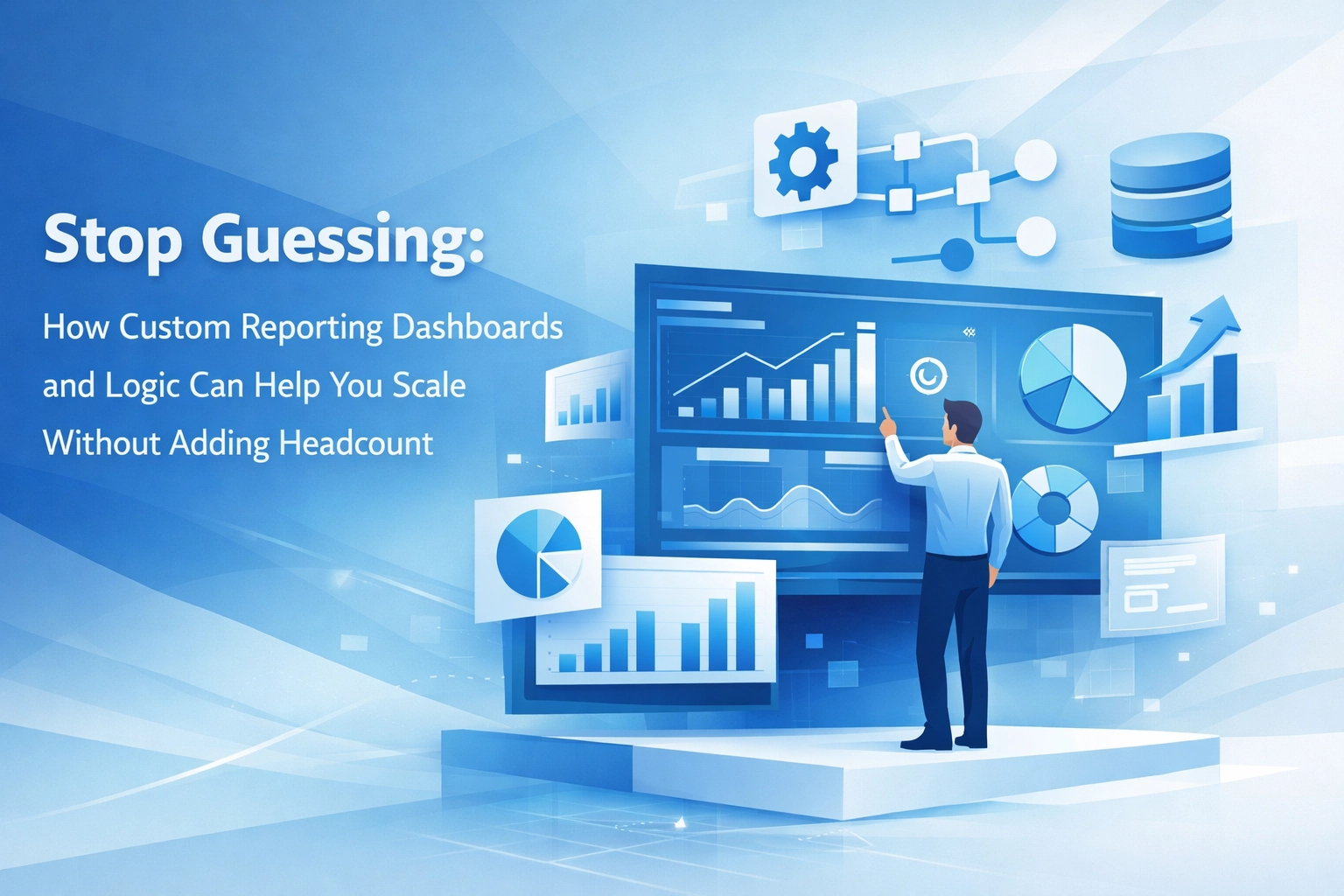
Custom reporting dashboards provide real-time clarity. Unlike off-the-shelf SaaS tools that offer generic metrics, a bespoke dashboard built for your specific operating model tracks the KPIs that actually drive your bottom line.
Strategic Visibility for Every Role
A visionary reporting strategy doesn't just dump data on a screen; it provides role-based governance:
- Executives: See high-level trends, capital efficiency, and long-term trajectory.
- Department Heads: Identify bottlenecks in real-time: such as a sudden drop in call-to-collection rates or a delay in fulfillment cycles.
- Front-line Staff: See their own performance against targets, creating a culture of self-accountability that reduces the need for heavy-handed supervision.
By centralizing this data into a single source of truth, you eliminate the "guessing game." You no longer wonder if a department is underperforming; you see the friction point and can address it before it impacts your quarterly goals.
The Next Frontier: Moving from Reporting to Logic
While dashboards help you see what is happening, Logic helps your systems decide what should happen next. This is where true scalability is born.
Consider the challenge of manual scheduling and task assignment. In many multi-location businesses, a human being has to look at a list of tasks and decide which technician or agent is best suited for the job based on location, skill level, and current capacity. As you scale from 50 tasks a day to 500, this manual intervention becomes a bottleneck.
Custom automation logic removes the human "middleman" from these routine decisions. At Pure Technology Consulting, we specialize in building these types of intelligent engines. Whether it’s a matching engine for healthcare intakes that processes 70-question forms to route patients or a GPS-logged accountability system for door-to-door sales teams, the goal is the same: let the software handle the high-volume, low-context decisions so your people can focus on high-value strategy.

Scaling Without Headcount: The Economic Reality
The most compelling reason to invest in custom logic and reporting is the impact on your EBITDA. Adding headcount is expensive: not just in salary, but in benefits, training, management overhead, and the inevitable "culture tax" that comes with a rapidly growing team.
Bespoke software development is a capital investment that pays dividends by lowering your long-term operating costs. When you automate your assignment logic:
- Response Times Drop: Decisions happen in milliseconds, not hours.
- Errors Are Eliminated: Logic-based systems don't have "off days" or skip steps in a workflow.
- Throughput Increases: Your existing team can process more volume because the "administrative friction" has been removed from their workday.
For instance, in the fintech and debt collection sectors, we’ve integrated complex telephony systems with custom call attribution logic. Instead of a manager manually assigning lead lists, the system routes calls dynamically based on agent performance and debtor profile. The result? Higher recovery rates with the exact same number of agents.
Why "Off-the-Shelf" Often Falls Short
You might wonder why you can't just buy a standard SaaS product to solve these issues. While SaaS has its place, it is designed for the "average" business. If your competitive advantage lies in a unique operational process or a specialized way of handling data, a generic tool will force you to change your process to fit the software.
At Pure Technology Consulting, we believe the software should fit the business, not the other way around. Whether we are building on the foundations of our previous work: like our HIPAA-adjacent healthcare workflows or our fintech telephony integrations: we focus on creating a roadmap that aligns with your specific growth strategy.
Custom builds are not just about "coding"; they are about automation consulting. We look at your current operating model, identify where the manual "glue" is holding things together, and replace that glue with robust, scalable code.

Implementation Strategy: Where to Start
If you are currently feeling operationally constrained, the path forward involves three strategic steps:
- Identify the Friction: Where is your team spending the most time on manual data entry or decision-making? Is it scheduling? Assignment? Reporting?
- Centralize the Data: Break the silos. Create a unified data layer that allows different systems to talk to each other.
- Layer the Logic: Once you can see the data, start automating the decisions. Begin with high-volume, repetitive tasks and move toward more complex workflows.
This transition from a "people-powered" business to a "platform-powered" business is the hallmark of modern industry leaders. It allows you to maintain the agility of a small firm with the output capacity of a giant.
Final Thoughts: Leading with Vision
The decision to invest in custom reporting and logic is a signal that you are moving from a reactive mindset to a visionary one. You are no longer just trying to survive the next surge in volume; you are building an infrastructure that welcomes it.
When your systems are designed to scale, your team is freed from the mundane and empowered to do the work they were actually hired for. You don't need a bigger team; you need a better engine.
If you’re ready to explore how custom software can remove your growth bottlenecks and provide the real-time clarity you need to lead effectively, we invite you to take the next step.
Ready to audit your workflow and identify your scaling bottlenecks?
Book a discovery call with our team to discuss a custom roadmap for your operations.
Amin Said, Founder of Pure Technology Consulting LLC
https://puretechconsult.com
+1 (803) 921-0969