It is Tuesday, March 17, 2026, and the landscape of professional services has shifted fundamentally. We are no longer in the era of "digital transformation" as a buzzword; we are in the era of operational maturity. For years, debt collection agencies, law firms, and accounting practices scaled by doing one thing: hiring more people.
If you had more cases, you hired more paralegals. If you had more debt files to recover, you hired more collectors. This linear growth model: where headcount must increase to match revenue: is officially breaking. The most successful firms in 2026 have realized that their greatest bottleneck isn’t a lack of talent; it’s the "data silo."
At Pure Technology Consulting, we’ve spent years watching service-based businesses struggle with "swivel-chair" operations: the manual process of copying data from a specialized legacy system into a modern CRM or billing tool. In 2026, custom API integration has moved from a "nice-to-have" IT project to a core strategic mandate for any firm that wants to scale without the anchor of a massive, unmanageable payroll.
The Hidden Cost of the "Human Glue"
In most operationally constrained businesses, humans act as the "glue" between disconnected software systems. Think about a typical debt collection agency or a high-volume law firm. They might use one platform for telephony, another for case management, and a third for financial reporting.
Because these systems don't talk to each other, a staff member has to manually update a record in three different places. This leads to:
- Data Latency: Information in your reporting dashboard is always 24–48 hours behind reality.
- Human Error: A missed digit in a debt file or a misspelled name in a legal intake can lead to compliance nightmares.
- Operational Friction: Your best employees spend 40% of their day on administrative data entry instead of high-value client work.
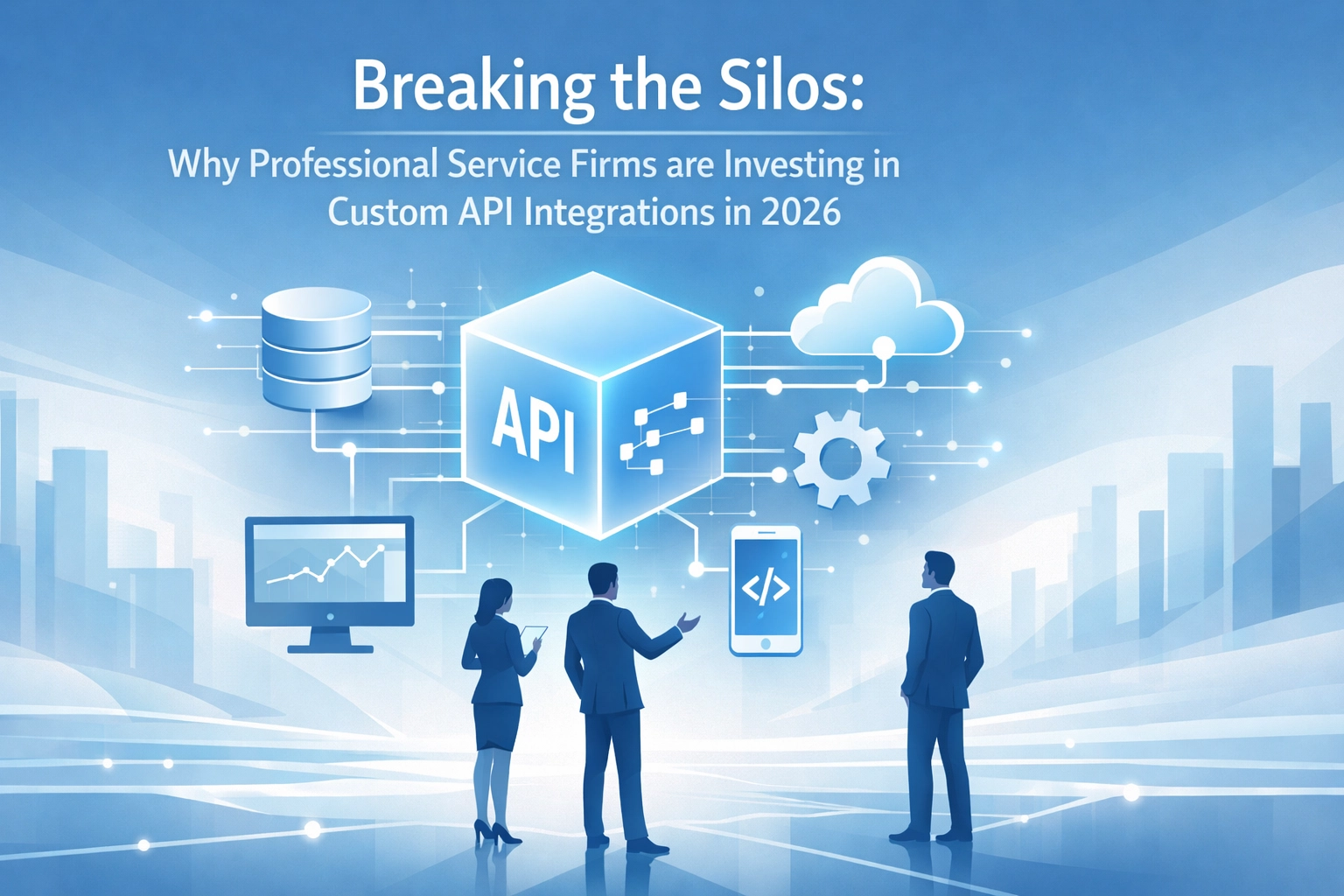
Custom API integrations are the solution to this "Human Glue" problem. By building bespoke bridges between your software stack, you allow data to flow autonomously. When a payment is processed in your fintech portal, the ledger in your case management system updates instantly. No clicks required.

Connecting Legacy Systems to the Modern Era
One of the biggest challenges facing professional services today is the reliance on legacy software. Many debt collection agencies operate on "tried and true" systems built decades ago. These systems are stable and compliant, but they weren't built for the cloud-first, AI-driven world of 2026.
We often see firms try to replace these legacy systems entirely, only to face a multi-year migration project that costs millions and disrupts the business. The visionary approach we take at Pure Technology Consulting is different. Instead of ripping and replacing, we build custom API layers that "wrap" around your legacy systems.
By developing custom connectors, we can feed data from an old-school on-premise database into a modern, bespoke web application or an automated reporting suite. This allows you to keep the stability of your core systems while gaining the agility of modern technology.
For example, we’ve implemented telephony integrations and call attribution for debt agencies that automatically log every interaction back into their legacy databases. This ensures that compliance logs are perfect every time, without requiring a single manual entry from the agent.
Scaling Without Linear Headcount Increases
The ultimate goal of custom integration is operating leverage. In a traditional service firm, if you double your client load, you often have to nearly double your staff. This eats into margins and makes the business increasingly difficult to manage.
In 2026, the winners are those who decouple revenue from headcount.
Imagine a legal firm that handles high-volume intakes. Traditionally, this requires a massive team of intake specialists. By leveraging custom-built matching engines and automated intake workflows: similar to the 70-question HIPAA-adjacent intake systems we’ve built for healthcare providers: a firm can process 10x the volume with the same size team.
The API handles the heavy lifting:
- Collecting the data.
- Validating it against internal rules.
- Pushing it into the document management system.
- Triggering the initial client communication.
This isn't just about saving money; it’s about speed. In 2026, the firm that responds and processes information the fastest wins the contract.

Real-World Proof: Beyond the Hype
We aren't just speculating about these outcomes. Our work across various high-stakes industries has proven that bespoke integration is the key to scaling.
- In Fintech & Debt Collection: We have built systems that integrate disparate telephony platforms with core agency software, ensuring call attribution and GPS logging are seamless and unalterable. This provides a level of rep accountability that is impossible to achieve with manual tracking.
- In Healthcare & Professional Services: Our experience with systems like EHRIO Pro has shown that complex data-matching engines can replace dozens of hours of manual review. When you can automatically match a client’s needs with the right professional or service tier, you eliminate the "discovery" bottleneck.
- In Local Operations: Through our work with tools like AILB (AI Local Boost), we’ve seen how automating Google Business Profile management and local SEO triggers can drive leads directly into a CRM, bypassing the need for a manual marketing-to-sales handoff.
These aren't just "apps": they are custom-engineered operational models. If you’re curious about how this looks in practice, you can view some of our video walkthroughs to see the level of complexity we manage.
What to Integrate First: A Roadmap for 2026
If your firm is currently feeling the weight of operational silos, you don’t need to integrate everything at once. We recommend a strategic roadmap that prioritizes ROI and risk reduction.
1. The Intake/Onboarding Silo
This is usually where the most friction exists. If your client onboarding involves more than two manual steps, it’s a candidate for a custom API integration. Connecting your front-end lead forms directly to your project management or case management tool is the quickest way to see an immediate boost in efficiency.
2. Financial & Billing Integration
Revenue leakage often happens because the people doing the work aren't the ones doing the billing. By integrating your time-tracking or task-completion data directly with your invoicing software, you ensure that every billable minute is captured accurately.
3. Reporting & Governance
In 2026, compliance is non-negotiable. Custom APIs can aggregate data from across your firm into a single "Source of Truth" dashboard. This isn't just for looking at pretty charts; it's for spotting compliance red flags before they become lawsuits.

Why Bespoke Over "Off-the-Shelf"?
You might be wondering: "Can't I just use a tool like Zapier?"
For simple tasks, low-code tools are great. But for professional service firms dealing with sensitive client data, complex regulatory requirements, and high-ticket transactions, "off-the-shelf" isn't enough.
Custom API integrations offer:
- Security & Compliance: You have full control over how data is encrypted and who has access to it. This is vital for HIPAA-adjacent or legal workflows.
- Reliability: Middleware like Zapier can break when an app updates. A custom-built integration is engineered to your specific environment and maintained as part of your core infrastructure.
- Complexity Handling: Standard connectors often can't handle the "if-this-then-that" logic required by a debt agency or a law firm. Custom code allows for nuanced business logic that fits your exact operating model.
The Visionary Path Forward
The "Data Silo" is the silent killer of the modern professional service firm. It hides in the hours your team spends on email, the mistakes in your spreadsheets, and the delay in your client reporting.
As we move further into 2026, the gap between "integrated firms" and "manual firms" will only widen. Integrated firms will have higher margins, happier employees, and the ability to pivot faster than their competitors.
Scaling doesn't have to be painful. It doesn't have to mean a bigger office or a larger payroll. It means building a digital nervous system that allows your business to move as one cohesive unit.
At Pure Technology Consulting, we specialize in helping operationally constrained businesses break through these barriers. We don't just write code; we architect the workflows that allow you to scale.
If you’re ready to see what your firm looks like without the silos, let’s talk. We can conduct a full workflow audit to identify exactly where your data is getting stuck.

Next Steps for Your Firm
- Audit your manual tasks: Where is your team copying and pasting data?
- Identify your "Source of Truth": Which system holds your most valuable data, and which systems are currently disconnected from it?
- Consult with an expert: Don't let a "rip and replace" vendor talk you into a multi-million dollar mistake. Look for a partner who understands how to bridge legacy systems with custom software.
Ready to build the future of your firm? Schedule a discovery call with our team today, and let’s discuss how custom API integrations can transform your operations.
Amin Said, Founder of Pure Technology Consulting LLC
https://puretechconsult.com
+1 (803) 921-0969
Leave a Reply