By Amin Said, Founder of Pure Technology Consulting LLC
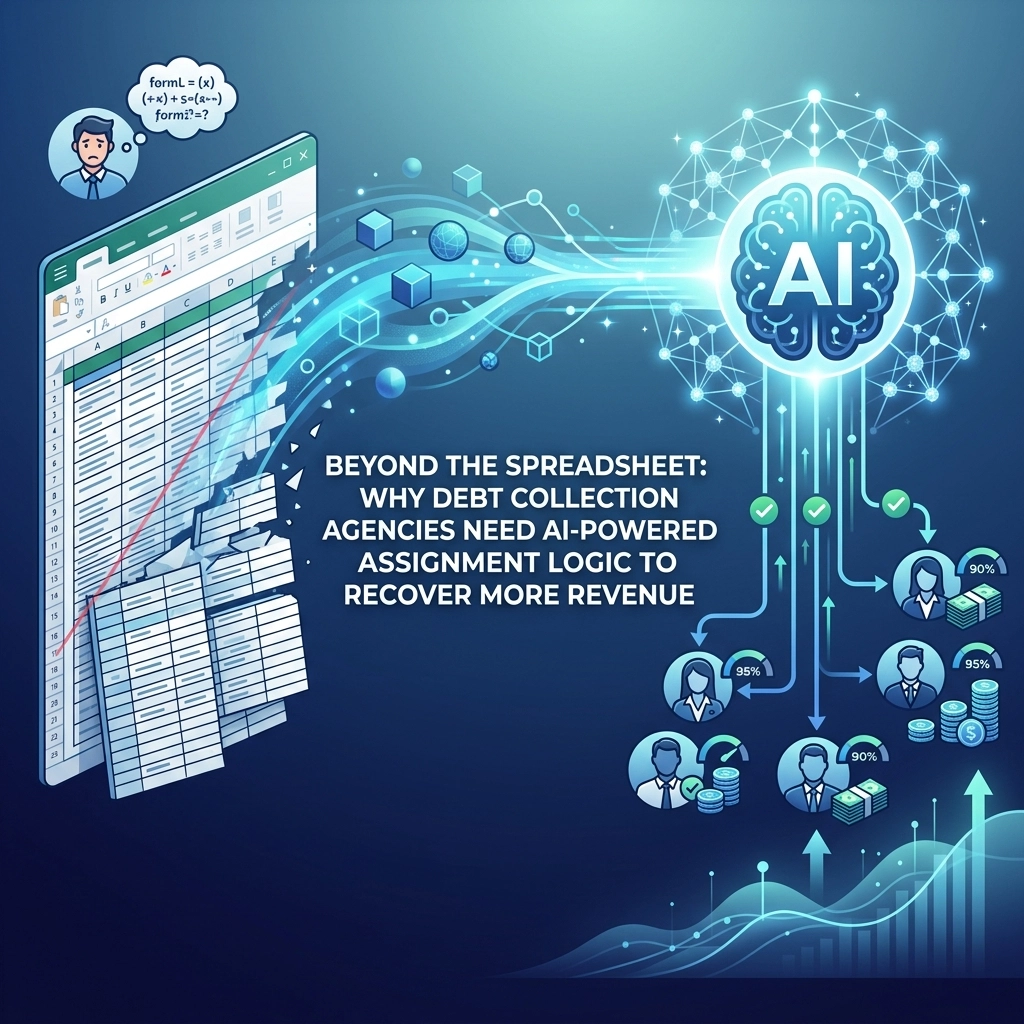
For years, the debt collection industry has relied on a foundational piece of technology that is, quite frankly, past its expiration date for high-volume operations: the spreadsheet.
If you’re running a debt collection agency or a high-volume service operation, you know the drill. You have a massive pool of accounts and a finite number of collectors. The goal is simple: recover as much revenue as possible as quickly as possible. But the method used to bridge those two points is often anything but strategic.
Most agencies still rely on "round-robin" assignments, manual sorting by balance size, or basic filters in a legacy CRM. While these methods worked in a world of lower volume and less data, they are now the primary bottleneck to growth. They create an "invisible ceiling" on your recovery rates.
The future of debt recovery isn't just about dialing more numbers; it’s about dialing the right numbers with the right person at the right time. This is where AI-powered assignment logic shifts from a "nice-to-have" to a strategic necessity.
The Invisible Ceiling of Manual Operations
When you manage your workflow through spreadsheets or basic static rules, you are essentially treating every debtor: and every collector: as an average. But in debt collection, there is no "average."
Every debtor has a unique psychological profile, a different payment history, and varying levels of "propensity to pay." Similarly, every collector in your building has a specific set of strengths. Some excel at high-intensity negotiations; others are better at empathetic, long-term payment plan structuring.
When you use a spreadsheet to dump 500 accounts onto a collector’s desk, you lose the ability to match these nuances. You end up with your best negotiators spending half their day on low-propensity accounts, while your most empathetic collectors are getting hung up on by high-conflict debtors.
This mismatch is where revenue goes to die.

What is AI-Powered Assignment Logic?
Think of AI-powered assignment logic as the "brain" that sits between your database and your communication stack. Instead of a static list, it creates a dynamic, living workflow.
At Pure Technology Consulting, when we talk about custom internal systems for fintech and debt operations, we aren't just talking about a prettier interface. We are talking about a sophisticated engine that analyzes hundreds of variables in real-time to decide which account should be touched next, by whom, and through which channel.
This logic doesn't just look at the balance amount. It looks at:
- Historical Payment Behavior: Did they pay on time three years ago?
- Communication Patterns: Do they answer the phone on Tuesday mornings but never on Friday afternoons?
- Risk Profiling: Based on 100+ variables, how likely is this account to go into default versus a successful settlement?
By building custom software tailored to these specific needs, agencies can move away from "guessing" and start "operating."
1. Intelligent Account Prioritization: Chasing Dollars, Not Pennies
The biggest drain on a collection agency’s ROI is "waste." Waste occurs when a high-value collector spends 20 minutes on a call that had a 2% chance of recovery, while a "hot" account: one with a 90% chance of immediate settlement: sits at the bottom of a spreadsheet.
AI-powered systems use machine learning to generate predictive risk scores. These scores allow your system to automatically bubble the most "recoverable" accounts to the top.
Imagine a system that identifies a debtor who just updated their employment information on a public portal or showed a specific behavioral signal. The AI identifies this "intent to resolve" and immediately moves that account to the front of the queue. This is how you recover revenue that previously would have timed out or been lost in the shuffle.

2. Strategic Collector Matching: The "Skill-to-Account" Fit
One of the most transformative aspects of custom assignment logic is the ability to match accounts to collectors based on historical success rates.
Traditional CRM systems might let you assign by "Region" or "Alphabetical Order." An AI-powered custom build allows you to assign by Performance DNA.
If Collector A has a 40% higher success rate with medical debt accounts over $5,000, and Collector B has a knack for talking down high-conflict debtors in the automotive sector, the system should know that.
By routing accounts to the agents most likely to close them, you aren't just increasing recovery; you’re increasing agent morale and reducing turnover. Collectors feel more successful because the system is feeding them the types of "wins" they are naturally suited to handle.
3. Proactive Intervention and Multi-Channel Routing
In the modern landscape, a "phone-first" strategy is often a losing game. AI-powered logic allows for a sophisticated "if-this-then-that" approach to multi-channel recovery.
Low-risk, high-propensity accounts don't always need a human touch. Your logic engine can route these debtors toward self-service portals or automated AI phone agents. This keeps your human talent focused on the "hard" cases: the ones that require negotiation, empathy, and complex problem-solving.
We’ve seen this work exceptionally well in our previous work with telephony integrations and call attribution. When the system knows exactly why a debtor is calling and who they should talk to before the agent even picks up the phone, the friction of the interaction drops significantly.

4. The Continuous Learning Loop
Unlike a spreadsheet, which is a snapshot of the past, an AI-powered system is a roadmap for the future. Every interaction: every hang-up, every partial payment, every disputed charge: is a data point.
Custom systems built by Pure Technology Consulting are designed to capture these signals and feed them back into the logic engine. If the system predicted an account was "High Propensity" but the collector failed to recover, the AI analyzes why. Was it the timing? The script? The collector?
Over months and years, this feedback loop compounds. Your "recovery engine" gets smarter, your predictions get more accurate, and your cost-per-dollar-recovered continues to drop.
Moving Beyond "Off-the-Shelf" Limitations
Many agencies hesitate to move away from spreadsheets because they feel "stuck" with their current legacy software. They believe that unless a feature exists in their out-of-the-box CRM, it’s not possible.
This is where the distinction of a custom build becomes vital. You shouldn't have to change your successful business processes to fit a software’s limitations. The software should be built to amplify your specific "secret sauce."
Whether it’s building custom middleware that sits on top of your existing database or creating an entirely new workflow automation platform, the ROI of custom logic is measurable. We’ve seen agencies increase their recovery throughput by 20-30% simply by optimizing who gets called when.

The Strategic Path Forward
The debt collection industry is entering a "sophistication war." The agencies that win over the next five years will be the ones that view their operations as a data problem rather than just a volume problem.
If your team is still spending hours every Monday morning manually dividing up accounts in Excel, you are leaving revenue on the table. You are also exposing yourself to compliance risks, as manual processes are far more prone to human error than automated, logic-based systems.
At Pure Technology Consulting, we specialize in building the custom web applications and automation engines that allow high-volume service operators to scale without adding massive headcount. From healthcare intake engines like EHRIO Pro to fintech-focused telephony stacks, our goal is to bring high-level technical strategy to industries that have been underserved by "generic" SaaS.
Ready to Audit Your Workflow?
Recovering more revenue doesn't always require more collectors. Often, it just requires a better way to direct the collectors you already have.
If you’re ready to see how custom AI-powered assignment logic can be integrated into your current stack, let’s talk. We don't just build software; we build operating models that drive bottom-line results.
- Explore our capabilities: View our Video Walkthroughs
- Review our approach: Pure Technology Consulting Terms of Use
- Schedule a Strategy Session: Book a discovery call here
Amin Said, Founder of Pure Technology Consulting LLC
https://puretechconsult.com
+1 (803) 921-0969
Leave a Reply