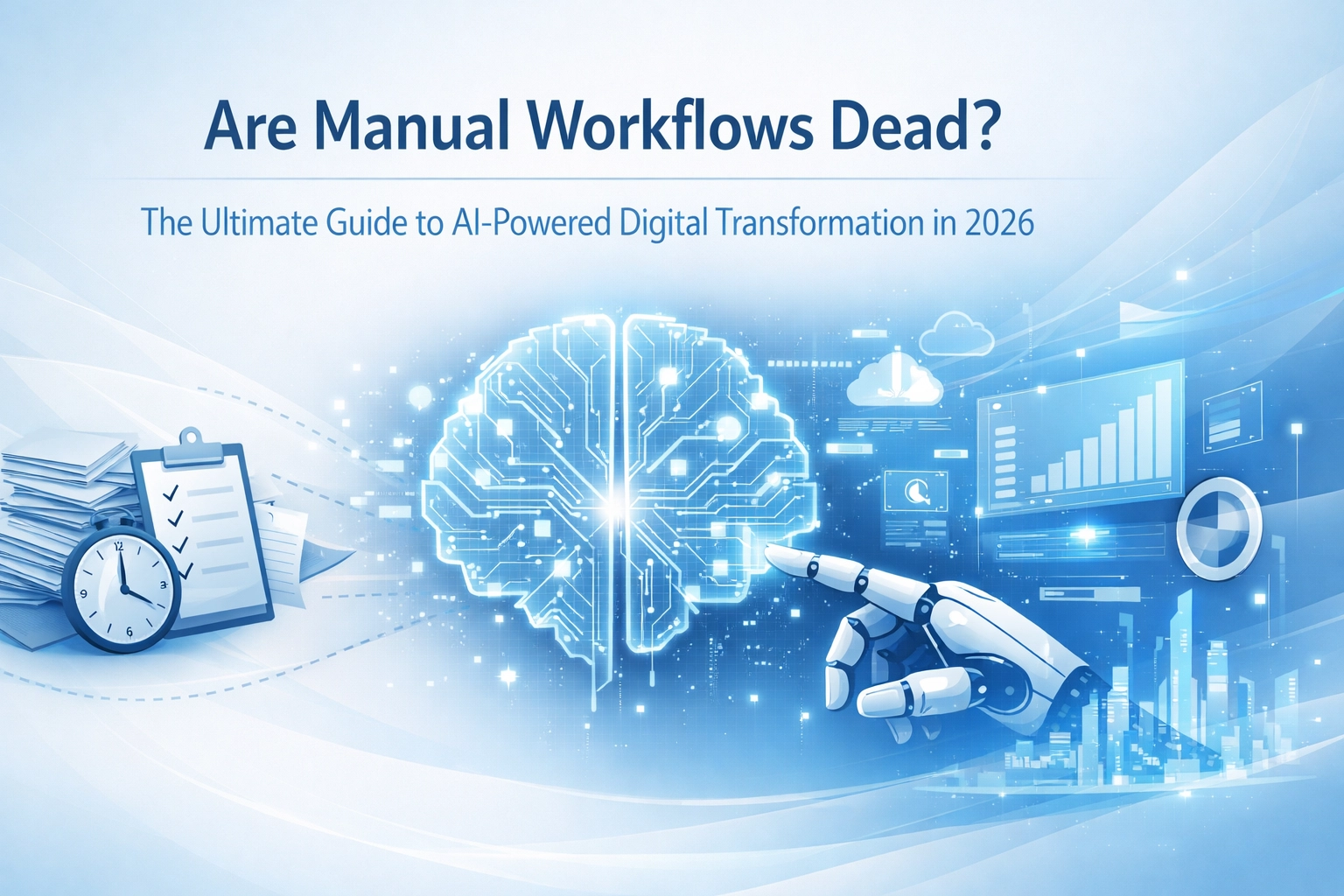
As we navigate the landscape of 2026, the question for executives is no longer "Should we automate?" but rather "How much of our competitive advantage is being eroded by manual legacy processes?"
The era of the "drudge work" is ending. We have reached a tipping point where manual workflows are becoming a strategic liability. In the high-stakes worlds of legal, accounting, and healthcare, the friction of manual data entry, physical document routing, and rule-based decision-making is more than an inefficiency: it is a barrier to scale. At Pure Technology Consulting, we view digital transformation not as a buzzword, but as the fundamental re-architecting of how a business generates value.
The Extinction of the Repetitive Task
The data in 2026 is clear: manual workflows aren't just slowing you down; they are costing your team approximately 40% of their productive time. When we look at the specific categories of work being eliminated, we see a pattern. Routine approvals, invoice handling, and structured data entry are being transitioned into the background.
The objective of AI-powered automation is not to replace the human element, but to reposition it. When a finance team no longer spends days on invoice processing, they spend that time on capital allocation and risk strategy. When an HR department automates the 70-question intake process for new hires, they can focus on culture and talent retention.

Case Study in Precision: FTP Inform
At Pure Technology Consulting, we believe that the most visionary solutions often address the "invisible" layers of a business. Consider FTP Inform. In many enterprise environments, FTP (File Transfer Protocol) remains a backbone for secure data exchange, yet it is often a "black box" of manual monitoring.
We built FTP Inform to demonstrate how legacy protocols can be brought into the era of AI-powered transformation. Instead of having an IT staffer manually verify file arrivals or troubleshoot failed transfers, FTP Inform provides real-time event-driven intelligence. It represents our approach to custom software development: taking a critical business function and adding a layer of autonomous oversight that ensures compliance and operational continuity without human intervention.
The Three Pillars of 2026 Digital Transformation
To move beyond the manual, organizations must adopt a roadmap built on three technological shifts that have matured over the last year.
1. Large-Scale Reasoning Engines
The Large Language Models (LLMs) of 2026 are no longer just "chatbots." They are reasoning engines capable of handling unstructured data: contracts, complex emails, and nuanced customer feedback: with a level of context-dependent decision-making that previously required a senior associate.
2. Event-Driven Architectures
Modern workflows no longer wait for a human to press "go." They are triggered by business events. A new lead enters the CRM, a stock level drops below a threshold, or a server logs a specific error: and the system reacts instantly. This real-time response capability is the difference between a reactive business and a proactive market leader.
3. Autonomous AI Agents
Multi-agent systems now break down complex projects into smaller, verifiable steps. These agents operate within tools: your ERP, your custom web app, your accounting software: performing actions and only flagging exceptions for human review.

Scaling Visibility: AI Local Boost
Digital transformation isn't limited to internal operations; it extends to how a brand communicates with its local market. Many firms, especially in the legal and accounting sectors, struggle with the manual burden of maintaining a consistent digital footprint.
Through AI Local Boost, we’ve demonstrated our capability to automate high-level marketing operations. By leveraging AI to manage Google Business Profile updates and local SEO signals, we eliminate the need for manual content scheduling. This isn't just about "posting"; it's about using intelligent automation to ensure that when a potential high-ticket client searches for your expertise, your digital presence is optimized and current, all while your team focuses on billable hours.
Why Custom Architecture Beats "Off-the-Shelf" SaaS
While the market is flooded with subscription-based tools, visionary leaders are realizing that $10k+ custom web applications provide a higher ROI than a dozen disjointed SaaS subscriptions. Why? Because bespoke software fits your operations, rather than forcing your operations to fit the software.
When we engage with clients for custom development at Pure Technology Consulting, we look for the "bottlenecks of judgment." These are the places where a manual process exists because "the software can't handle our specific rules."
Our experience in healthcare: specifically with the EHRIO Pro matching engines and HIPAA-adjacent workflows: has taught us that the most complex logic can, and should, be automated. We bring this same level of rigor to the legal and accounting fields. If your firm requires a 70-question intake process, we don't just give you a form; we build a matching engine that triages those responses and routes them to the correct department with an AI-generated summary.
Strategic Integration: ChainHQ and EHRIO Pro
The sophistication of our proprietary builds, such as ChainHQ and EHRIO Pro, serves as a testament to what is possible when you move beyond manual workflows.
- ChainHQ demonstrates our ability to handle complex supply chain and project management logic.
- EHRIO Pro showcases our expertise in building high-security, high-logic matching systems for the healthcare sector.
For an accounting firm or a legal practice, this means we can build custom platforms that integrate with existing telephony (like our work with debt agencies for call attribution) or GPS logging (as seen in our D2D Tracking solutions). We aren't starting from scratch; we are applying proven, enterprise-grade capabilities to your specific operational model.
The Roadmap to 2027: How to Start
If you are currently overseeing a team that spends more than 20% of its time on "data movement," you have a transformation opportunity. The transition away from manual workflows is a phased journey:
- Workflow Audit: Identify the high-volume, low-complexity tasks that consume the most hours.
- Architecture Scoping: Determine where custom software can integrate your existing tools into a single, automated ecosystem.
- Deployment of Intelligent Layers: Implement autonomous agents or event-driven triggers to handle the routine.
- Governance and Human-in-the-Loop: Establish the oversight protocols where humans review the "exceptions" flagged by the AI.
The goal is to create an operating model where your staff are supervisors of systems, not manual laborers within them. This shift increases individual worker performance by double digits and allows your organization to scale without a proportional increase in headcount.

Final Thoughts: The Cost of Hesitation
In 2026, the competitive gap between automated firms and manual firms is widening into a canyon. Those who invest in custom, AI-powered digital transformation are operating faster, cheaper, and with a level of precision that manual processes simply cannot match.
At Pure Technology Consulting, we specialize in building the custom web applications and bespoke automations that power this transition. Whether it is secure data transfer through FTP Inform or a complex matching engine for a professional services firm, our focus is on delivering high-ticket, high-impact results.
If you are ready to audit your current workflows and explore what a bespoke automation roadmap looks like for your organization, we invite you to schedule a discovery call. Let’s move your business from manual drag to automated leverage.
Amin Said, Founder of Pure Technology Consulting LLC
https://puretechconsult.com
+1 (803) 921-0969
Leave a Reply