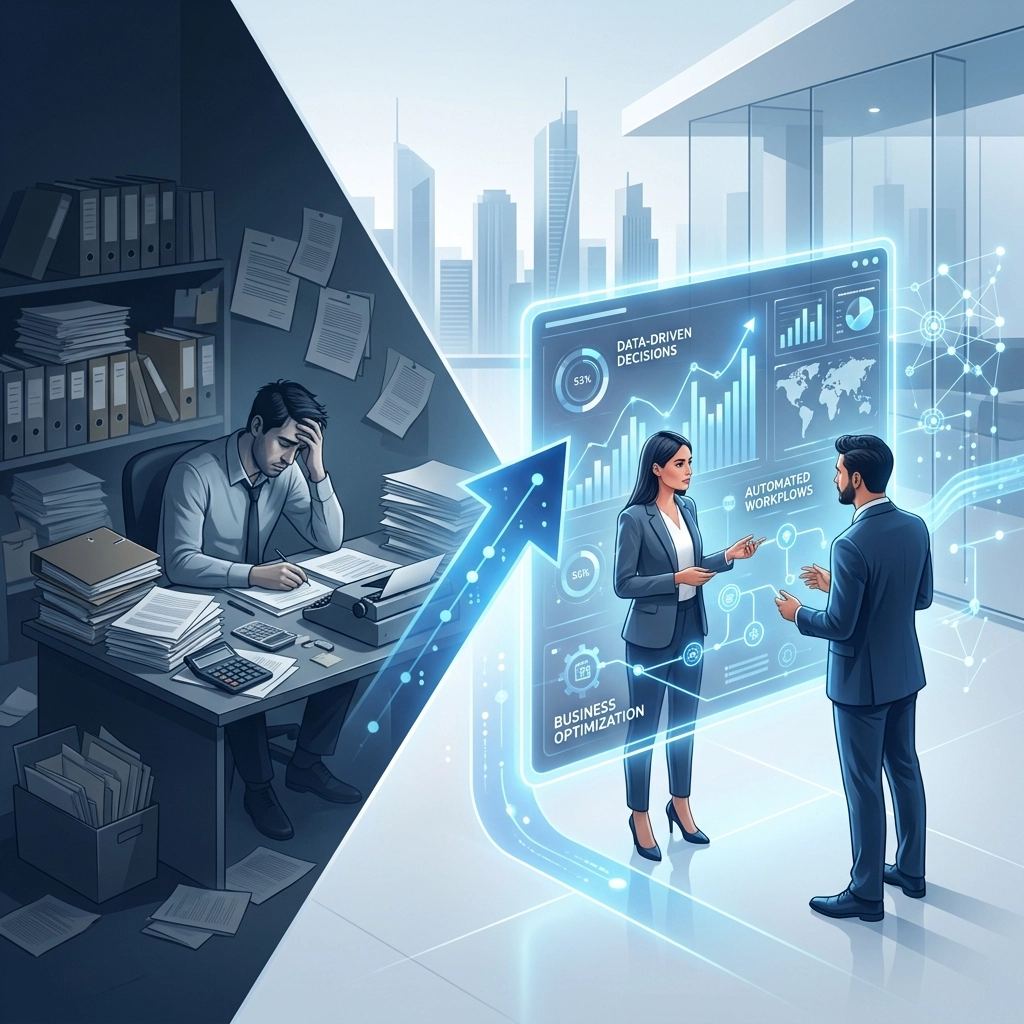
For decades, "manual" was a synonym for "thorough." In law firms, accounting practices, and healthcare organizations, the human touch was the gold standard for accuracy and trust. But as we move deeper into 2026, the landscape has shifted. Today, manual processes are increasingly seen as a liability: a bottleneck that introduces risk, drains morale, and hemorrhages capital.
At Pure Technology Consulting, we’ve watched this transition unfold across multiple industries. We are no longer asking if a business should automate; we are asking how fast they can transition to an automated operating model before their competitors leave them in the dust. The "New Standard" isn't just about buying a piece of software; it’s about strategic automation consulting that re-architects how work actually happens.
The Invisible Tax of Manual Work
The data is becoming impossible to ignore. Research shows that manual data entry errors cost an average of $4.70 per instance. When you multiply that by thousands of entries across a fiscal year, the "invisible tax" on your operations becomes a significant line item. In the United States alone, poor data quality: largely driven by manual handling: contributes to a staggering $75 billion loss annually.
But the cost isn't just financial. It’s a talent drain. Over 40% of workers spend at least a quarter of their week on repetitive, low-value tasks. In high-stakes fields like legal and accounting, having a senior associate or a CPA spend hours on manual reconciliation or data migration isn't just inefficient; it’s a recipe for burnout. These professionals want to solve complex problems, not copy-paste data between spreadsheets.

Why Software Alone Isn’t the Solution
Many executives make the mistake of thinking automation is a product you buy off the shelf. They subscribe to a dozen SaaS tools, only to find their team is now doing "manual work 2.0": manually moving data between those very tools.
This is where Business Process Automation Consulting differentiates itself. It’s not about the tool; it’s about the architecture. When we engage with a client for a custom web app or a complex automation roadmap, we look at the entire lifecycle of a data point.
- Where does it originate?
- Who needs to validate it?
- What compliance frameworks (like HIPAA or SOC2) govern it?
- Where does it need to end up to trigger the next stage of the workflow?
We don't just "add AI." We build bespoke systems that act as the central nervous system for a business.
Authority Anchors: Proven Capabilities in High-Stakes Sectors
At Pure Technology Consulting, we don’t start from scratch. We bring proven frameworks from highly regulated industries and apply them to the legal and accounting sectors. Our proprietary solutions serve as proof-of-concept for what’s possible with custom development.
For instance, our work in healthcare with EHRIO Pro involved building complex matching engines and 70-question intake forms that manage HIPAA-adjacent workflows with surgical precision. We’ve taken that same logic of "complex data validation" and applied it to legal intake and accounting audits. If we can handle the life-and-death accuracy required in healthcare tech, we can certainly handle the rigorous documentation required in a law firm.
Similarly, our experience with FTP Inform showcases our ability to handle secure, automated data transmission and monitoring at scale. In an era where data breaches are a constant threat, having an automated, monitored pipeline for sensitive files is no longer a luxury: it’s a foundational requirement for any modern enterprise.

The Roadmap to Automation: A Consultative Approach
When we sit down with a CEO or a Managing Partner, we aren't looking to sell a subscription. We are looking to build a multi-year asset. Our engagements, often starting at $10k+ for scoped consulting and bespoke builds, follow a rigorous strategic roadmap:
- Workflow Audit: We identify the "friction points" where manual work is causing delays or errors.
- Gap Analysis: We look at your current tech stack and identify where data is "falling through the cracks."
- Bespoke Architecture: Instead of forcing your business to fit into a SaaS box, we build a custom web application or integration layer that fits your specific operations.
- AI Integration: We leverage AI not as a chatbot, but as a processing engine: using it for document summarization, predictive analytics, and automated categorization.
- Governance & Scaling: We ensure the system is compliant, secure, and ready to grow with your firm.
Case Study: From Debt Telephony to Legal Ops
Our background in Fintech and debt agency telephony integrations has taught us the value of "call attribution" and automated logging. We’ve taken those lessons in rep accountability and GPS logging: originally developed for field operations like D2D Tracking: and moved them into professional service environments.
Imagine a legal practice where every client interaction, every document update, and every filing deadline is tracked and logged automatically without a single minute of manual entry from the attorney. That’s the level of operational leverage we provide. It’s about moving from a reactive "catch-up" mode to a proactive, visionary stance.
The AI Local Boost: Automating Growth
Automation isn't just for back-office operations; it’s for market positioning too. Our AI Local Boost product demonstrates how we use Google Business Profile automation to ensure our clients maintain a dominant local presence without manual intervention. By automating the "growth" side of the business, leaders can focus on the "delivery" side, knowing their pipeline is being managed by intelligent systems.

Is Manual Work Truly Dead?
While a human will always be needed for final decision-making and high-level strategy, the era of the "manual workflow" is effectively over for any business that wants to remain competitive. AI-powered automation achieves 99% accuracy compared to the 85-95% average for human work. It doesn't sleep, it doesn't get bored, and it doesn't make "copy-paste" errors after a long day.
The companies that thrive in the next five years will be those that view automation as a core pillar of their strategy, not an IT afterthought. They will be the ones who invest in custom solutions that provide a unique competitive advantage, rather than relying on the same generic tools as everyone else.
Your Path Forward
Transitioning away from manual processes can feel daunting. There are legacy systems to consider, team cultures to navigate, and data security risks to mitigate. That’s why we don't just deliver code; we deliver a strategy.
If you are ready to eliminate the operational drag of manual processes and build a scalable, automated future, let’s start a conversation. My assistant, Emily, can help coordinate a discovery call where we can audit your current workflows and identify the highest-impact opportunities for bespoke automation.
We aren't just building apps; we’re building the future of how your business operates.
Ready to see what custom automation can do for your firm?
Book a discovery call with our team or call us directly at +1 (803) 921-0969.
Amin Said, Founder of Pure Technology Consulting LLC
https://puretechconsult.com
Leave a Reply