Amin Said, Founder of Pure Technology Consulting LLC
https://puretechconsult.com
Composite case study notice: This illustrative scenario combines common field service operating patterns. It does not describe a named client or report measured results.
The operating challenge: growth across locations, fragmented coordination
Consider a contractor group with about ten franchise or dealer locations handling equipment installations and ongoing HVAC and refrigeration service. Each location has its own technicians, customers, service area, and day-to-day priorities. Group leadership needs a reliable view across the operation, but work is coordinated through paper work orders, shared spreadsheets, and text messages.
As the group expands, territory and lead ownership become harder to resolve informally. A new request may appear to belong to more than one location. Dispatchers call each other to confirm ownership, while job handoffs and schedule changes depend on someone seeing a message at the right time. Customer and equipment history can be scattered across records, and leadership has limited visibility into aging requests or warranty follow-ups.
The first response is often to add a shared inbox or a generic project management tool. Both can help with basic communication and task tracking. But they do not necessarily represent the operational rules behind a multi-location field service business: who owns a lead, which territory applies, what skills a job requires, and what information must be captured before work is considered complete.
The result is often more digital coordination without a dependable operating model. A purpose-built custom web application development engagement can instead bring routing, dispatch, field documentation, and reporting into workflows designed around how the group actually works.

A shared platform with clear location boundaries
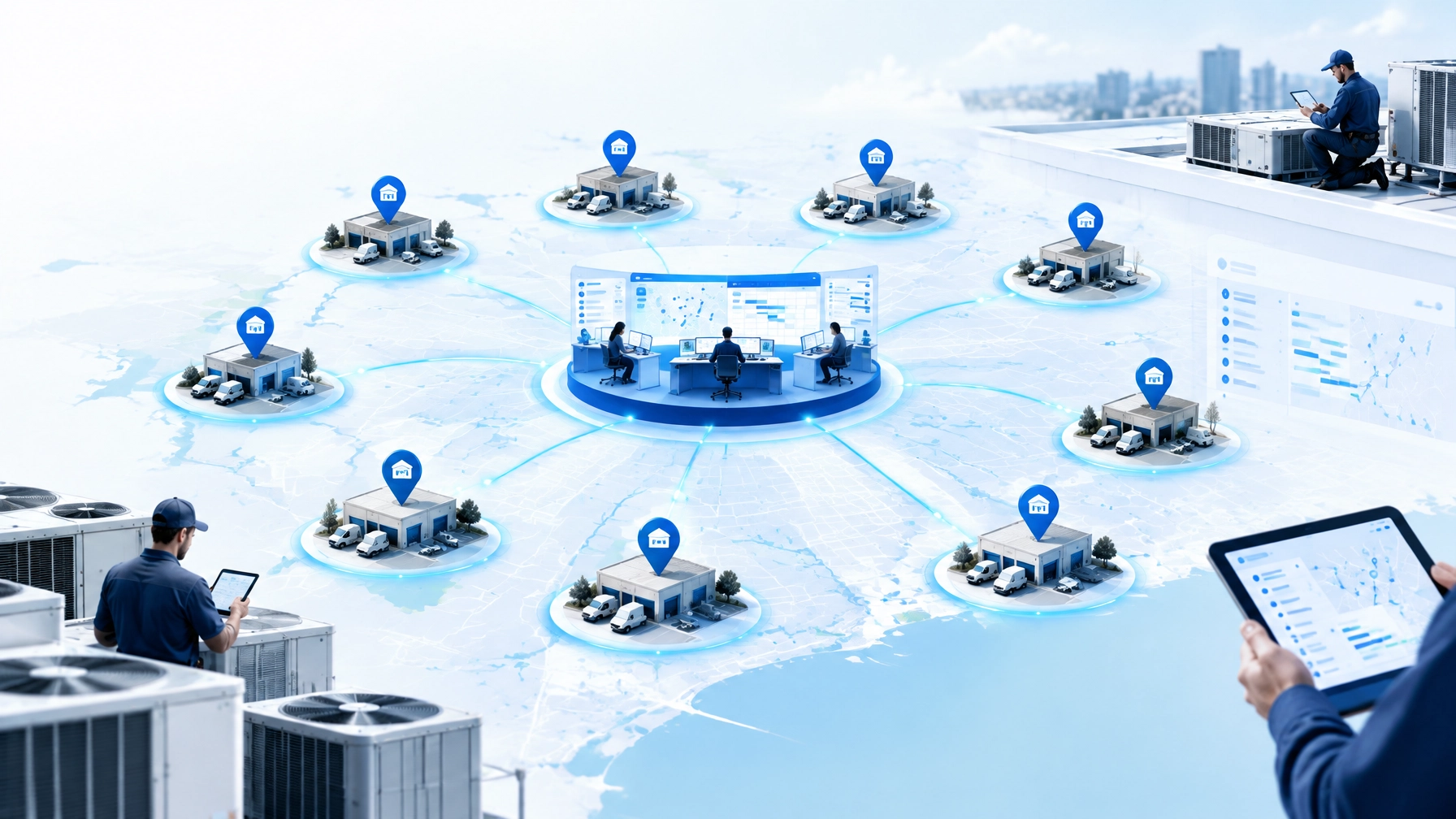
The proposed platform would give each location a dedicated operational workspace. Its technicians, territories, customers, price book, and job history remain associated with that location. Group leadership can access cross-location reporting through defined permissions, without treating every location's working data as one undifferentiated pool.
This is a multi-tenant model: multiple locations use shared platform logic, while tenant-aware access controls keep location data appropriately separated. Architecture decisions would address identity and permissions, data boundaries, reporting access, auditability, and how shared services handle each location's records.
Microsoft's Azure Architecture Center guidance on multitenant solutions is a useful reference for understanding the considerations involved. It is a reference architecture, not an endorsement of any specific technology stack. The right implementation depends on business requirements, risk, scale, and the degree of isolation each tenant needs.
Intake and routing that make ownership visible
A customer request should enter through a structured intake workflow, capturing the service location, equipment details where available, issue description, urgency, and preferred scheduling window. Routing rules then assign the request to the owning location based on defined territories and lead-ownership rules.
The important design choice is not only to automate routing, but to make the decision understandable. The record should show why a request was routed to a particular location, such as a territory match or an agreed ownership rule. If territories overlap or two locations claim a lead, the request should move to a defined escalation path for review. Authorized staff can resolve the dispute, document the decision, and preserve an audit trail.
That approach turns ownership from an informal phone conversation into a governed business process. It also gives operators a basis for refining rules as the group adds locations or adjusts its service areas.
Dispatch built around the work on the ground
Each location would have its own dispatch board showing unassigned, assigned, in-progress, and completed work. Dispatchers could assign technicians based on availability, scheduling windows, and skill or certification notes relevant to the equipment and work requested. The board would make the current state visible without requiring staff to piece it together from spreadsheets and messages.
A usable workflow must also handle exceptions. If a technician calls out, the dispatcher needs to identify impacted jobs and reassign or reschedule them. If a job runs over, the board should help show downstream schedule conflicts and support communication with affected customers. The system should record changes so the next person handling the job can see what happened.
For field staff, the technician workflow should be mobile-friendly. A technician should be able to review assigned work, update status, and access relevant job information from a phone or tablet without returning to an office-based process.

Job files, accounting handoffs, and management visibility
A job file can bring together the details needed to complete and review work: equipment make, model, and serial number; installation notes; photos captured in the field; completion checklists; and references to warranty documentation. This creates a consistent place to record what was done and what follow-up may be required.
When a job is complete, a defined event or export can hand the relevant information to accounting for invoicing. That handoff might use agreed files or APIs, depending on the existing accounting environment. The design should not imply a certified accounting integration unless one has been confirmed. Where the accounting process makes status available, the platform could display it to help staff see whether a job has progressed toward invoicing.
A management dashboard could provide a cross-location view of jobs by stage, aging unassigned work, directional technician utilization, and warranty follow-ups due. The dashboard is intended to support operational decisions, not to replace local dispatch judgment. Location-level access and group-level visibility should be designed deliberately.
Why custom software instead of an off-the-shelf tool?
Generic field service software can support common work-order and scheduling needs. But in this scenario, territory and lead ownership rules are central to how the group operates. Those rules may span locations, franchise or dealer relationships, and overlapping claims. A generic field service or project management tool may not model group-level ownership in the way the business requires.
The decision is not that custom software is automatically better. It is whether the operating rules are important enough that adapting the business to a generic tool would add friction, workarounds, or ambiguity. A custom software development agency can scope the workflows, permissions, integrations, and reporting around those requirements rather than assuming one standard process fits every location.
A discovery and architecture phase would clarify how much should be standardized across the group and where locations need flexibility. Typical deliverables could include a workflow map, tenant and permission model, routing rules, dispatch experience, integration requirements, and a phased implementation roadmap. This is the kind of work that can sit within broader enterprise automation consulting and business process automation consulting engagements. Pure Technology Consulting's web development work provides more context on its custom web application capabilities.
Where AI can assist, and where people decide
AI may help surface recurring failure patterns by equipment model or territory, or summarize technician notes so managers can review trends more efficiently. These are focused examples of ai workflow automation and bespoke AI solutions: support for recognizing and organizing information already captured in the workflow.
Assignment decisions and ownership disputes should remain with authorized people. AI-generated summaries or patterns should be presented as decision support, not as a substitute for operational rules, technician expertise, or management judgment. This approach keeps ai-powered business systems grounded in accountable processes.
Objectives, not measured results
For this illustrative scenario, the goals of the proposed platform would be:
- Shorter dispatch cycles by reducing time spent clarifying ownership and locating job status.
- Fewer lead disputes through visible routing rules and a documented escalation path.
- Cleaner warranty documentation through consistent job files and field capture.
- More useful management visibility across locations without removing local operating control.
These are objectives for a potential engagement, not measured results or claims about a named client.
Field experience and a practical next step
The operational patterns described here align with PTC's broader field services experience, including work on D2D Tracking for rep accountability and GPS logging. That work is a proof-of-concept of custom build capability, not a field service product being offered for sale. The same design discipline applies: represent real operating rules clearly, capture activity in context, and make information useful to the people responsible for the work.
A multi-location service platform succeeds when its architecture reflects the way the business assigns ownership, dispatches work, documents outcomes, and governs access. If these questions are relevant to your operation, you can book a discovery call, no obligation to discuss the workflows and scope.
Amin Said, Founder of Pure Technology Consulting LLC
https://puretechconsult.com
+1 (803) 921-0969
Leave a Reply