Amin Said, Founder of Pure Technology Consulting LLC
https://puretechconsult.com
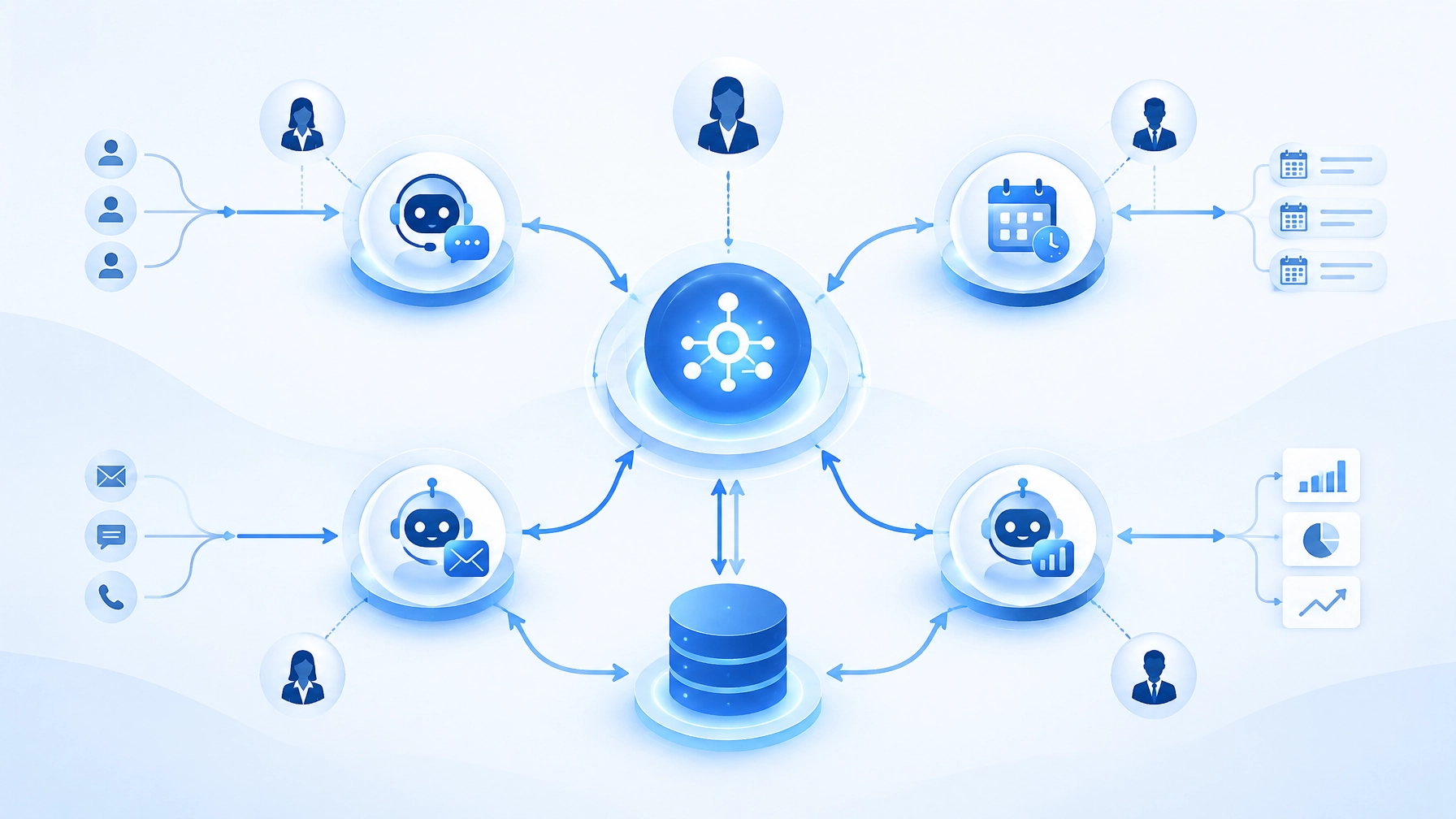
A service business may begin with one useful automation: sorting inquiries, drafting a follow-up, or routing a request to the right location. As the business grows, separate agents may take on intake, scheduling, customer communications, and reporting. Each can be useful on its own. Together, without a shared operating structure, they can create a new kind of complexity.
The central challenge is not simply building more capable agents. It is deciding how they work together, what authority each one has, and how the business stays informed when an action goes wrong. That orchestration layer is what turns separate automations into dependable AI-powered business systems.
Why scattered agents become difficult to manage
An intake agent might classify a new request. A scheduling agent might suggest an appointment. A follow-up agent might send a message if the request goes unanswered. If those agents rely on separate records, rules, or assumptions, one action can undermine the next. A change made in one system may not reach another, and an error can travel further than the team can easily trace.
For multi-location operators and professional services firms, that risk is also an operational concern. A workflow may affect customer commitments, sensitive information, staff capacity, or the way work is assigned across locations. Adding more AI workflow automation without clear ownership can make it harder to answer basic questions: What happened? Why did the system act? Who can stop it?
The answer is to design the whole workflow as a governed system. Agents should be specialized workers inside it, not free-floating assistants with broad authority.
What should the orchestration layer own?
A workflow or orchestration layer should be the system that owns the state of each case: what has happened, what needs to happen next, and whether a person needs to review it. Individual agents can perform bounded tasks, such as summarizing an inquiry or proposing appointment options, but the workflow layer coordinates handoffs and records progress.
For example, a new inquiry might move through defined stages: received, classified, reviewed, ready to schedule, scheduled, and closed. An intake agent can help organize the information. A scheduling agent can suggest options based on availability and service rules. The orchestration layer ensures the work moves to the appropriate next step and retains a coherent record.
This approach also makes integrations easier to reason about. Rather than allowing each agent to connect independently to every tool, a business can mediate access through defined workflow steps and approved integrations. That creates a clearer foundation for bespoke AI solutions and custom software development, especially when existing CRM, scheduling, billing, or intake systems do not share a common operating model.
How should decision boundaries be set?
Not every action needs the same level of human involvement. But the boundary should be based on the consequence of an error, not on how confident a model sounds.
A routine, reversible task may be suitable for bounded autonomy. An action that affects a customer commitment, sensitive data, money, or a consequential service decision may need a person to review it first. Some decisions should remain human-only, with AI limited to gathering information or preparing a recommendation.

A practical design can distinguish three types of work:
- Autonomous: The agent completes a low-impact, well-defined task within approved rules.
- Recommend, then approve: The agent prepares an action and supporting context; an authorized person reviews it before execution.
- Human-only: A person makes the decision, while AI may assist with information gathering or documentation.
For each boundary, define what the agent can access, which actions it can take, what conditions require a pause, and where an exception should go. For instance, an agent might prepare a routine follow-up but route an unusual or sensitive request to staff rather than sending an unreviewed response.
This principle is especially important in healthcare-related workflows. PTC’s work on clinician matching and intake systems, including EHRIO and Thrive proof-of-concept capabilities, demonstrates how structured information and explainable recommendations can support routing while leaving the final decision with a human. A related case study on clinical intake and provider matching describes this kind of custom system design.
What should an audit trail capture?
Oversight requires more than a record of the final outcome. A useful audit trail should help an operator reconstruct the sequence: what triggered the workflow, what information was available, what the agent proposed, which rule was applied, and what happened after approval or execution.

The detail recorded should suit the workflow and the sensitivity of its data. At a minimum, teams should be able to trace key actions, handoffs, approvals, exceptions, and outcomes. Where appropriate, that includes the relevant workflow version and the source of the information used. Logging should be designed alongside data access and retention controls, not added as an afterthought.
The NIST AI Risk Management Framework is a useful voluntary reference for organizations developing risk controls across the design, deployment, and use of AI systems. It is a governance resource, not a certification or endorsement of a particular implementation.
PTC brings related experience from multiple operational settings. For example, debt agency telephony integrations with call attribution illustrate the importance of connecting events across systems. Multi-location clinic intake automation highlights how structured information and clearly routed exceptions can support staff workflows. These are proof points for custom development and integration capabilities, not standalone products being offered for purchase.
How can failures be contained?
A reliable system assumes that an agent, an integration, or a downstream service may fail. The goal is to keep one failure from triggering a chain of unintended actions.
Start by making important actions safe to retry. If a workflow pauses and resumes, the system should be designed to avoid sending the same message or creating the same record twice. Add limits on retries and define what happens when a required service is unavailable. If the system cannot verify that an action is safe, it should pause or send the case to a human queue rather than continue on assumption.
Containment also depends on having a clear way to stop work. Teams should know who can pause an agent or workflow, how exceptions are reviewed, and how an interrupted task can be reconciled before it resumes. These controls turn failure handling into part of the operating model rather than an emergency improvisation.
When should autonomy expand?
A staged rollout gives a business a way to test the system before granting it more authority. Begin in shadow mode: agents analyze cases and propose actions, while staff continue to make the decisions and complete the work. Compare the recommendations with real operating needs, review edge cases, and identify where rules or integrations need adjustment.
If the workflow performs as intended, autonomy can expand in controlled steps. A low-risk action might move from recommendation to execution under defined limits, while higher-consequence decisions remain subject to approval. Autonomy is earned by action type and workflow, not granted to an agent everywhere at once.

What does good look like in practice?
In a well-designed system, staff can see where each case stands and why it reached that point. Agents have narrow responsibilities. Decisions with meaningful consequences have clear approval paths. A failure produces a contained exception rather than an invisible cascade, and the business can review what happened afterward.
The same structure helps leadership decide what to automate next. Instead of asking only whether an agent can perform a task, operators can ask whether the workflow is well understood, whether its data and rules are reliable, and whether its risks can be monitored. That is a more durable basis for enterprise automation consulting, business automation consulting, and broader digital transformation consulting than adding isolated tools one at a time.
Pure Technology Consulting applies these principles through custom software development, integrations, and workflow design for service businesses and SaaS licensing partners. As a custom software development agency, PTC focuses on building systems that fit the organization’s operating model, with the governance and human oversight the work requires. Learn more about custom web development capabilities or read about a practical AI workflow automation framework.
A practical next step
Start with one workflow that matters to the business, such as intake, scheduling, follow-up, or reporting. Map its current steps, systems, decision owners, and common exceptions. Then identify which actions are suitable for autonomy, which require approval, and what evidence the team will need to oversee the process.
If you are considering a move from isolated automations to a coordinated system, book a discovery call to discuss the workflow, integrations, and oversight model that fit your organization.
Pure Technology Consulting
Phone: +1 (803) 921-0969
Amin Said, Founder of Pure Technology Consulting LLC
https://puretechconsult.com
Leave a Reply