By Amin Said, Founder of Pure Technology Consulting LLC
Multi-location growth depends on more than creating content. Each location needs accurate profile information, timely updates, appropriate review responses, and a consistent brand experience. As the location count grows, coordinating those responsibilities manually becomes an operational challenge.
AI Local Boost is Pure Technology Consulting’s proprietary platform for governing local SEO workflows across Google Business Profile locations. We built it as a proof of concept for a broader capability: designing and delivering complex custom web applications that connect business rules, people, and external systems in a scalable operating model.
The operational problem: local execution without shared visibility
A service brand may have dozens of profiles managed by a mix of headquarters staff, regional managers, and local teams. Without a coordinated workflow, routine work can become fragmented:
- Staff prepare and publish posts separately for each location.
- Review responses vary in tone and may bypass brand review.
- Profile details drift across locations or are difficult to verify centrally.
- Managers lack a clear view of what is drafted, awaiting approval, or complete.
The result is not simply more administrative work. It is reduced governance over how the brand appears locally, and limited visibility for leaders who need to understand whether core workflows are being completed.
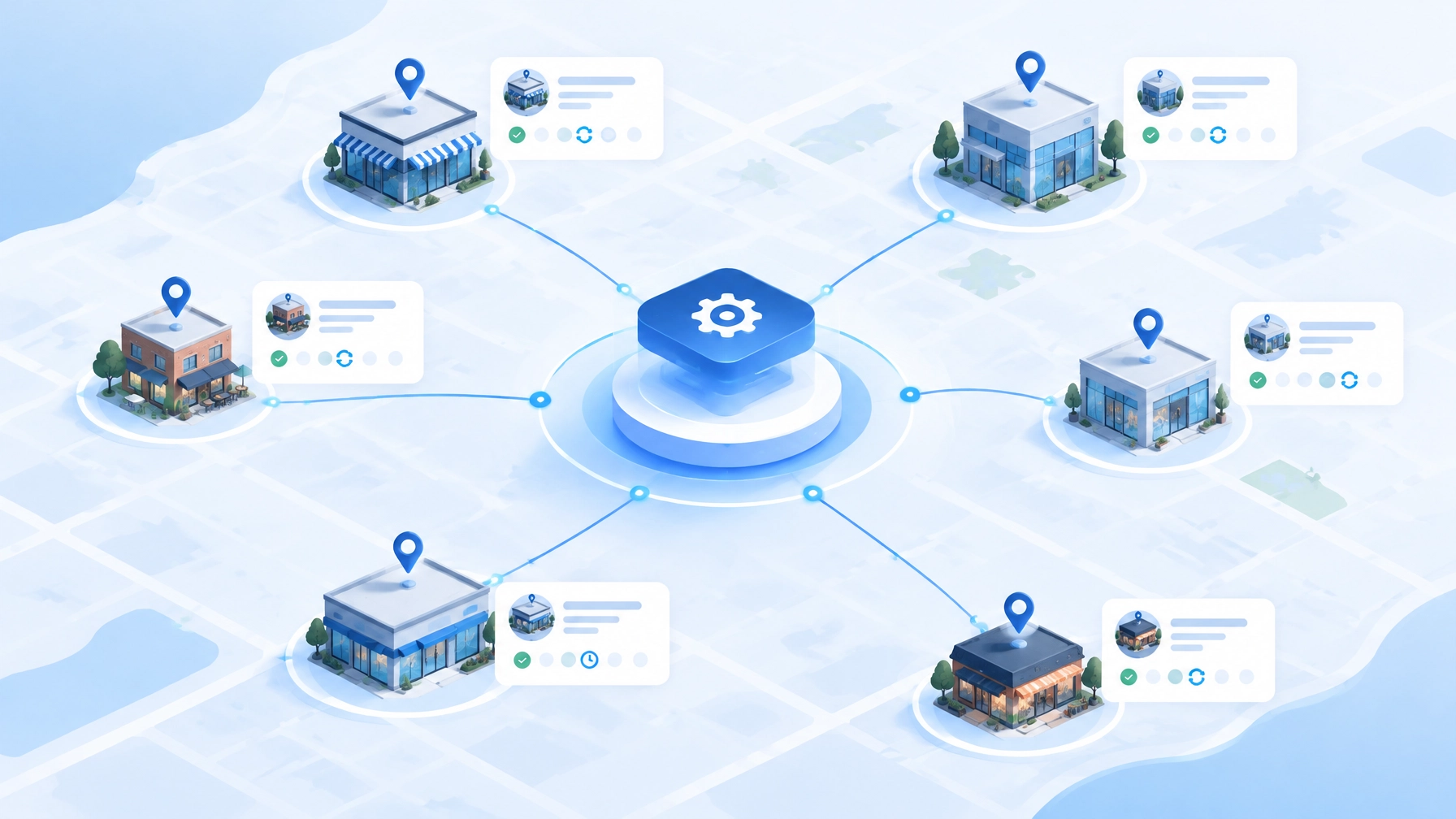
AI Local Boost was designed to bring those activities into a coordinated system. Rather than treating every location as an isolated account, the platform organizes work around locations, roles, approval requirements, and shared reporting.
The constraints: scale while preserving control
A multi-location workflow must balance local flexibility with brand consistency. A regional manager may need to review content for a group of locations, while a central administrator needs oversight across the organization. Those users should not automatically have the same access or approval authority.
The system also operates within Google Business Profile’s authorization and API boundaries. Google’s documentation describes API access, supported methods, and quotas; applications need to account for those limits rather than assume requests can be made without constraint. For example, Google documents quota enforcement and the possibility of 429 Too Many Requests responses when limits are exceeded. Google Business Profile API limits
These constraints informed the product design:
- Governance: Define who can create, review, approve, and manage location-level work.
- Brand compliance: Keep content within reviewable workflows rather than publishing every draft automatically.
- Integration boundaries: Use supported Google Business Profile capabilities and respect authorization requirements.
- Operational resilience: Queue and pace work so external API limits do not become a source of unpredictable failures.
- Traceability: Record meaningful actions so teams can see what happened and who took action.
Architecture built around locations, roles, and workflows
The key design decision was to make the location, not a generic content item, the organizing unit of operations.
Each location can have its own profile information, scheduled content, review-response activity, assigned users, and status history. At the same time, locations can be managed as part of broader brand or regional groupings. That structure supports centralized oversight without erasing the distinctions that matter at the local level.

The application’s core design combines several capabilities:
- Location-aware data model: Connects each post, profile detail, review workflow, and activity record to the relevant location.
- Roles and permissions: Allows access and responsibilities to be scoped for central teams, regional managers, and location-level users.
- Approval queues: Makes pending decisions visible and helps teams move work through defined review stages.
- Queue-based automation: Organizes scheduled and integration tasks so they can be processed in a controlled way.
- Google Business Profile integration: Connects supported workflows to the external platform within its authorization and API constraints.
- Audit logging: Captures activity to support accountability and operational review.
- Multi-location dashboards: Gives leadership a consolidated view of work across locations, rather than requiring a location-by-location check.
Google documents local post methods and review workflows as part of its Business Profile API resources. The application layer still needs to manage the business-specific questions around ownership, permissions, content review, scheduling, and reporting. See Google’s documentation for local posts and review data.
Workflow design: automation with human approval
The platform is intended to reduce repetitive coordination while keeping judgment with the people responsible for the brand. For example, a location-aware post workflow can move from content preparation to review, approval, and scheduling. A review-response workflow can similarly route a draft through an approval step before it is sent.

A typical workflow can follow this sequence:
- Prepare: A user creates content or initiates a review-response task for one or more selected locations.
- Validate: The system checks the relevant location, user permissions, and required workflow details.
- Review: Content enters an approval queue when the organization’s rules require human review.
- Approve or revise: An authorized user approves the item or returns it for changes.
- Schedule or process: Approved work is queued for execution, subject to platform availability and applicable API constraints.
- Record: The system logs the action and updates the item’s status for team and leadership visibility.
This model makes automation a structured part of the operating process, not a substitute for brand judgment. Approval requirements can be especially important when local context, reputation, or regulated messaging calls for review.
Deliverables and operational outcomes
The platform brings together the application components needed to manage local SEO operations across multiple locations:
- Location-level content and post scheduling
- Review-response workflows with human approval steps
- Listing and profile data consistency workflows
- Location-aware permissions for franchise and regional managers
- Centralized approval queues and activity logging
- Dashboards for multi-location workflow reporting
- Integration and queue controls designed around Google Business Profile boundaries
The defensible outcome is greater operational visibility and a more governed process: teams can see where work stands, route decisions to the appropriate people, and review activity across locations. The platform’s dashboards support oversight of workflow status, approvals, profile consistency, and activity history.

We do not present an unverified percentage increase in rankings, engagement, or time savings as a measured AI Local Boost result. Those outcomes depend on the organization’s starting process, location count, content cadence, staffing, and market conditions.
A useful way to establish a time baseline is to count repeatable manual tasks. For illustration, not as a measured platform result, a 20-location brand publishing two location-specific updates each week, with 10 minutes of manual preparation and scheduling per update, would spend about 400 minutes, or 6 hours and 40 minutes, on that activity weekly. A real assessment should validate the task time and include review, revisions, and exceptions before estimating any reduction. After implementation, teams can compare time logs and workflow records against that baseline.
What this proves about custom development at PTC
AI Local Boost demonstrates how Pure Technology Consulting approaches bespoke software: begin with the operating model, then build the data structure, permissions, integrations, automation, and reporting needed to support it.
The same development discipline applies when a client needs a system that does not fit neatly into off-the-shelf software, whether that means coordinating multiple teams, connecting existing tools, or applying approval rules to business-critical workflows. PTC scopes custom application and automation engagements around the client’s requirements, constraints, and integration landscape, often as projects of $10,000 or more.
For teams exploring a similar operating challenge, our custom web application development capability is a starting point for discussing architecture, integration, and delivery scope.
Discuss your workflow and application scope
If your organization is coordinating work across multiple locations, systems, or approval roles, a discovery conversation can help identify what should be automated, where human review belongs, and what a practical build roadmap could include.
Book a discovery call to discuss Pure Technology Consulting’s custom web application development and automation capabilities.
Phone: +1 (803) 921-0969
Website: https://puretechconsult.com
Amin Said, Founder of Pure Technology Consulting LLC
https://puretechconsult.com
Leave a Reply