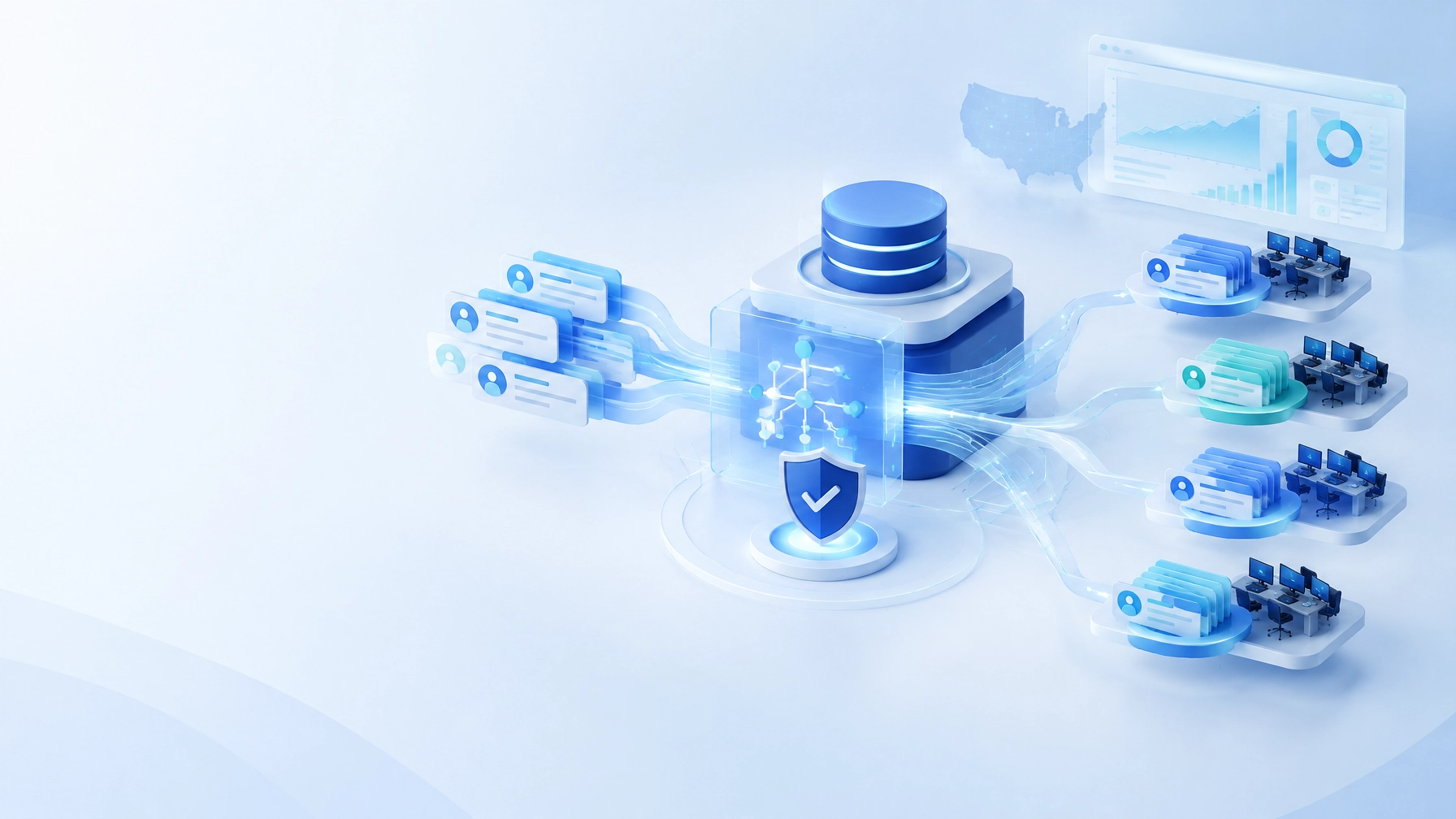
A national debt collection agency needs more than a database of accounts. It needs a dependable operating system for deciding which accounts are ready to work, who should handle them, what controls apply, and how activity translates into recovery performance.
Pure Technology Consulting designed a custom web application to address those connected needs. The platform brought account assignment logic, compliance checkpoints, and operational reporting into a shared workflow, while integrating with the agency’s existing dialer, CRM, and payment systems.
The agency’s identity and proprietary performance figures are not disclosed here. This case study focuses on the system design and operational challenges, rather than presenting unverified results. To learn more about Pure Technology Consulting, visit our website.
The operating challenge: decisions scattered across systems
The agency’s account data and collection activity lived across separate platforms. The CRM held account and workflow details, the dialer managed calls, and payment systems recorded financial activity. Each platform served a purpose, but the agency lacked a unified operational view.
That separation made several important processes difficult to coordinate:
- Assignment decisions depended on multiple factors. Account status, scoring rules, collector capacity, skills, and business priorities all shaped the next assignment.
- Controls needed to follow the account. Disputes, holds, contact restrictions, and other status changes had to be reflected before an account was made available for collection activity.
- Auditability required a coherent history. When a decision was questioned, teams needed to understand what information and rule led to that decision.
- Reporting required reconciliation. Managers had limited visibility into assignment activity, payment outcomes, recovery trends, and exceptions across systems.
The issue was not simply that staff had to perform manual steps. The agency needed a reliable way to coordinate decisions across systems without losing the context behind them.
The design goal: coordinate work, controls, and evidence
The custom application was designed as an operational layer connected to the agency’s existing systems. Rather than replacing every platform, it organized key account decisions and gave staff a consistent place to review assignment status, workflow conditions, and reporting.
The project was scoped around four capabilities: a structured data model, an integration layer, a rules-driven assignment engine, and governance features that made system activity reviewable.

Account data designed for decisions
A dependable assignment process begins with consistent records. The application brought together the fields needed to evaluate and route accounts, while preserving links to the systems that originated or updated each piece of information.
That meant defining core account attributes and relationships, including relevant account status, scoring inputs, assignment history, and references to source-system records. The data model also had to make room for changes over time: an account could move between queues, acquire a new status, or become subject to a hold.
The aim was not to copy every field from every platform into a new database. It was to identify the information required for reliable decisions, document where it came from, and maintain a usable account history.
An integration layer that accounts for real-world exceptions
Connecting the CRM, dialer, and payment systems required more than moving data from one place to another. The integration layer needed to handle inconsistent timing, duplicate updates, failed messages, and changing account states.
The application was designed to manage those realities through controlled data exchange, validation, and exception handling. When incoming information was incomplete or conflicting, the workflow could route the record for review instead of treating uncertainty as a green light for assignment.
This distinction matters in high-volume operations. A successful integration is not only one that transfers records; it is one that helps staff recognize when records are missing, stale, or inconsistent, and provides a path to investigate.
Assignment logic that reflects the operating model
The assignment engine applied the agency’s defined scoring and routing rules to determine how eligible accounts should move into work queues. The rules could account for the decision factors established during discovery, such as account status, priority, collector capacity, and operational constraints.
A central engine made assignment decisions more consistent and easier to review than a patchwork of spreadsheets or informal practices. It also provided a foundation for controlled changes: business stakeholders could evaluate how a rule update might affect routing before the change became part of daily operations.
The system’s purpose was not to remove human judgment from every decision. It was to automate repeatable routing, surface exceptions, and make the basis of an assignment easier to understand.
Compliance controls built into the workflow
In a regulated operation, a control that exists only in a policy document may be difficult to apply consistently across disconnected systems. The application was designed to bring relevant status checks into the workflow so that assignment decisions could account for holds, restrictions, and other conditions maintained by the agency.
The governance model emphasized clear event histories: what changed, when it changed, which system or user initiated the change, and what action followed. Where a status or integration response required review, the workflow could keep the account out of ordinary processing until it was resolved.
These are technology and process controls, not a substitute for legal advice or a compliance program. Federal rules establish obligations but do not prescribe a particular software architecture. Agencies should have qualified compliance counsel assess how their policies and technology align with applicable requirements. The CFPB’s Regulation F provisions and record-retention rule are useful starting points for that review.

Recovery reporting that connects activity to outcomes
The reporting layer brought operational and recovery information into a more coherent view. Instead of treating assignment, collection activity, and payment records as separate reporting problems, the application connected them through account and event references.
That gave managers a framework for examining questions such as:
- How are eligible accounts moving through assignment queues?
- Where are exceptions or delays accumulating?
- How do account status and work allocation relate to payment activity?
- Which results are visible in the source systems, and which require reconciliation?
- Can a reported figure be traced back to the underlying account activity?
The objective was not to claim a specific recovery increase without a verified baseline and measurement period. It was to improve the quality and traceability of the information leaders use to manage operations and evaluate performance.

How this fits into a broader custom-build capability
This engagement is distinct from file-processing and telephony attribution work. Its center of gravity is the coordination of account assignment, workflow controls, and recovery reporting.
It also builds on capabilities developed in adjacent operational settings. PTC’s experience includes debt-agency telephony integrations that connect calls to attribution, as well as FTP Inform, which demonstrates secure file ingestion, validation, transformation, and workflow orchestration. Those systems are proof points for complex data and integration work, not substitutes for scoping the agency’s own operating model.
A custom application can bring those capabilities together when the requirement calls for a tailored system. Learn more about PTC’s custom web application development approach.
Typical deliverables for a scoped engagement
The exact roadmap depends on source systems, data quality, operating policies, and stakeholder requirements. A premium custom build may include:
- Workflow discovery and a prioritized requirements map.
- Account and event data models with source-system traceability.
- Integration specifications and resilient data-exchange workflows.
- Configurable assignment rules, queue management, and exception paths.
- Role-based access, event histories, and governance controls.
- Operational dashboards and recovery reporting.
- Testing, deployment planning, documentation, and post-launch support.
These engagements are scoped around business complexity and integration requirements. Custom application projects may begin at $10,000 or more, with the final investment determined through discovery and a defined delivery plan.
Turn fragmented operations into a coordinated system
For a national agency, assignment, compliance controls, and recovery reporting are interdependent. Treating them as separate software problems can preserve the very silos that make operations difficult to manage. A purpose-built application creates a shared framework for routing work, handling exceptions, and understanding performance.
To discuss an operational challenge or define the right project scope, book a no-obligation discovery call or contact Pure Technology Consulting at +1 (803) 921-0969.
Amin Said, Founder of Pure Technology Consulting LLC
https://puretechconsult.com
Leave a Reply