Amin Said, Founder of Pure Technology Consulting LLC
Debt collection operations depend on precise coordination between account data, calling activity, agent workflows, payment outcomes, and compliance requirements. When those functions are spread across a collections platform, a separate dialer, spreadsheets, reporting tools, and disconnected storage systems, the organization loses visibility at the moments when accuracy matters most.
Pure Technology Consulting developed a proprietary proof-of-concept for a debt collection operation to demonstrate how custom web application development can unify telephony integrations, call attribution, workflow automation, and compliance-aware controls in one operating system.
The goal was not to build another generic CRM or dialer. It was to demonstrate how a complex, high-value operation can be translated into a scalable web application with explicit business rules, connected data, and audit-ready event history.
The strategic problem: collections data was fragmented across systems
In a typical collections environment, agents may work from one application while placing calls through another. Payment activity may be recorded elsewhere, and managers may depend on exported reports to understand performance.
This creates several operational challenges:
- Call outcomes must be manually entered or reconciled.
- Account activity and telephony records may not share a reliable identifier.
- Managers cannot easily determine which campaigns, scripts, or channels influence payment outcomes.
- Consent, opt-out, contact frequency, and calling-window rules may be managed inconsistently.
- Compliance teams have to reconstruct events from multiple systems during reviews.
- Leadership lacks a complete view of cost per contact, resolution paths, and agent performance.
These are not isolated software problems. They are operating-model problems.
A collections organization needs to know not only whether a call occurred, but also:
- Which account and debt was involved?
- Which phone number was used?
- What consent or suppression status existed at the time?
- Which agent, campaign, or workflow initiated the contact?
- What was the result?
- Did the interaction lead to a promise to pay, payment, dispute, or opt-out?
- Can the organization reconstruct the full sequence later?
The proof-of-concept was designed around those questions.
The architecture: one application coordinating multiple systems
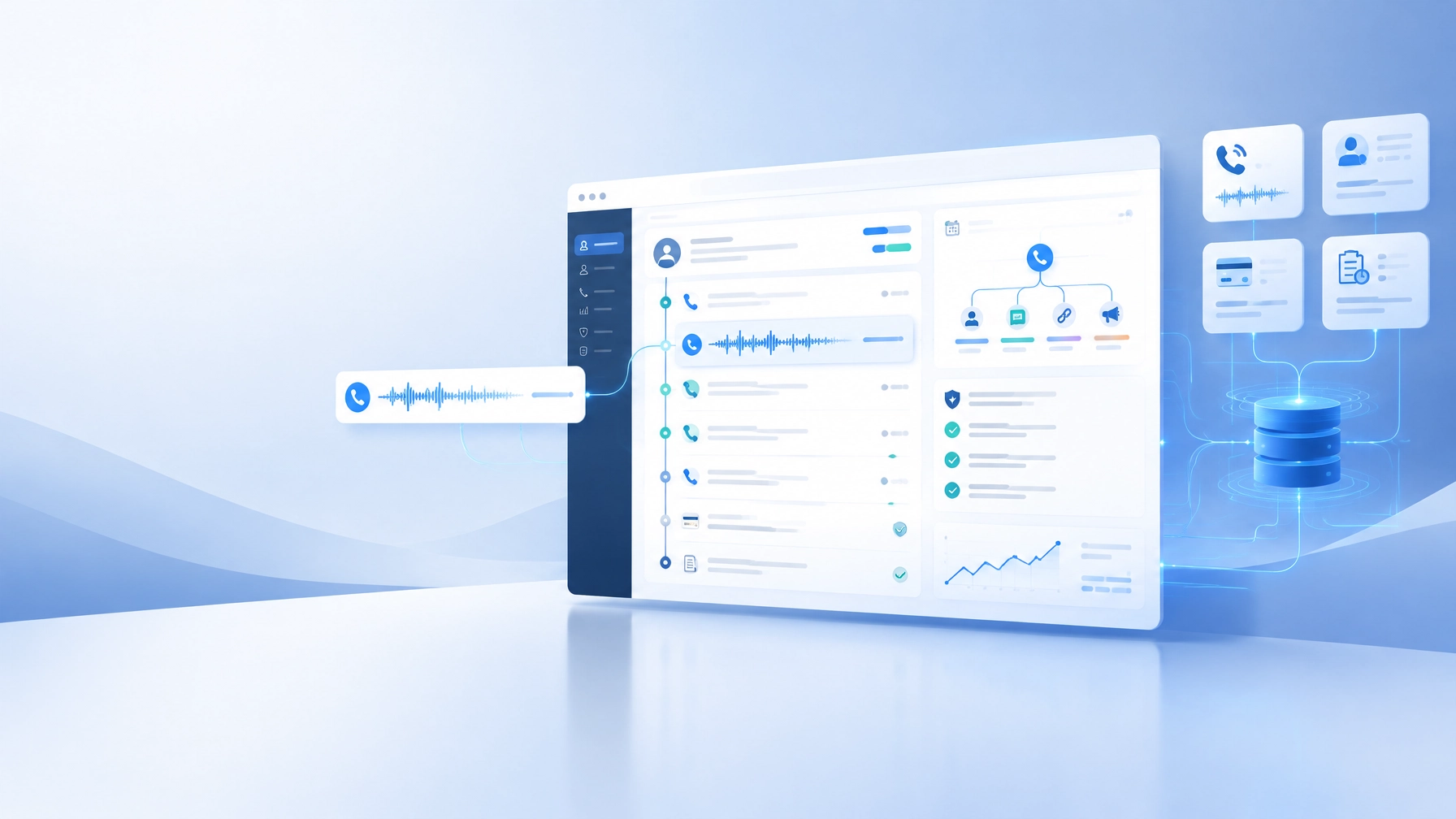
The system centers on a unified collections web application with an integration layer connecting telephony, account records, payment outcomes, compliance controls, and analytics.

The architecture is organized around several core components:
-
Collections operations interface
Agents and managers work from account queues, customer profiles, contact history, payment information, and workflow tasks. -
Telephony integration layer
APIs and webhooks connect the application to external dialers, SIP providers, contact-center platforms, SMS systems, or voice automation tools. -
Compliance rules engine
Before a contact attempt is initiated, the system evaluates configurable rules related to consent, opt-outs, contact windows, frequency limits, dialing modes, and jurisdiction. -
Event and attribution store
Calls, messages, payments, disputes, promises to pay, and other activities are stored as structured events connected to the appropriate account. -
Recording and audit repository
Call references, metadata, transcripts, disclosures, dispositions, and workflow changes can be retained according to organizational policy and applicable requirements.
This architecture reflects a principle we use across our enterprise automation consulting engagements: external systems should remain connected, but the organization should not lose control of its operating logic.
Why an account-level event model matters
The most important design decision was to treat each interaction as a structured business event rather than a disconnected activity log.
An event can include:
- Account or debt identifier
- Consumer and phone-number references
- Agent, campaign, or automation identifier
- Communication channel
- Timestamp and time zone
- Dialing mode
- Call outcome or disposition
- Consent status
- Recording reference
- Workflow and script version
- Payment or resolution outcome
- Related follow-up actions
This creates a complete operational timeline for each account.
For example, a resolution path might include:
SMS reminder → automated call → live agent conversation → promise to pay → payment confirmation
With a structured event model, the organization can analyze that path without manually combining data from five different applications.
It also enables multiple attribution approaches. Leadership may want to understand the first meaningful touchpoint in a resolution journey. Operations may need to evaluate the final interaction before payment. Strategy teams may want a multi-touch view that considers every channel involved.
The right attribution model depends on the decision being made. Custom software allows those models to be represented directly instead of forcing the organization into generic marketing analytics.
Telephony becomes part of the workflow, not a separate activity

The proof-of-concept connects the agent’s workflow to telephony so that calling activity is initiated, tracked, and evaluated from the same operational environment.
A typical call workflow can operate as follows:
- An agent opens a prioritized account queue.
- The system displays the account, debt details, contact history, and recommended next action.
- The agent selects a contact number.
- The rules engine evaluates whether the call is permitted under the configured policy.
- If approved, the application triggers the telephony provider.
- Call status, duration, connection result, and recording reference are returned through an API or webhook.
- The agent completes or confirms the disposition.
- Any payment, promise to pay, dispute, or opt-out is attached to the account timeline.
- Follow-up actions are created automatically based on the outcome.
This approach reduces duplicate entry and improves the consistency of operational records. It also makes exceptions visible. If a call cannot be initiated because consent is missing or a contact threshold has been reached, the application can show the reason and route the account to an approved alternative workflow.
The system is not intended to replace legal or compliance counsel. Instead, it gives the organization a technical framework for enforcing approved policies consistently at the point of action.
Compliance controls are designed into the operating layer
For debt collection organizations, compliance cannot be treated as a report generated after activity has already occurred.
A rules-based system can be configured to evaluate requirements and internal policies such as:
- Calling windows based on the consumer’s time zone
- Account-level contact frequency
- Per-number consent records
- Do-not-call and internal suppression lists
- Opt-out propagation across channels
- Manual versus automated dialing requirements
- State-specific policies
- Recording and retention workflows
- Escalation requirements for disputes or complaints
The CFPB’s Debt Collection Rule FAQs provide important regulatory context for organizations designing these controls. Actual implementation should be reviewed by qualified legal and compliance professionals.
From an engineering perspective, the key requirement is traceability. The system should be able to show which rule was evaluated, what data was available at the time, what decision was made, and whether a user later changed the record.
That creates a stronger foundation for internal reviews, client reporting, dispute resolution, and future system improvements.
Call attribution connects activity to business outcomes
A call log alone does not explain operational value. The system must connect communications to outcomes that matter to the business.
Potential outcomes include:
- Right-party contact
- Payment received
- Promise to pay
- Arrangement enrollment
- Kept or broken promise
- Dispute submitted
- Consumer portal registration
- Opt-out request
- Account resolution
- Escalation to a specialist
With these relationships in place, leaders can evaluate questions such as:
- Which calling sequences produce the strongest payment results?
- How do manual, automated, and AI-assisted calls compare?
- Which scripts improve promise-to-pay rates?
- What is the cost per resolved account?
- How long does it take to reach the first payment?
- Which contact paths create the most compliance exceptions?
- Where are agents spending time without advancing resolution?
This is where ai-powered business systems can create additional leverage. Once the underlying data is structured and governed, AI can assist with prioritization, anomaly detection, call summarization, disposition recommendations, and workflow routing.
AI should enhance a reliable operating model, not conceal a fragmented one.
Proof of capability across complex industries
The debt and telephony proof-of-concept is part of a broader body of work at Pure Technology Consulting.
Our proprietary builds demonstrate how the same engineering principles can be adapted to different operating environments:
- Healthcare: Thrive and EHRIO matching engines, 70-question intake workflows, and HIPAA-adjacent process design demonstrate our experience with structured intake, matching logic, and sensitive operational data.
- Ops and field service: D2D Tracking demonstrates rep accountability, GPS logging, activity monitoring, and field-team visibility.
- Fintech and debt: Debt agency telephony integrations and call attribution demonstrate how communications, account events, and financial outcomes can be connected.
- Local SEO: AI Local Boost demonstrates governed Google Business Profile automation across distributed business locations.
- Data exchange: FTP Inform demonstrates secure ingestion, schema validation, exception governance, deterministic routing, and audit trails for compliance-sensitive operations.
- Multi-location operations: ChainHQ demonstrates location-aware architecture, role-based access, intelligent assignment logic, and centralized reporting.
These are proof-of-work examples, not generic products being presented as a replacement for a client’s operating model. They show how Pure Technology Consulting brings proven capabilities into bespoke software engagements.
When a custom collections application is justified
A custom build becomes especially valuable when an organization:
- Operates across multiple disconnected systems
- Needs telephony and CRM data synchronized in near real time
- Requires account-level attribution
- Has complex compliance policies
- Depends on manual reconciliation or spreadsheet reporting
- Needs workflow rules that generic SaaS cannot support
- Handles high volumes of sensitive data
- Wants to reduce labor dependency without sacrificing oversight
- Is preparing for AI workflow automation
A project of this complexity should be scoped as a premium technology engagement, often reaching $10,000 or more depending on integrations, security requirements, data migration, compliance controls, reporting, and rollout strategy.
The appropriate starting point is not a feature list. It is a discovery process that maps the current operating model, identifies integration dependencies, defines governance requirements, and establishes a phased roadmap.
Build the system behind the operation
This case study demonstrates what custom web application development can accomplish when it is treated as a business transformation initiative rather than a standalone software project.
Telephony becomes part of the application. Call attribution becomes part of the data model. Compliance becomes part of the workflow. Analytics becomes part of daily decision-making.
If your collections, financial services, healthcare, or professional services operation is constrained by disconnected systems, Pure Technology Consulting can help define the next stage of your technology roadmap through business process automation consulting and custom engineering.
Book a discovery conversation to discuss your current systems, workflow constraints, and integration priorities. The objective is a practical scope for a scalable solution: not a commitment to technology for its own sake.
Phone: +1 (803) 921-0969
Amin Said, Founder of Pure Technology Consulting LLC
Leave a Reply