By Amin Said, Founder of Pure Technology Consulting LLC
For a growing door-to-door sales organization, the field is where revenue is created: and where operational visibility often disappears.
Reps spend their days moving through neighborhoods, visiting prospects, recording outcomes, and creating opportunities for downstream sales teams. Leadership, however, may see only self-reported activity totals, occasional check-ins, and spreadsheets assembled after the fact.
That gap creates more than a reporting problem. It affects territory planning, coaching, attendance, lead follow-up, onboarding, and the organization’s ability to understand what is actually happening outside the office.
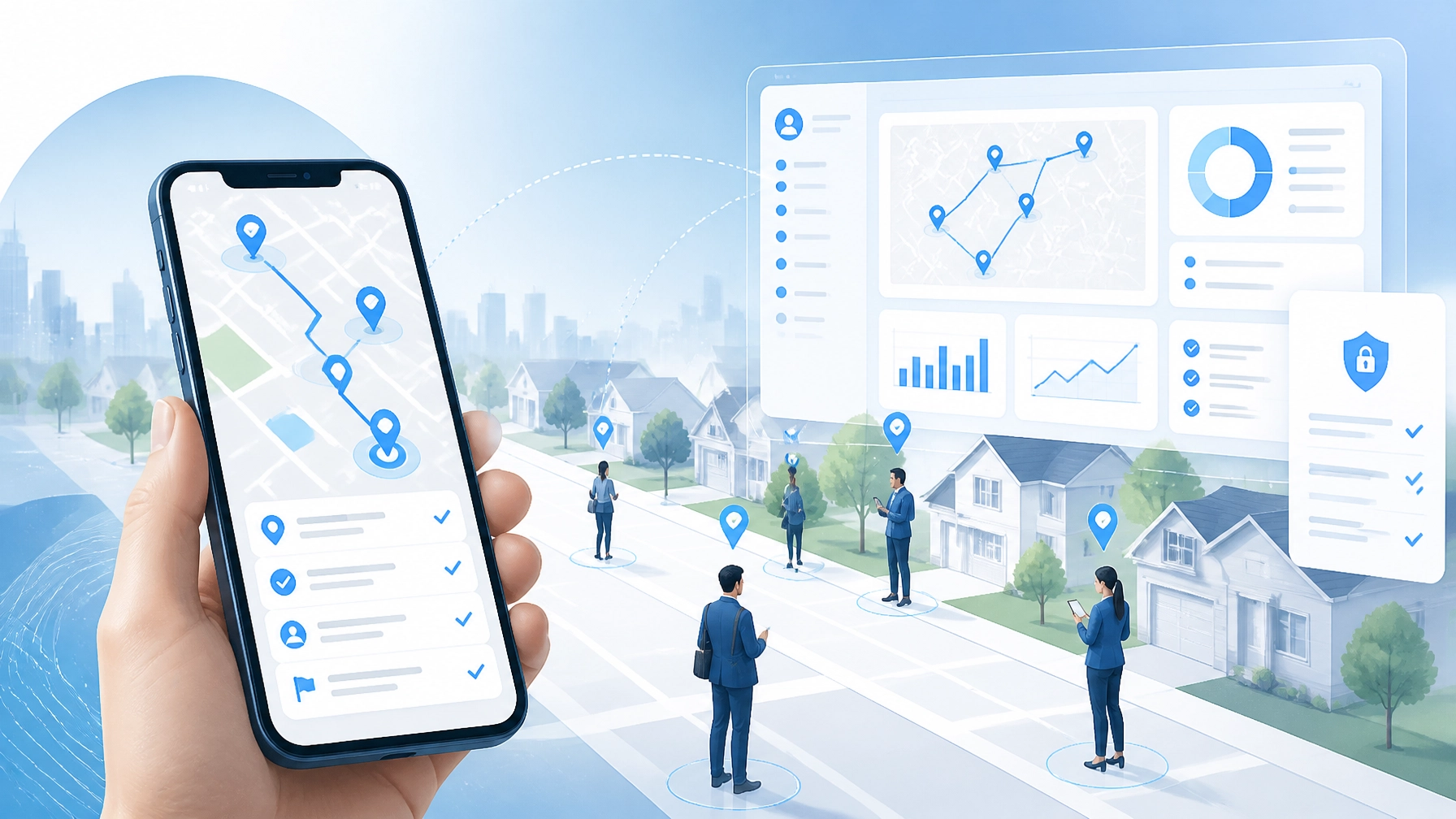
To demonstrate how custom software can solve this class of operational challenge, Pure Technology Consulting engineered D2D Tracking, a proprietary field accountability system for door-to-door and field sales teams. The build combines a mobile rep experience, GPS-verified activity records, territory management, attendance tracking, role-based dashboards, and CRM integration.
D2D Tracking is not one of our four named SaaS platforms. It is a proprietary proof-of-concept build that demonstrates the same engineering discipline behind AI Local Boost, ChainHQ, EHRIO Pro, and FTP Inform.
The broader lesson is straightforward: when field operations become too important to manage through paper logs and spreadsheets, a purpose-built system can turn activity data into an operating advantage.
The field visibility problem leaders cannot solve with spreadsheets
A typical door-to-door sales organization may have dozens of reps working across multiple neighborhoods, cities, or territories. These teams may sell home services, pest control, telecom and internet packages, solar services, security systems, or other high-consideration offerings.
The operating model is inherently distributed. Reps rarely return to the office between visits, and managers cannot physically observe every interaction. As the team grows, leadership begins to encounter recurring questions:
- Which territories were actually covered today?
- How many doors did each rep visit?
- Were reported visits completed at the expected locations?
- How much time was spent actively working versus traveling or waiting?
- Which leads require immediate follow-up?
- Are new reps receiving enough coaching and territory support?
- Are multiple reps unknowingly working the same streets?
- How should managers distinguish low performance from incomplete reporting?
Manual check-ins, paper records, and self-reported numbers provide some information, but they do not create a dependable operational record. They also force managers to spend time reconciling activity instead of coaching the team.
The problem is not that field sales teams lack effort. The problem is that the business lacks a shared system of record for field execution.
The design objective: accountability without unnecessary surveillance
The goal of D2D Tracking was not to place a permanent tracking dot on every rep. It was to create reliable evidence around meaningful work events.
That distinction influenced the product and data model from the beginning.
Rather than treating continuous movement as the primary measure of productivity, the system focuses on activity records such as:
- Attendance and work-session check-ins
- GPS-verified door visits
- Visit timestamps and outcomes
- Territory and route assignments
- Rep notes and follow-up requirements
- Lead handoff events
- Manager review and coaching activity
A GPS coordinate becomes useful when it is attached to a specific event: a door visit, a check-in, or a logged outcome. The result is a more practical balance between operational flexibility and data integrity. Reps can move through neighborhoods as their work requires, while the organization retains verifiable records of where and when activity took place.
A responsible deployment would also define clear policies around what is tracked, when tracking occurs, who can access records, and how long activity data is retained. GPS should support fairness, route planning, and accurate coaching: not create an ambiguous surveillance environment.

What PTC built into D2D Tracking
D2D Tracking was structured as a coordinated system rather than a standalone map or time-clock application. The mobile experience and manager dashboard work from the same operational data model, giving each user the information appropriate to their role.
A mobile-first rep experience
Field reps need to record activity quickly, often while standing outside a property or moving between streets. The mobile workflow therefore prioritizes simple actions and minimal data entry.
A rep can begin a work session, access assigned territory information, record a visit, select an outcome, add notes, and flag a follow-up requirement. The system captures relevant GPS and timestamp data as part of the event rather than requiring the rep to reconstruct activity at the end of the day.
This approach reduces duplicate entry and improves the quality of information flowing into management reports.
GPS-verified activity records
Each meaningful field event can include location and time information that helps verify the activity. This creates an auditable record without requiring managers to rely exclusively on rep-submitted totals.
The record can help answer practical operational questions:
- Was the visit logged within the assigned territory?
- Was the activity performed during the scheduled work session?
- Which addresses or streets have already been visited?
- What outcome was recorded?
- Does the activity require a sales follow-up?
The value is not the map alone. The value is the connection between location, time, outcome, and next action.
Territory and route structure
Door-to-door organizations need flexibility because territories change. A neighborhood may be assigned to one team today and revisited by another later. New representatives may need smaller zones during onboarding, while experienced reps may manage larger routes.
D2D Tracking separates territory structure from individual activity records. Managers can organize regions, assign reps, review coverage, and adjust routes without losing historical activity data.
That structure supports more deliberate decisions around:
- Coverage gaps
- Repeated visits
- Territory overlap
- Rep workload
- New territory launch
- Onboarding progression

Role-based access and management dashboards
A field rep should not have the same interface or permissions as a regional manager. D2D Tracking uses role-based access to create different views for different responsibilities.
Reps see their own activity, assigned areas, recorded outcomes, and follow-up tasks. Managers see aggregate coverage, attendance, team activity, territory performance, and exceptions requiring attention.
This separation supports both transparency and governance:
- Reps can review their own records and results.
- Managers can compare activity across territories and teams.
- Leadership can evaluate broader operational patterns.
- Sensitive administrative controls remain restricted.
The system turns field data into a management workflow instead of an undifferentiated stream of location points.
Connecting field activity to the sales pipeline
GPS verification is only valuable when the resulting information helps the business act.
For that reason, D2D Tracking was designed to connect field outcomes with the client’s CRM and lead pipeline. A rep’s recorded visit can create or update a downstream activity, identify a qualified opportunity, trigger a follow-up task, or pass notes to the sales team.
This removes a common operational failure: the field team gathers information, but the office team receives it late or has to re-enter it manually.
A connected workflow allows the organization to move from:
“A rep says they visited this area.”
to:
“The system contains a time-stamped, location-verified visit, its outcome, the rep’s notes, and the next assigned follow-up.”

The integration layer can be adapted to the client’s existing CRM, lead stages, assignment rules, and notification requirements. That is an important distinction between custom development and simply purchasing another field tracking tool. The system is designed around the organization’s operating model and downstream sales process.
Operational outcomes without fabricated metrics
Because D2D Tracking is presented as a proprietary proof-of-concept rather than a public client engagement with published performance data, the outcomes should be described structurally rather than through unsupported percentages.
The system is designed to provide:
- Verifiable visit and activity records
- Clearer visibility into territory coverage
- Less dependence on manual reporting
- Faster handoff of qualified leads into follow-up
- More consistent attendance records
- Better coaching conversations based on shared evidence
- Stronger rep accountability
- A repeatable process for onboarding new representatives
- A more organized framework for launching new territories
These outcomes matter because they improve the quality of management decisions. Leaders can focus on where support is needed, which territories require adjustment, and how field activity connects to revenue operations.
What this build demonstrates about PTC’s engineering practice
D2D Tracking is one proof point in a wider body of custom software and automation work at Pure Technology Consulting.
With ChainHQ, we demonstrated location-aware architecture for multi-location operations, including centralized visibility, scoped access, and workflow coordination across distributed business units.
With EHRIO Pro, we engineered healthcare-oriented workflows involving complex intake, matching logic, scheduling, and HIPAA-adjacent data considerations.
With AI Local Boost, we developed automation infrastructure for managing local search activity across large numbers of business profiles.
With FTP Inform, we built secure file ingestion, validation, transformation, and downstream workflow automation for a high-volume debt collection environment.

These systems operate in different industries, but the engineering principles are consistent:
- Start with the business workflow, not a feature checklist.
- Establish a reliable data model.
- Design role-based experiences around real responsibilities.
- Integrate with the systems that already run the business.
- Automate repeatable handoffs and exception handling.
- Build governance into the application layer.
- Create architecture that can expand with the organization.
That is why high-ticket buyers should evaluate a development partner based on more than a portfolio of websites. The relevant question is whether the partner can understand a complex operating model and translate it into a scalable application, automation framework, or bespoke AI solution.
Build visibility into the way your team works
Field sales organizations do not need more disconnected tools. They need a technology foundation that connects activity, territory, accountability, and follow-up.
D2D Tracking shows how a custom web application can provide that foundation while respecting the realities of field work. Reps retain operational flexibility. Managers gain clearer visibility. Leadership receives structured data for better decisions. Sales follow-up begins with more complete information.
If your organization is managing distributed teams through spreadsheets, manual check-ins, or disconnected CRM workflows, a discovery conversation can help identify what should be automated first.
Book a discovery call with Pure Technology Consulting or contact our team at +1 (803) 921-0969 to discuss a custom web application, bespoke AI solution, enterprise automation engagement, or AI workflow automation roadmap.
Amin Said, Founder of Pure Technology Consulting LLC
Leave a Reply