By Amin Said, Founder of Pure Technology Consulting LLC
For growth-focused local businesses, inconsistent lead flow is rarely caused by a single marketing problem. More often, it reflects a wider operational gap: Google Business Profiles are not updated consistently, reviews are answered too slowly, local content is difficult to coordinate, and marketing activity remains disconnected from the systems that manage customers and revenue.
For a single location, these issues may be manageable. For a multi-location business, franchise group, or agency portfolio, they become a technology challenge.
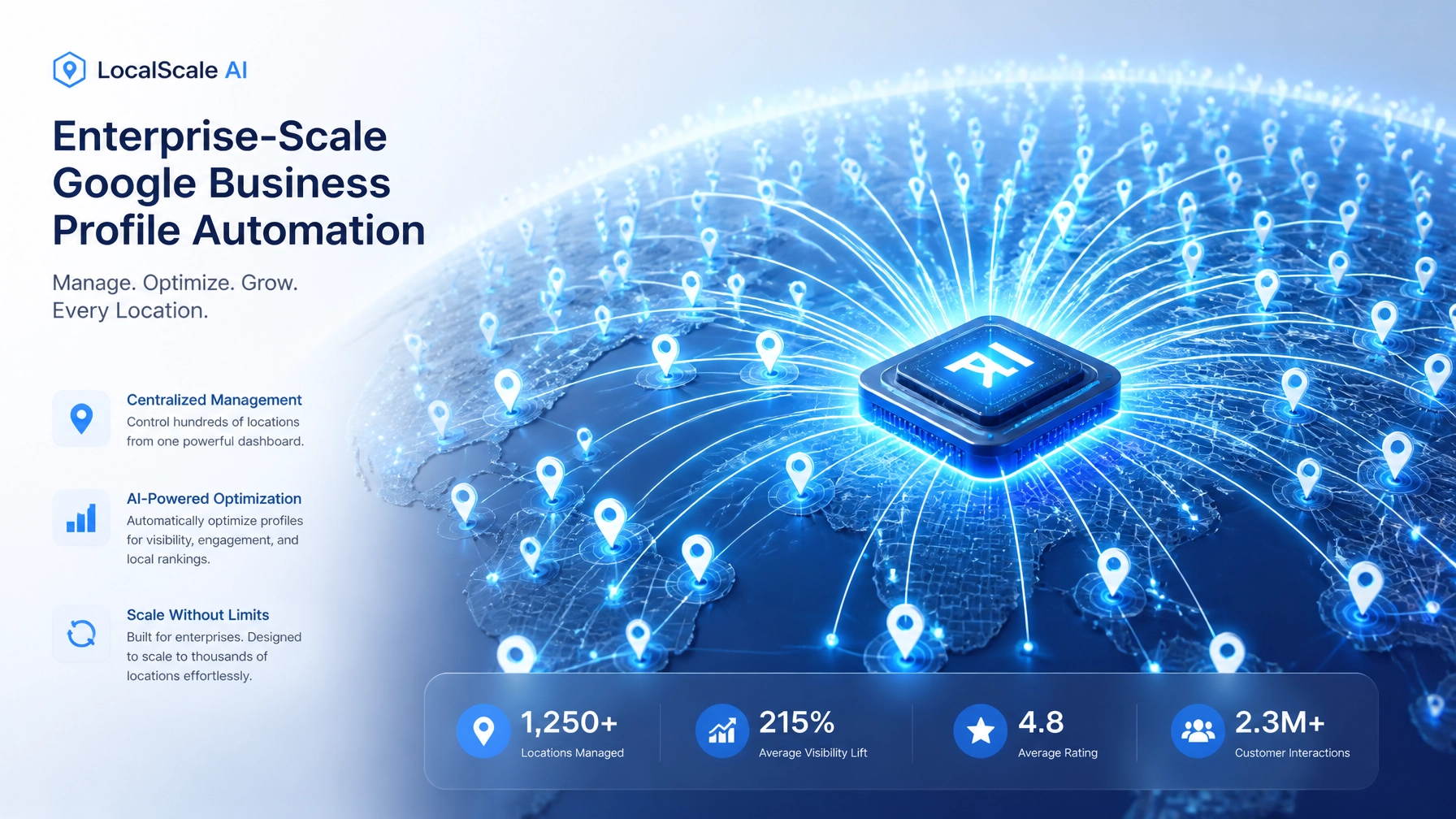
Pure Technology Consulting built AI Local Boost to address that challenge. The platform began as a local SEO automation system and evolved into a proof-of-concept for what custom web application development, bespoke AI solutions, and enterprise automation consulting can deliver when software is designed around a real operating model.
AI Local Boost demonstrates that local visibility can become more than a marketing task. With the right architecture, it can become an integrated, measurable, and scalable business system.
The business problem: local visibility does not scale through manual effort
Local service businesses depend heavily on discovery through Google Search and Google Business Profile listings. For chiropractors, physical therapy clinics, counseling centers, specialty medical practices, permanent jewelry brands, and other service businesses, strong local visibility can influence calls, direction requests, consultations, and bookings.
However, maintaining that visibility requires continuous execution:
- Publishing location-specific Google updates
- Adding relevant photos, videos, and media
- Responding to positive and negative reviews
- Keeping business information accurate across channels
- Requesting reviews after completed customer interactions
- Connecting local marketing activity to CRM, scheduling, POS, and communication systems
- Reporting on performance across locations
The problem is not that business owners lack strategic intent. The problem is that the workflow is repetitive, distributed, and difficult to govern.
At scale, organizations typically face two unsustainable choices. They can hire a large team to manage every profile manually, increasing labor costs and the likelihood of inconsistent execution. Or they can allow profiles to become stagnant, reducing the frequency and relevance of the activity that supports local discovery.
AI Local Boost was created to replace that tradeoff with a structured automation layer.

The architecture: a multi-tenant system built for scale
AI Local Boost was not designed as a simple content scheduler. Its purpose was to support multiple organizations, brands, users, and locations through a shared technology foundation.
That required a multi-tenant SaaS architecture. In practical terms, the platform needed to serve many customers while ensuring that each organization’s data, business profiles, integrations, users, and workflows remained properly separated.
This architecture included several foundational capabilities:
Tenant-aware data modeling
Every important record is associated with the correct organization, location, and operating scope. This enables a single application to support:
- Platform administrators
- White-label partners
- Client administrators
- Regional managers
- Location-level users
A corporate team can view portfolio-wide performance, while a local manager can work within the locations they are responsible for. The system provides centralized visibility without giving every user unrestricted access.
Role-based access control
In enterprise automation, access control is not merely a security feature. It defines how work moves through the organization.
AI Local Boost was structured so users can access the tools and data appropriate to their responsibilities. A corporate administrator may manage brand standards and reporting. A regional manager may oversee a group of locations. A local operator may review content or approve responses for one profile.
This allows local teams to act with the necessary context while preserving governance at the corporate level.
White-label infrastructure
A serious white-label platform requires more than changing a logo and color palette. Partners may need their own branded environment, client hierarchy, workflow policies, user permissions, and reporting structure.
AI Local Boost was designed to support those requirements within a centralized infrastructure. That allows a partner or enterprise team to present a cohesive software experience without building and maintaining an entire SaaS platform from the ground up.
For high-ticket buyers, this is an important distinction. The goal is not to resell a collection of features. The goal is to create reusable operational infrastructure.
The AI workflow: automate execution without eliminating judgment
The AI layer within AI Local Boost was designed as an orchestration system rather than an unrestricted content generator.
The platform evaluates context such as industry, location, audience, services, brand language, and workflow rules before generating or recommending an action. This makes the output more relevant to the business and more consistent across its locations.
A typical governed workflow can include five stages:
- Context collection: The system gathers business information, location details, services, brand guidelines, and campaign objectives.
- AI recommendation: The platform generates a post, review response, media concept, or follow-up action.
- Validation: Configured rules evaluate tone, timing, required information, and tenant-specific standards.
- Routing: The action is sent for human approval, scheduled publication, or automated execution based on policy.
- Recording: The result is stored for reporting, auditing, and future optimization.
This suggest-and-approve model is especially valuable for reputation management. AI can analyze the sentiment and context of a review, then draft a response. A business can decide whether that response requires human review or qualifies for a trusted automation rule.
The objective is not to remove people from every process. It is to reserve human attention for decisions that require judgment while automating repetitive execution.
Connecting local SEO to the rest of the business
Local SEO becomes more valuable when it is connected to operational events.
A completed purchase, patient visit, consultation, or service appointment can trigger a review request. A new promotion can generate coordinated content across relevant channels. A change in business information can be reflected across connected platforms. Performance data can be brought into a unified reporting view.
AI Local Boost was designed to connect with systems such as:
- CRMs
- POS platforms
- Scheduling tools
- Email and SMS providers
- Social channels
- Review and reputation workflows
- External business applications
The platform’s integration strategy reflects a broader principle in business automation consulting: software should connect systems around how the business actually operates.
When teams no longer need to copy information between disconnected tools, the organization gains more than efficiency. It gains a clearer relationship between marketing activity, customer engagement, and business outcomes.

The results: measurable visibility and reclaimed operating capacity
AI Local Boost was built to address two linked outcomes: improve local visibility and reduce the administrative effort required to maintain it.
In the deployment context documented by Pure Technology Consulting, the platform was designed to manage 500+ Google Business Profile locations without requiring human intervention for every routine action. It also supported integrations with more than 6,000 external tools, enabling review requests and related workflows to originate from events across the broader business ecosystem.
Reported performance outcomes included:
- A 25% increase in call and direction click-through rates
- Up to a 340% increase in local leads within the documented measurement period
- Consistent profile activity across a large multi-location portfolio
- Faster, more context-aware review response workflows
- Reduced administrative dependence on manual profile management
Results will vary by market, baseline visibility, location quality, offer strategy, and implementation discipline. The more important lesson is architectural: when repetitive local marketing processes are connected to data, rules, approvals, and reporting, they can be managed as an operating system rather than a series of isolated tasks.

AI Local Boost is one proof point in a broader engineering practice
AI Local Boost is not an isolated experiment. It is one example of how Pure Technology Consulting develops scalable, complex systems for organizations whose processes do not fit neatly into standard SaaS products.
Other proprietary builds demonstrate the same engineering approach in different environments:
- ChainHQ uses unified, location-aware architecture to help multi-location businesses reduce data silos and coordinate operations across branches, regions, and corporate teams. Read the ChainHQ case study.
- EHRIO Pro demonstrates custom healthcare workflow design through 70-question intakes, provider matching logic, scheduling coordination, and HIPAA-adjacent data workflows. Explore the EHRIO Pro case study.
- FTP Inform shows how secure file ingestion, validation, transformation, workflow orchestration, and auditability can replace fragmented enterprise tools in debt collection operations. Review the FTP Inform case study.
These systems serve different industries, but the principles remain consistent: understand the operating model, structure the data correctly, integrate the systems that matter, automate repeatable decisions, and preserve governance.
That is the difference between adding another software subscription and investing in a custom AI-powered business system.
When custom development becomes the strategic choice
Standard SaaS is often appropriate when a workflow is simple, stable, and shared across the market. Custom software development becomes more valuable when a business needs to:
- Manage multiple tenants, brands, locations, or partner organizations
- Encode proprietary workflows into software
- Connect systems that do not integrate natively
- Control data ownership and permissions at a granular level
- Create a differentiated customer or operator experience
- Launch a white-label or recurring-revenue platform
- Scale execution without increasing administrative headcount at the same rate
For these organizations, custom web application development is not about building technology for its own sake. It is about creating leverage.
Pure Technology Consulting brings this perspective to custom software, AI consulting services, digital transformation consulting, and business process automation consulting engagements. We help growth-minded organizations move from manual processes and disconnected applications toward scalable technology foundations.
If your business is evaluating a proprietary SaaS platform, an AI workflow automation initiative, or a complex internal application, book a discovery call with our team. You can also contact Pure Technology Consulting at +1 (803) 921-0969 to discuss your operating model, technical roadmap, and automation priorities.
Amin Said, Founder of Pure Technology Consulting LLC
https://puretechconsult.com
Leave a Reply