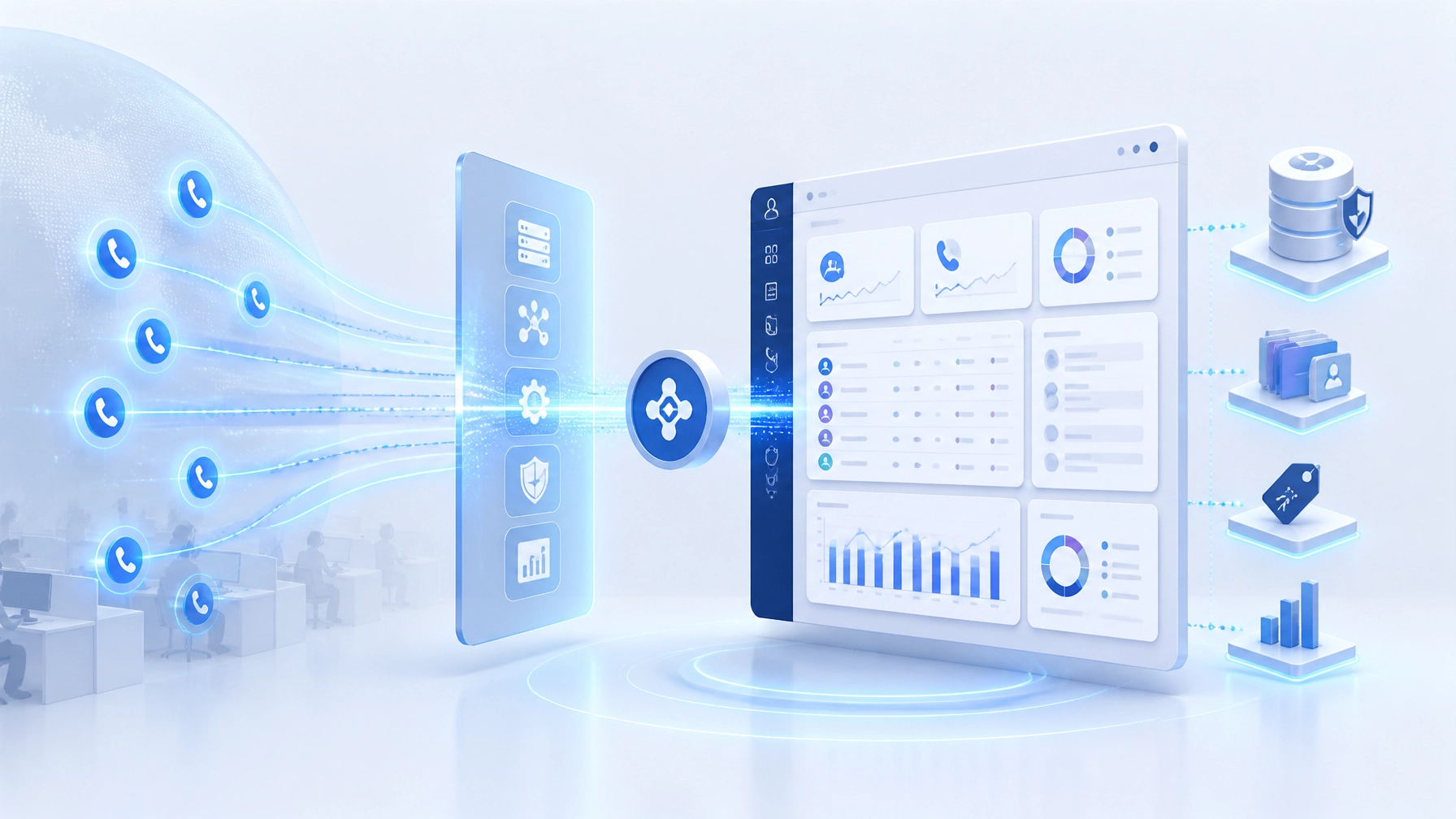
For a high-volume debt collection agency, every call contains operational intelligence. It can indicate a right-party contact, a promise-to-pay, a dispute, a callback request, or a compliance-sensitive interaction. When that information remains trapped inside a dialer or call center platform, the agency loses visibility into the workflows that follow.
Amin Said, Founder of Pure Technology Consulting, led a custom integration initiative designed to connect telephony events with account records, campaigns, agent activity, and downstream business processes. The objective was not simply to add click-to-call functionality. It was to create a reliable operating layer for call attribution and outcome-based automation.
This case study shows how custom web application development can connect a complex telephony environment to the systems a collection agency depends on every day.
The operational challenge: calls were happening faster than the system could interpret them
The agency managed a large volume of outbound and inbound activity across multiple campaigns, account portfolios, teams, and phone numbers. Its telephony platform could place and receive calls, but the surrounding operational systems lacked a complete picture of what happened during each interaction.
Information was distributed across several places:
- The dialer held call identifiers, timestamps, dispositions, recordings, and agent activity.
- The collections platform held account balances, portfolio assignments, and account status.
- Spreadsheets and manual notes tracked callbacks, promises-to-pay, and exceptions.
- Reporting systems lacked consistent relationships between campaigns, phone numbers, agents, and recovery outcomes.
This created several forms of operational drag. Managers could see call volume, but not always the business context behind it. Staff members manually re-entered call results. Follow-up tasks depended on individual discipline rather than system-driven rules. Reporting teams spent time reconciling records instead of analyzing performance.
The agency did not need another isolated dashboard. It needed a unified data model that could interpret every call as an event connected to the appropriate account, campaign, agent, and next action.
The solution: a custom integration layer between telephony and operations
Pure Technology Consulting approached the project as an integration and orchestration problem. The telephony provider remained responsible for call delivery, while the custom application became the system responsible for interpreting events and coordinating workflows.
The architecture included three connected layers:
- Telephony infrastructure for inbound routing, outbound campaigns, call recording, and agent activity.
- A custom collections data model for accounts, portfolios, campaigns, contacts, dispositions, and compliance attributes.
- An event-driven automation layer for receiving call updates, resolving relationships, and initiating the next workflow.
This approach allowed the agency to preserve its existing telephony capabilities while adding the operational intelligence it needed around them.
The integration was designed to receive API events and webhooks for relevant call milestones, including:
- Call initiation
- Ringing and connection
- Answer or no-answer status
- Call completion
- Call duration
- Inbound or outbound direction
- Agent assignment
- Campaign or list assignment
- Recording availability
- Final disposition
Instead of treating each event as a disconnected log entry, the system mapped it to a canonical call record. That record could then be related to the correct debtor account, client portfolio, campaign, agent, and workflow history.

Designing reliable call attribution
Call attribution means more than knowing that a call occurred. It means understanding which business entity should receive credit, responsibility, and follow-up for that interaction.
For this engagement, the attribution model centered on several identifiers:
- Account ID: The internal record associated with the consumer or account.
- Portfolio or client ID: The creditor, client group, or portfolio responsible for the account.
- Campaign ID: The recovery strategy, aging segment, or outreach list involved.
- Agent ID: The employee, team, or automated assistant responsible for the interaction.
- Call ID: The unique identifier generated by the telephony system.
- Phone number and DID: The originating number, destination number, or campaign-specific line.
- Disposition code: The standardized result of the call.
The system used these identifiers to resolve relationships as call data entered the platform. For example, an outbound call could be associated with a specific campaign and agent before it began, while the final disposition and recording metadata were attached after the interaction ended.
Inbound calls required a different path. Caller ID and phone-number matching could identify a likely account, allowing the application to present relevant information to the agent or route the call according to account status. When a number matched multiple records or lacked sufficient confidence, the system could route the interaction for review rather than making an unsafe assumption.
This structure created a unified interaction timeline. Voice calls, follow-up messages, payment links, disputes, and scheduled callbacks could be viewed as related events instead of separate activities across disconnected applications.
Standardizing dispositions so workflows can act on outcomes
One of the most important design decisions was replacing inconsistent free-text notes with structured disposition categories.
A disposition should do more than describe what happened. It should help the system determine what should happen next.
Typical outcome categories included:
- Promise-to-pay
- Payment completed
- Broken promise
- Dispute raised
- Right-party contact
- No right-party contact
- Wrong number
- Callback requested
- Hardship discussion
- No answer
- Opt-out or do-not-call request
Each category could include additional structured fields. A promise-to-pay might require a due date and amount. A dispute might require a case type and escalation status. A callback might include a preferred time window.
This made the data more useful for both operations and reporting. Managers could compare outcomes across campaigns. Supervisors could identify where agents required support. Automated workflows could act on structured information without trying to interpret ambiguous notes.
Outcome-based automation for the next best action
Once call attribution and disposition data were reliable, the agency could introduce rules-based workflow automation around the events that occurred during calls.
A promise-to-pay, for example, could trigger a confirmation message, create a due-date reminder, and schedule a follow-up task. A dispute could open a case, suspend inappropriate outreach, and route the record to a specialized team. A no-answer outcome could return the account to a campaign according to defined pacing rules rather than simply adding another manual task to an employee’s queue.

The resulting workflows could include:
- Automated callback scheduling
- SMS or email payment-link delivery
- Promise-to-pay reminders
- Escalation to a senior recovery specialist
- Campaign reassignment
- Dispute case creation
- Account status updates
- Manager notifications for exceptions
- Follow-up tasks based on defined time windows
This is where ai workflow automation can become valuable, provided it is applied within clear controls. AI can help summarize calls, classify interaction themes, suggest a disposition, or identify the next best action. However, sensitive decisions should remain governed by explicit business rules, human review, and compliance requirements.
The goal is not to introduce AI for its own sake. The goal is to reduce repetitive work while improving consistency, traceability, and decision quality.
Compliance and auditability built into the architecture
Debt collection technology must be designed around governance from the beginning. Compliance cannot be treated as a reporting feature added after deployment.
The custom system was structured to preserve an auditable history of important events, including call attempts, contact outcomes, consent attributes, opt-out requests, disposition changes, workflow actions, and recording references.
Operational safeguards can include:
- Dialing-window validation
- Contact-frequency controls
- Do-not-call and opt-out suppression
- Consent and phone-number status tracking
- Role-based access controls
- Recording-retention policies
- Immutable event logs
- Approval requirements for sensitive workflow actions
These controls support the agency’s internal governance model and help operational teams investigate disputes or exceptions. They also provide a foundation for aligning system behavior with applicable regulatory requirements, including guidance published by the Consumer Financial Protection Bureau.

The exact compliance configuration must reflect the agency’s legal obligations, client agreements, jurisdictions, and operating policies. Custom software makes it possible to express those requirements directly in workflows rather than relying exclusively on manual checklists.
The business impact: moving from call volume to operational intelligence
The value of this build was not limited to faster dialing. It came from connecting call activity to the rest of the operating model.
With a reliable attribution layer, the agency could work toward:
- Less manual re-entry of call results
- More consistent follow-up execution
- Faster visibility into campaign performance
- Better separation of agent, portfolio, and campaign outcomes
- More complete audit trails
- Fewer disconnected records across telephony and collections systems
- A scalable foundation for future AI-assisted workflows
The architecture also created a path for more advanced reporting. Leaders could evaluate right-party contact rates, promise-to-pay outcomes, kept promises, callback completion, campaign performance, and agent activity using data tied to a consistent model.
That distinction matters. A call center report tells you how many calls occurred. An integrated operational system helps explain what those calls produced.
Proven engineering discipline across complex systems
This telephony and call-attribution build is part of a broader body of work at Pure Technology Consulting.
- FTP Inform demonstrates secure file ingestion, validation, portfolio processing, and workflow orchestration for national debt collection operations.
- EHRIO Pro applies matching engines, 70-question intakes, and HIPAA-adjacent workflows to healthcare operations.
- ChainHQ demonstrates location-aware architecture, centralized reporting, and granular operational permissions.
- AI Local Boost shows how governed automation can support multiple tenants, brands, users, and locations.
The industries differ, but the engineering discipline remains consistent: understand the operating model, establish a dependable data foundation, integrate systems at the event level, automate repeatable decisions, and preserve governance throughout the process.
When to consider a custom telephony integration
A custom build may be appropriate when a collection agency or multi-location service business:
- Relies on several systems that do not share data reliably
- Needs call outcomes connected to account-level workflows
- Has complex campaign, agent, or portfolio attribution requirements
- Uses manual spreadsheets to manage follow-up activity
- Needs stronger auditability and operational controls
- Wants to introduce AI without surrendering human oversight
- Is scaling beyond what generic integrations can support
This type of project is best approached through structured business process automation consulting: first mapping the workflows, data relationships, compliance constraints, and measurable outcomes; then defining an architecture that can support the organization’s next stage of growth.
If your agency is losing operational value between the dialer, CRM, collections platform, and reporting layer, book a discovery call with Pure Technology Consulting. We can help scope the integration strategy, workflow roadmap, and custom application requirements.
You can also contact our team directly at +1 (803) 921-0969.
Amin Said, Founder of Pure Technology Consulting LLC
https://puretechconsult.com
Phone: +1 (803) 921-0969
Leave a Reply