Amin Said
File-based operations rarely fail because FTP or SFTP is inherently inadequate. They fail because the surrounding workflows are fragmented, difficult to govern, and dependent on manual intervention.
For high-volume organizations, a file may represent a debt portfolio, a customer intake, a financial report, a payment record, or a compliance document. When that file arrives late, contains inconsistent data, or disappears into an unmonitored folder, the operational impact can spread across multiple departments.
Pure Technology Consulting built FTP Inform as a proprietary proof-of-concept to demonstrate how a custom web application can transform file-based operations into a controlled, observable, and scalable automation system. It is not presented here as a standalone product for sale. Instead, it represents the type of complex platform PTC can design and deploy for organizations with specialized workflows, high data volumes, and demanding integration requirements.
The project reflects PTC’s broader capabilities in custom web application development, bespoke AI solutions, enterprise automation consulting, and AI-powered business systems.
The business challenge: critical workflows hidden inside files
The operating environment behind FTP Inform was representative of a common enterprise pattern. A high-volume organization relied on multiple systems, file exchanges, manual exports, and custom scripts to move information between internal teams and external partners.
The process may have looked simple on the surface:
- A partner uploads a file.
- An employee checks whether it arrived.
- Someone opens or parses the file.
- Data is validated manually.
- Records are imported into another system.
- Exceptions are investigated through email and spreadsheets.
- Managers wait for reports to understand what happened.
At low volume, this approach can appear manageable. As the organization grows, it creates operational drag and introduces risk.
The core challenges included:
- No single operational view of inbound and outbound file activity.
- Different partners using different file structures and naming conventions.
- Manual identification of missing, incomplete, or malformed records.
- Scripts and scheduled jobs that were difficult to maintain.
- Limited visibility into processing status and ownership.
- Scattered logs that made audits and root-cause analysis harder.
- Disconnected systems requiring repeated data entry and reconciliation.
The requirement was not simply to monitor an FTP server. The organization needed an operating layer that could receive data securely, understand its structure, apply business rules, coordinate downstream actions, and make every outcome visible.
The architecture: a custom ingestion and orchestration layer
PTC approached FTP Inform as a custom automation architecture rather than a collection of isolated features.
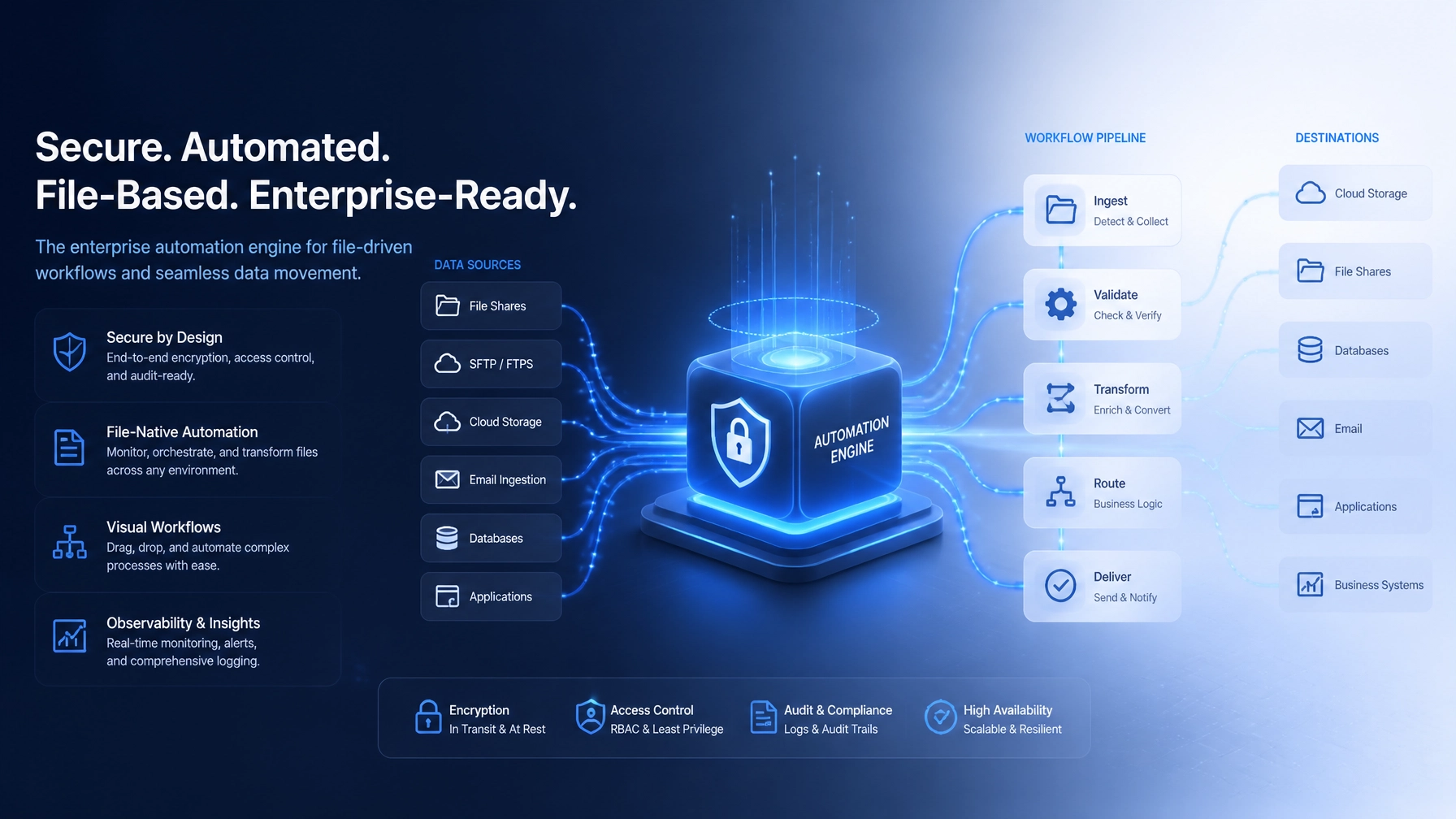
The system was designed around several coordinated layers:
- Secure file ingestion.
- File and record validation.
- Canonical data transformation.
- Workflow orchestration.
- Exception handling.
- Audit and governance.
- Dashboards and operational reporting.
- External system integrations.
This architecture matters because automation is only valuable when it preserves control. A file can arrive automatically and still create problems if the data is incomplete, the destination is unavailable, or the business rules are unclear.
The system therefore separated the movement of information from the decisions made about that information. That separation made the workflows easier to monitor, modify, and extend as operational requirements evolved.

Secure file ingestion with controlled handoffs
The first responsibility of FTP Inform was to establish a dependable entry point for file-based data.
Secure FTP and SFTP endpoints could be configured according to the needs of each workflow or business relationship. Credentials, connection settings, directories, and monitoring rules were managed centrally rather than distributed across individual scripts and servers.
When a file became available, the system could initiate processing without waiting for an employee to discover it manually. The ingestion process was designed to support:
- Controlled access to file locations.
- Secure credential management.
- File-type and naming-pattern recognition.
- Duplicate detection and processing safeguards.
- Event or schedule-based monitoring.
- Status tracking from arrival through completion.
The objective was not merely speed. It was consistency. Every file should pass through the same controlled sequence, with a clear record of what the system received and what happened next.
Validation that protects downstream operations
In a file-based environment, bad data is often more expensive than a missing file. A missing file can trigger an alert. A malformed file may pass through several systems before the problem becomes visible.
FTP Inform was structured to validate data before it entered downstream workflows. Validation could be applied at both the file level and the record level.
Examples include:
- Confirming that required columns or fields are present.
- Checking file structure against client-specific schemas.
- Normalizing data types and formats.
- Identifying missing values or invalid identifiers.
- Detecting unexpected balances, statuses, or consent fields.
- Comparing file contents with expected business rules.
- Producing feedback reports for rejected or incomplete records.
Validated records could then be translated into a consistent internal data model. This canonical model reduced the need for every connected system to interpret every partner’s unique format.
That approach is central to effective business process automation consulting. The goal is not to automate inconsistency. The goal is to create a reliable operational standard while preserving the flexibility required by different partners and departments.
Workflow orchestration turns data into action
File ingestion and validation create the foundation. Workflow orchestration creates business value.
Once data was accepted and normalized, FTP Inform could route it according to defined rules. In a debt and fintech environment, those rules might include account status, aging category, balance range, jurisdiction, contact restrictions, or recovery priority.
In another industry, the same orchestration model could route:
- Healthcare referrals based on intake responses and provider criteria.
- Accounting documents based on entity, period, or approval status.
- Legal matters based on practice area, jurisdiction, and assigned team.
- E-commerce files based on inventory thresholds, fulfillment status, or marketplace.
- Professional-services requests based on service type, urgency, and staff capacity.
The system’s value came from making these decisions explicit and repeatable.
Typical workflow actions included:
- Routing records to the correct department or queue.
- Triggering notifications when a file or process reached a defined state.
- Initiating API calls to connected platforms.
- Updating internal records and dashboards.
- Assigning work according to rules.
- Creating follow-up tasks or review requirements.
- Escalating items that exceeded defined time thresholds.

Exception handling is where scalable automation proves itself
A mature automation system does not assume that every file will be correct or every integration will be available. It defines what happens when reality deviates from the expected path.
FTP Inform treated exceptions as first-class workflow states rather than silent failures.
Invalid records could be separated into a quarantine or review queue while valid records continued through the process, depending on the business rules. Failed connections, missing files, duplicate submissions, and processing delays could be logged and routed to the appropriate owner.
This model gives operations teams the information they need to act:
- What failed?
- At which stage did it fail?
- Which records were affected?
- Was the issue caused by the source file, a connection, or a downstream system?
- Who owns the next action?
- Was the issue resolved, retried, or overridden?
This is a meaningful distinction between a script and an automation platform. A script performs a task. A governed system manages the task, its outcomes, and its exceptions.
Auditability, dashboards, and integration governance
Every high-volume workflow eventually becomes a management and governance problem. Leaders need to know whether work is moving, where it is delayed, and whether the organization can demonstrate what occurred.
FTP Inform was designed to provide a centralized activity history covering file arrival, validation, processing, routing, integration events, retries, and resolution activity.
A practical audit trail can support:
- Operational investigations.
- Partner communication.
- Internal accountability.
- Compliance reviews.
- Service-level monitoring.
- Historical reporting.
- Root-cause analysis.
Dashboards translate this activity into operational visibility. Instead of asking employees to search folders, review scripts, or reconcile spreadsheets, stakeholders can monitor workflow status through a unified interface.
Integrations extend that visibility into the systems already used by the organization. Depending on the operating model, a custom platform may connect with telephony providers, payment systems, accounting ledgers, CRMs, data warehouses, notification services, or internal APIs.
The integration strategy should be deliberate. Not every system needs to be replaced. The purpose of custom development is to create a reliable coordination layer around the systems that matter.

Designing for scale without multiplying complexity
Scalability is not only a question of processing more files. It is also the ability to add partners, workflows, rules, and users without creating a new maintenance burden each time.
FTP Inform demonstrated several principles that support that outcome:
- Reusable workflow templates for common file-processing patterns.
- Configuration-driven partner and endpoint management.
- Standardized validation and retry policies.
- Separation between business rules and infrastructure.
- Centralized monitoring across multiple connections.
- Role-based access to operational information.
- Structured data models that support future integrations.
This creates a path from one custom workflow to a broader AI-powered business system. Once data is structured and observable, organizations can introduce additional intelligence, such as anomaly detection, prioritization recommendations, document classification, or predictive routing.
AI should not be added as a disconnected feature. It should be applied where the underlying workflow, data ownership, and governance are already clear.
Measuring the operational impact
Because this project is presented as a proprietary proof-of-concept rather than a public client performance report, PTC does not assign unsupported numeric results to the implementation.
The measurable impact of a system like FTP Inform should instead be evaluated against the organization’s baseline. Relevant measures may include:
- Time from file arrival to validated processing.
- Number of manual touchpoints per file or record.
- Frequency of duplicate or rejected submissions.
- Time required to identify and resolve exceptions.
- Number of systems requiring manual reconciliation.
- Time required to onboard a new partner or workflow.
- Percentage of file activity covered by centralized audit logs.
- Staff hours redirected from monitoring toward higher-value work.
The important transformation is structural: file movement becomes visible, validation becomes consistent, exceptions become actionable, and workflows become easier to extend.
What FTP Inform means for other industries
The same proven capabilities can transfer well beyond debt and fintech operations.
PTC has built related proof-of-work across healthcare, field operations, local SEO, and other complex environments:
- Healthcare: Thrive and EHRIO demonstrate structured 70-question intakes, matching engines, and HIPAA-adjacent workflows.
- Operations and field services: D2D Tracking demonstrates rep accountability and GPS logging.
- Debt and fintech: Telephony integrations and call attribution support high-volume, compliance-sensitive operations.
- Local SEO: AI Local Boost demonstrates Google Business Profile automation across distributed locations.
These examples reinforce a broader point: PTC is not starting from scratch when entering legal, accounting, healthcare, debt, fintech, or professional-services environments. The domain logic changes, but the engineering capabilities remain transferable.
Build the operating system your business actually needs
FTP Inform illustrates how custom web application development can convert a fragile file-based process into a scalable operating model.
For organizations managing complex data exchanges, the opportunity is larger than replacing scripts. It is the opportunity to create a governed digital foundation for automation, integration, reporting, and future AI solutions.
If your teams are still coordinating critical workflows through folders, spreadsheets, email, and disconnected enterprise tools, visit https://puretechconsult.com to explore a more deliberate path forward.
Book a discovery call to review your workflow architecture, identify the highest-value automation opportunities, and define a practical roadmap. You can also contact Pure Technology Consulting at +1 (803) 921-0969.
Amin Said, Founder of Pure Technology Consulting LLC
https://puretechconsult.com
Leave a Reply