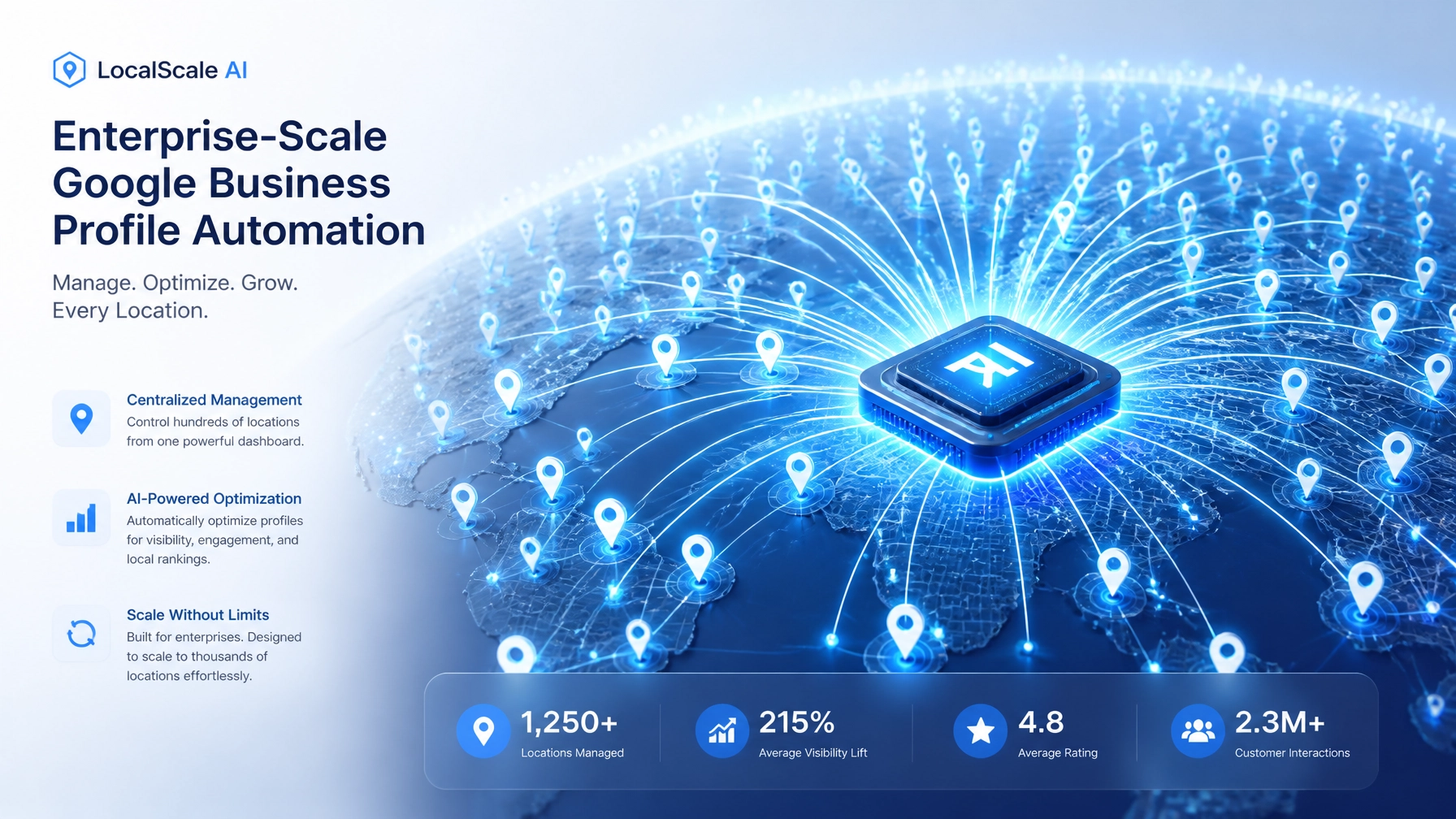
For a multi-location service business, every Google Business Profile is a revenue asset. It influences how customers discover a location, evaluate its reputation, request directions, make a call, or schedule an appointment.
The challenge is operational consistency. Managing one profile manually may be practical. Managing dozens, hundreds, or more requires a different operating model.
At Pure Technology Consulting, we engineered AI Local Boost as a proof-of-concept for what is possible when local SEO is treated as a custom software and automation problem: not simply a marketing task.
The platform demonstrates our capabilities in custom web application development, bespoke AI solutions, and enterprise automation consulting. It combines data aggregation, AI-generated content, workflow orchestration, multi-location controls, reporting, and white-label infrastructure into one scalable system.
The result is an AI-powered business system designed to maintain local visibility with less manual effort and greater operational control.
The business challenge: local SEO does not scale linearly
Multi-location brands often manage local SEO through a collection of spreadsheets, reminders, agency portals, and disconnected directory tools.
That model creates several problems:
- Location data becomes inconsistent across Google and other directories.
- Review responses are delayed or handled unevenly.
- Google Business Profile posts are published inconsistently.
- Local teams lack visibility into which locations need attention.
- Marketing teams spend time repeating administrative work instead of improving strategy.
- Agencies and channel partners struggle to deliver consistent execution across client accounts.
The problem becomes more significant as a business grows. Adding locations adds profiles, reviews, content calendars, approvals, data changes, and reporting requirements.
A platform built for one location cannot simply be duplicated hundreds of times. The underlying architecture must account for tenancy, permissions, data isolation, rate limits, error handling, audit trails, and different business rules for every location.
That required the approach of a custom software development agency: understand the operating model first, then build the technology around it.

Product vision: a local SEO operating system
We designed AI Local Boost to function as a centralized local visibility engine.
The objective was not to promise automatic rankings. Search performance depends on market competition, business relevance, customer behavior, profile quality, and many other factors. The objective was to automate the repeatable work that supports a stronger local presence while giving operators appropriate oversight.
The platform was designed to coordinate four major workflows:
- Audit and data accuracy
- AI-assisted content and engagement
- Review and reputation management
- Performance monitoring and reporting
This architecture allows a team to establish a repeatable local SEO playbook and apply it across locations without treating every profile as a separate manual project.
Engineering the data foundation
Effective automation begins with trustworthy data.
AI Local Boost was designed around a location-level data model that can collect and organize information about each business entity, including:
- Business name, address, phone number, and hours
- Service categories and descriptions
- Service areas and local attributes
- Website content and brand messaging
- Reviews and customer sentiment
- Existing posts, images, and videos
- Directory and citation status
- Performance trends across locations
This creates a structured profile graph for each location. Instead of asking an operator to search through multiple systems, the platform can identify missing information, inconsistencies, and opportunities from a central dashboard.
The data layer also provides the context required for AI-generated content. A post for a physical therapy clinic should not sound like a post for a permanent jewelry brand. A multi-location counseling center may require a more careful and regulated brand voice than a general home services company.
By connecting business context with location data, the system can produce content that is more relevant, differentiated, and aligned with the client’s operating standards.
Building the AI content and workflow orchestration layer
The intelligence layer combines large language models with rules, templates, business logic, and approval controls.
That distinction is important. An AI model can generate text, but enterprise automation requires more than text generation. It requires predictable behavior.
AI Local Boost was engineered to support workflows such as:
- Drafting Google Business Profile posts based on services, location, and seasonality
- Creating responses to customer reviews based on sentiment and context
- Identifying reviews that require human escalation
- Recommending profile improvements
- Selecting or organizing relevant media
- Maintaining a repeatable publishing cadence
- Triggering actions based on events from connected systems
The system can use brand voice instructions, location-specific details, and content history to reduce repetition. It can also apply different operating rules based on the risk of an action.
For example, adding a routine post may be eligible for automated publishing. Changing a primary category, business name, or core address should receive a higher level of review.
This combination of AI and governance is central to responsible ai workflow automation. The goal is not to remove people from important decisions. It is to remove unnecessary repetition while preserving control over high-impact changes.
Automating the review lifecycle
Reviews influence trust, conversion, and the amount of attention required from local teams.
At scale, the challenge is not simply responding to reviews. It is managing the entire lifecycle:
- Detecting new reviews
- Classifying sentiment
- Prioritizing urgent or negative feedback
- Drafting context-aware responses
- Routing exceptions to the appropriate team
- Recording approval and publishing history
- Connecting completed transactions to review-request workflows
AI Local Boost was designed around a suggest-and-approve model. The system can analyze a review and generate a response in the brand’s approved voice. Teams can then approve responses individually, approve batches, or define rules for lower-risk scenarios.
This creates a practical balance between efficiency and reputation governance.
The same architecture can support integrations with CRMs, scheduling systems, point-of-sale platforms, and intake workflows. When a customer completes a defined event, the system can trigger a follow-up request without requiring staff to remember another administrative task.

Scaling the system across hundreds of locations
AI Local Boost was built with multi-location operation as a core requirement rather than a later enhancement.
The platform’s architecture supports:
- Separate business and location entities
- Shared templates with local customization
- Role-based access and approval permissions
- Centralized and location-level dashboards
- Automated task scheduling
- Event-driven workflows
- Error logging and retry logic
- Change history and rollback capability
- Partner and white-label configurations
This matters for both enterprise operators and agencies. A franchise group may need corporate governance with local flexibility. A marketing partner may need to manage multiple client accounts under its own branding. A service business may want regional managers to approve content while maintaining central standards.
White-labeling therefore involves more than changing a logo. It requires tenant-aware infrastructure, flexible permissions, branded reporting, account isolation, and a configuration model that can support different commercial relationships.
These are the same considerations we address in broader business automation consulting engagements: how should the system operate, who should control it, what data should move between systems, and how can the organization measure performance?
Reporting that connects activity to business value
Automation is only valuable when leadership can see what it is accomplishing.
AI Local Boost was designed to organize reporting around operational and marketing indicators such as:
- Profile completeness and data accuracy
- Review volume, sentiment, and response time
- Publishing cadence by location
- Directory consistency and correction status
- Local visibility trends
- Calls, direction requests, and website actions
- Location-level exceptions requiring attention
This reporting model helps teams move beyond activity metrics. A business does not automate local SEO to publish more posts for their own sake. It automates the process to improve consistency, reduce labor dependency, strengthen customer trust, and create more opportunities for qualified local demand.
The return on investment can be evaluated through several measurable categories:
- Staff hours reclaimed from repetitive profile management
- Faster response times for customer reviews
- Lower error rates across location data
- Reduced agency or administrative overhead
- Improved visibility into underperforming locations
- Increased capacity to support additional locations without proportional headcount growth
The most important benefit is often operational leverage. When a central team can manage a larger footprint without duplicating manual work, growth becomes easier to support.

AI Local Boost as proof of broader engineering capability
AI Local Boost is one example of how Pure Technology Consulting builds complex systems around real business workflows.
The same engineering principles appear across our other proof-of-work pillars:
- Healthcare: EHRIO includes matching engines, intelligent scheduling concepts, and detailed 70-question intake workflows for HIPAA-adjacent operational environments.
- Field operations: Door-to-door tracking systems use GPS logging and representative accountability to improve visibility across distributed teams.
- Fintech and debt management: Telephony integrations support call attribution, workflow tracking, and operational reporting for high-volume agencies.
- Multi-location operations: ChainHQ demonstrates how centralized architecture can reduce data silos across inventory, events, and sales activity.
This experience is especially relevant for professional services firms, including legal and accounting organizations. These businesses often need secure intake, document routing, client communication, approvals, and reporting: but may not have the resources or technical team to build those systems internally.
PTC brings proven capabilities into those environments. Clients do not have to begin with a blank page.
When a custom build is the right strategy
Off-the-shelf software is useful when a business can adapt its workflow to the product. Custom development becomes more compelling when the workflow itself is a competitive advantage.
A bespoke system may be appropriate when you need to:
- Coordinate data across multiple existing platforms
- Support unique approval and compliance requirements
- Manage complex location or account relationships
- Create a branded partner or white-label experience
- Connect marketing activity to operational events
- Build reporting around your own performance model
- Scale without increasing manual administration at the same rate
The right question is not whether custom software costs more than a subscription. The better question is whether the operating leverage, control, and strategic differentiation justify a purpose-built system.
That is the lens we bring to digital transformation consulting, ai consulting services, and business process automation consulting engagements.
Build the system your growth requires
AI Local Boost began as an internal proof-of-concept. It became a demonstration of how an AI-powered platform can coordinate complex, repetitive, multi-location workflows with structure and governance.
For high-growth service businesses, enterprise teams, and white-label partners, the opportunity extends beyond local SEO. The same architecture can support custom CRMs, intake systems, scheduling platforms, operational dashboards, customer engagement engines, and proprietary SaaS products.
If manual processes, disconnected tools, or fragmented data are limiting your next stage of growth, book a discovery call with Pure Technology Consulting. We can help map the workflow, identify the highest-value automation opportunities, and define a practical roadmap for a custom build.
+1 (803) 921-0969
Amin Said, Founder of Pure Technology Consulting LLC
https://puretechconsult.com
Leave a Reply