Written by Amin Said
When scaling a business across multiple physical locations, regional hubs, or pop-up branches, operational friction is almost always the silent growth killer. As multi-location enterprises expand, off-the-shelf software solutions frequently fracture. Each store, clinic, or regional office adopts disparate tools, local spreadsheets, and siloed databases. The result? Fragmented reporting, duplicated data entry, inventory blind spots, and leadership teams making high-stakes decisions based on delayed, incomplete information.
At Pure Technology Consulting, our work with high-growth enterprises and proprietary platforms like ChainHQ proves a fundamental truth: overcoming operational friction requires more than patching together disparate SaaS subscriptions. It demands purpose-built, scalable engineering. Through disciplined custom web application development, enterprises can replace brittle multi-system stacks with unified, multi-location architectures that turn geographic complexity into a competitive advantage.
In this case study, we examine the architectural blueprint behind ChainHQ, demonstrating how strategic enterprise automation consulting and bespoke engineering eliminate data silos, streamline operations, and unlock true enterprise scalability.
The Multi-Location Dilemma: Why Off-the-Shelf SaaS Breaks Down
Growing businesses: from permanent jewelry brands and multi-location medical clinics to regional service providers: frequently reach an inflection point where standard, single-location software platforms fail.
When an organization operates across five, ten, or fifty distinct locations, standard SaaS products often force companies into one of two undesirable compromises:
- Isolated Instances per Location: Setting up an independent account or software instance for every branch. While this gives local teams immediate autonomy, it instantly creates severe data silos. HQ has no real-time visibility into inventory levels, customer lifetime value, or cross-branch performance without manual report consolidation.
- Rigid Monolithic Restraints: Forcing every location into a rigid, non-customizable global tool that lacks the nuanced workflows required for local service delivery, localized pricing, or regional tax and compliance variations.
[Store A: Isolated DB]    [Store B: Isolated DB]    [Store C: Isolated DB]
         \                        |                         /
          v                       v                        v
            --> [ Fragmented Data Silos & Blind Spots ] <--
This structural disconnect leads directly to operational drag: staff spend hours reconciling inventory discrepancies, managers lack cross-site performance benchmarks, and leadership operates in the dark. For enterprises aiming to scale without linear increases in administrative headcount, these friction points are unsustainable.
The Architectural Solution: Unified Infrastructure with Location-Aware Modeling
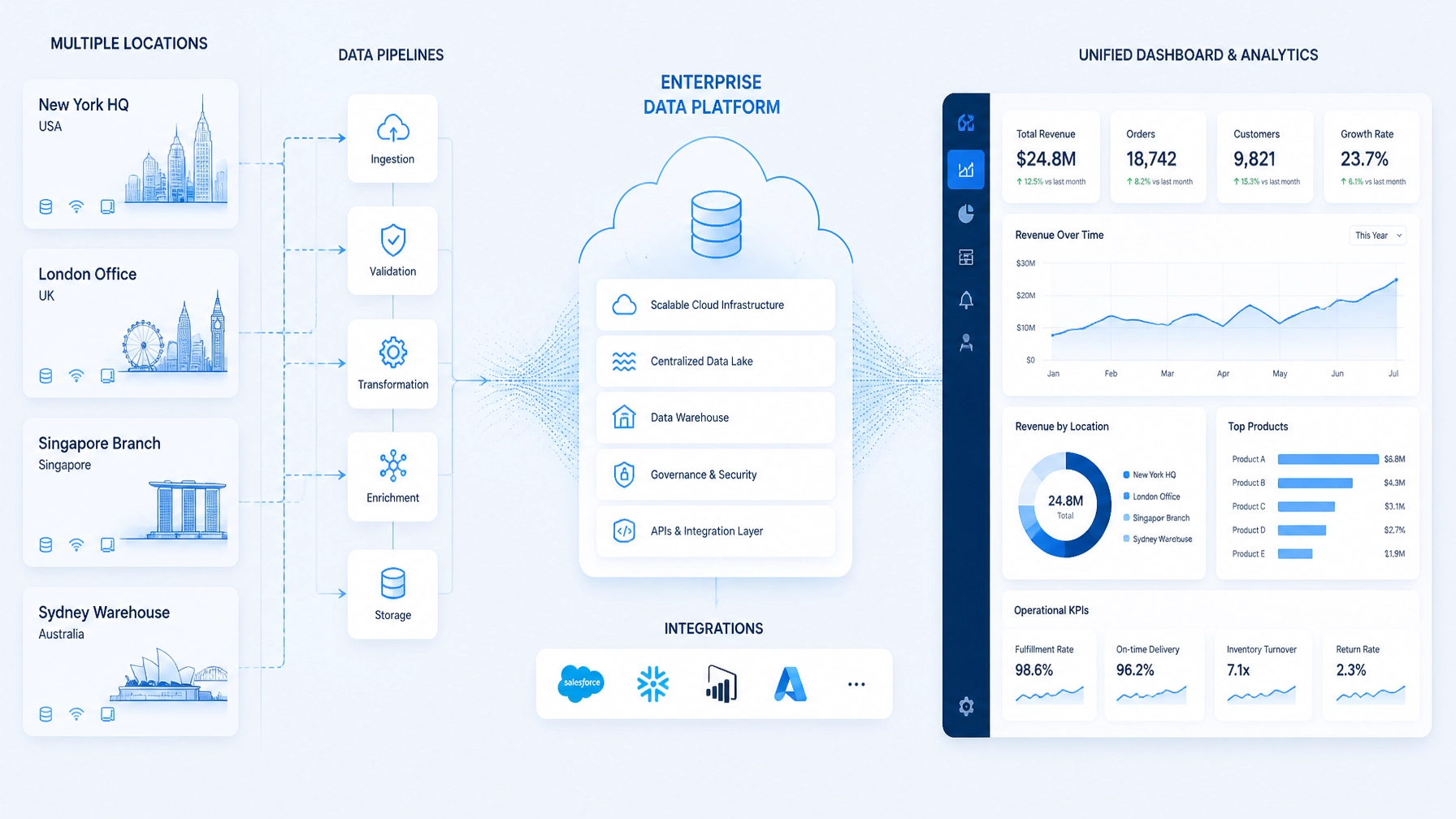
To solve the multi-location data silo challenge for ChainHQ, our engineering and consulting teams approached the architecture not as a collection of separate storefronts, but as a single, distributed, location-aware ecosystem.

Through advanced custom software development agency capabilities, we established a robust foundation centered around core architectural principles:
1. Centralized Data Core with Scoped Entities
Rather than spinning up separate databases for every location, ChainHQ utilizes a unified multi-tenant schema where core entities: such as customers, master product catalogs, and global financial records: live in a centralized, highly secure repository. However, every transactional record is enriched with tenant and location identifiers (tenant_id, location_id).
This structure ensures that:
- Headquarters maintains complete, real-time visibility across all operational touchpoints.
- Local Managers see only the data, inventory, and staff rosters relevant to their specific branch without sacrificing global governance.
2. Hierarchical Inventory and Supply Chain Syncing
In multi-location retail and service operations, inventory movement between warehouses, pop-up events, and permanent storefronts is notoriously difficult to track accurately. ChainHQ models inventory hierarchically (Global Warehouse $\rightarrow$ Regional Hub $\rightarrow$ Storefront Shelf). Every transfer is logged via automated event-driven workflows, ensuring real-time stock accuracy, eliminating shrinkage, and preventing overselling.
3. Granular Role-Based Access Control (RBAC)
Enterprise scalability requires strict security governance. By integrating granular permissions directly into the application layer, regional directors, store associates, and executive leadership interact with tailored interfaces. Staff members see streamlined workflows customized to their daily tasks, while executives access high-level analytical dashboards.
Streamlining Workflows Through Intelligent Automation
Architecture alone is only half the equation. True operational transformation requires removing manual intervention from repetitive, error-prone administrative tasks. As part of our comprehensive digital transformation consulting engagements, we design automated workflows that connect the software layer directly to day-to-day business execution.

In the ChainHQ ecosystem, automation serves several critical functions:
- Automated Reordering & Threshold Alerts: When local stock dips below predefined velocity thresholds, purchase orders trigger automatically upstream, notifying suppliers before stockouts occur.
- Consolidated Financial Reconciliation: Daily sales, local tax breakdowns, and payment gateway payouts are automatically normalized and mapped to enterprise accounting systems, cutting bookkeeping reconciliation time from days to minutes.
- Cross-Location Customer Profiles: A customer visiting a permanent jewelry location in one city can have their profile, purchase history, and preferences instantly recognized at a pop-up branch in another city, delivering a seamless brand experience.
Measuring Impact: From Operational Drag to Predictable Growth
When businesses replace disconnected tools with a purpose-built, unified web application, the operational metrics shift dramatically:
| Operational Dimension | Fragmented SaaS Stack | Unified Custom Architecture (ChainHQ Model) |
|---|---|---|
| Inventory Visibility | Delayed (24–72 hour manual reports) | Real-time across all locations and pop-ups |
| HQ Reporting Time | Days of spreadsheet consolidation | Instantaneous, multi-dimensional dashboards |
| Administrative Overhead | High (frequent manual reconciliation) | Minimized through event-driven automation |
| Cross-Branch Consistency | Low (custom workarounds per site) | Enforced governance with local flexibility |
By partnering with Pure Technology Consulting for custom web application development, businesses transition from reactive firefighting to proactive, data-driven scaling.
Strategic Roadmap: How to Evaluate Your Multi-Location Architecture
If your organization is experiencing the growing pains of multi-location data silos, evaluating your technology stack requires a deliberate, consultative approach. Here is how executive leadership teams can begin assessing their digital maturity:
- Audit Data Flow Intersections: Identify where operational data is manually copied between systems (e.g., from point-of-sale to inventory sheets to accounting software). Each manual transfer represents an automation opportunity and a potential data silo.
- Evaluate SaaS Limitations: Determine whether your current third-party tools constrain your expansion plans or require costly, fragile middleware integrations just to share basic customer records across branches.
- Engage in Strategic Advisory: Partner with experienced engineering consultants who understand enterprise architecture, workflow automation, and scalable database design.

Conclusion: Build for Where Your Business Is Going
Technology should never be the bottleneck holding your enterprise back. As demonstrated by platforms like ChainHQ, investing in bespoke, multi-location software architecture transforms operational complexity into a seamless engine for predictable growth.
At Pure Technology Consulting, we partner with growth-minded leaders across healthcare, professional services, e-commerce, and multi-location operations to design and deploy custom web applications and AI-driven automation systems that stand the test of time.
Ready to eliminate operational data silos and build a scalable foundation for your enterprise? We invite you to explore our capabilities and schedule a discovery session with our advisory team.
Visit us at https://puretechconsult.com to learn more about how we engineer custom software solutions tailored to your unique operating model.
Amin Said, Founder of Pure Technology Consulting LLC
https://puretechconsult.com
Phone: +1 (803) 921-0969
Leave a Reply