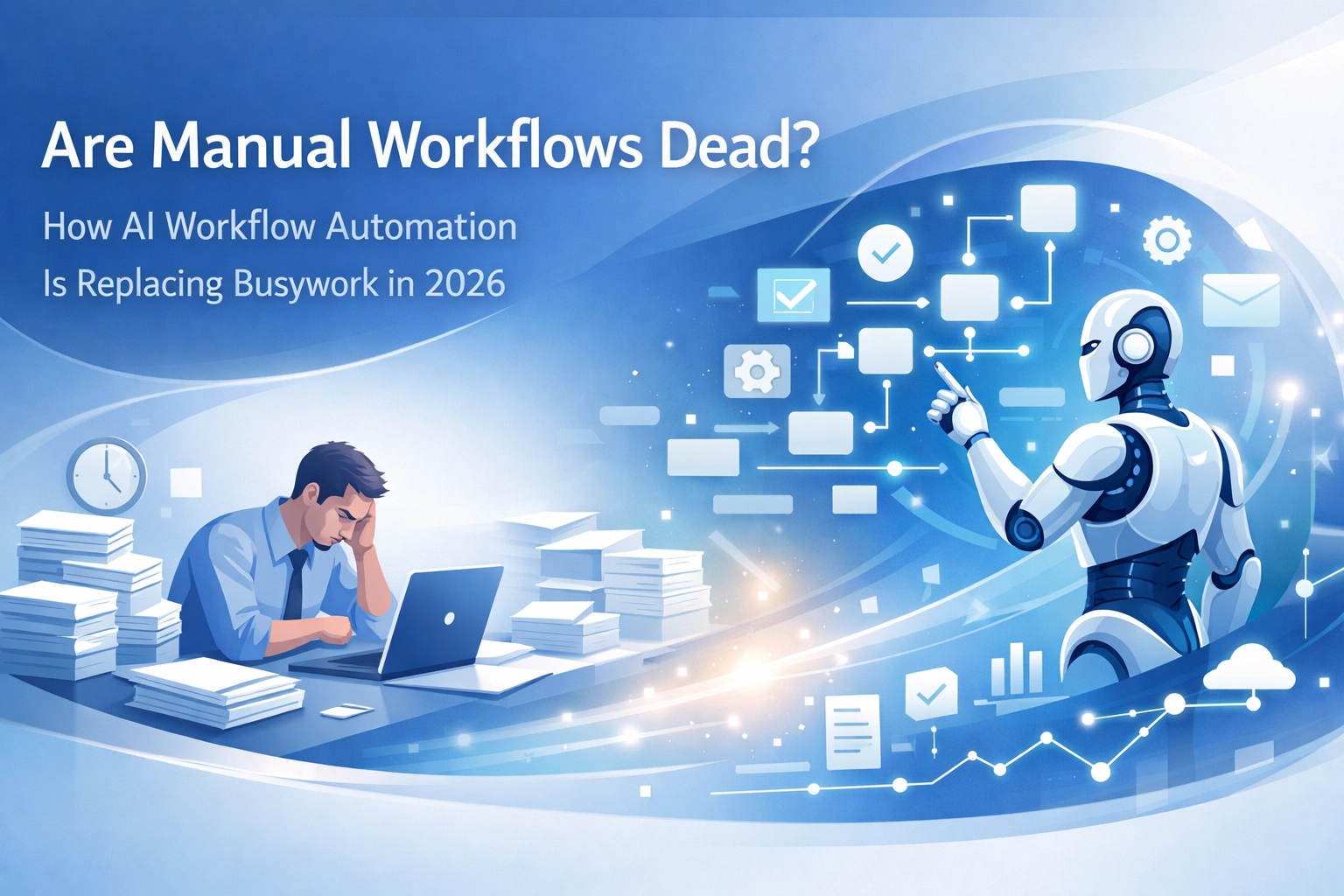
As we navigate the first quarter of 2026, the definition of "efficiency" has undergone a radical transformation. For decades, businesses relied on manual workflows: sequential tasks driven by human intervention: to move data from point A to point B. Even the first wave of automation, characterized by simple "if-this-then-that" rules, still required constant oversight and rigid structuring.
Today, that model is effectively obsolete. We have entered the era of Agentic AI, where workflows are no longer static paths but intelligent, self-correcting ecosystems. At Pure Technology Consulting, we are seeing a fundamental shift: our clients are no longer asking how to automate a task; they are asking how to orchestrate an entire outcome.
The question isn't just whether manual workflows are dead: it’s how quickly your organization can transition to an autonomous operating model before the competitive gap becomes insurmountable.

From Rule-Based Logic to Autonomous Orchestration
In 2024 and 2025, many firms felt "automated" because they had integrated their CRM with their email marketing tool. However, those systems were still fragile. If a data format changed or an unexpected variable entered the mix, the workflow broke, requiring a human to step in and fix the "busywork."
In 2026, the landscape is defined by intelligent orchestration. Agentic systems now possess the capability to detect work as it happens, analyze the context, and execute multi-step tasks across disparate software environments. These agents don’t just follow a script; they make decisions.
For example, in high-stakes industries like legal and accounting, a manual workflow might involve a staff member manually sorting through incoming discovery documents or tax records. An agentic workflow, however, can ingest those documents, cross-reference them against historical data, flag inconsistencies, and even initiate a request for missing information: all before a human even opens their laptop for the day.
This level of custom automation is where we focus our expertise. By building bespoke web applications that integrate these agentic capabilities, we help firms move from being "reactive" to being "predictive."
Solving the Data Movement Bottleneck: The Role of FTP Inform
One of the greatest hurdles in the path toward full automation has always been the secure and timely movement of data. Many legacy industries still rely on FTP (File Transfer Protocol) for large-scale data exchanges, but these processes are often black boxes. If a file doesn't arrive, the workflow stalls, and the manual "busywork" of checking folders begins.
This is why we developed FTP Inform. It serves as a prime example of how we bridge the gap between legacy requirements and modern AI-driven oversight. FTP Inform provides real-time monitoring and automated notifications for file transfers, ensuring that the foundational data for your AI workflows is exactly where it needs to be, when it needs to be there.
Instead of a staff member manually verifying file uploads from a vendor or a remote office, FTP Inform automates the confirmation and triggers the next step in the autonomous chain. It’s about creating a "zero-friction" environment where the AI has the fuel it needs to operate without human hand-holding. You can explore how this fits into a larger technical architecture at ftpinform.puretechconsult.com.

Authority in Action: Lessons from Healthcare and Fintech
Our transition into the legal and accounting sectors is built upon a decade of rigorous software development in high-compliance industries. We don't start from scratch; we bring proven frameworks to the table.
In the healthcare sector, our work with EHRIO Pro demonstrated the power of complex matching engines. We developed 70-question intake systems that didn't just collect data but analyzed it in real-time to match patients with the right providers or clinical trials. This HIPAA-adjacent workflow logic is now being applied to legal intake, where the "busywork" of vetting potential clients can be handled by an AI agent that understands context and conflict-of-interest parameters.
Similarly, our work in Fintech and debt recovery involved deep telephony integrations and call attribution. We didn't just record calls; we built systems that could analyze sentiment and trigger follow-up actions based on the verbal cues of a conversation.
When a law firm or an accounting practice partners with Pure Technology Consulting, they aren't just getting a developer; they are getting a roadmap for transformation. Whether it’s GPS logging for field accountability or sophisticated matching engines for high-volume intake, our video walkthroughs showcase the tangible impact of these custom builds.
Scaling the Unscalable: AI Local Boost (AILB)
One area where manual workflows traditionally dominated was local SEO and reputation management. Responding to reviews, updating Google Business Profiles, and maintaining local citations was the definition of "busywork" for marketing managers.
Through AI Local Boost (AILB), we have demonstrated that even the most "human" tasks: like engaging with a local community: can be intelligently automated. AILB uses proprietary AI to manage Local SEO at scale, ensuring that a business’s digital footprint is always optimized without requiring a manual update every time a customer leaves a review.
This isn't about "bot-like" responses; it's about using AI to maintain a visionary and inspirational brand tone across thousands of touchpoints. It’s a testament to how custom automation can handle the nuances of brand voice while eliminating the drudgery of manual execution.

The Shift in Human Capital: From "Doers" to "Governors"
As AI agents take over the execution of workflows, the role of the employee is shifting. In 2026, the most valuable team members are no longer those who can perform the most tasks, but those who can govern the most systems.
IT leaders and operations managers are moving into a "governance" role. They define the standards, set the security parameters, and optimize the AI’s performance. This shift allows for unprecedented scalability. Instead of hiring ten people to handle a 50% increase in workload, a firm can simply scale their compute power and refine their agentic logic.
However, this transition requires a strategic roadmap. Moving from manual to autonomous isn't an overnight switch; it’s a phased integration. At Pure Technology Consulting, my assistant Emily works with our team to coordinate discovery calls where we audit your existing "busywork" and identify the high-leverage areas for custom development.
The goal is to move your high-value talent away from data entry and into strategic decision-making. If your senior associates are still spending 20% of their week on manual workflows, you aren't just losing time: you're losing the opportunity to innovate.
Why Custom Development Beats Off-the-Shelf SaaS in 2026
The market is flooded with SaaS solutions promising "one-click" automation. While these are useful for generic tasks, they often fail when faced with the unique complexities of a specialized business.
Bespoke web applications are the only way to ensure that your automation fits your operations, rather than forcing your operations to fit a software’s limitations. Whether it is a custom dashboard for real-time GPS logging or a complex telephony integration for a debt agency, custom builds provide:
- Full Data Sovereignty: You own your data and the logic that processes it.
- Seamless Integration: No more "middleman" software that breaks when an API updates.
- Scalable Architecture: Built specifically for your growth trajectory, not a generic user base.

Taking the Next Step Toward an Autonomous Future
The death of manual workflows is an opportunity for those ready to lead. In 2026, the businesses that thrive will be those that viewed AI not as a tool, but as a new way of operating.
At Pure Technology Consulting, we specialize in building the infrastructure of the future. From custom web development to high-level automation consulting, we provide the visionary leadership and technical expertise required to replace busywork with progress.
If you are ready to audit your current workflows and explore the possibilities of bespoke AI integration, we invite you to start the conversation. The transition from manual drag to autonomous momentum begins with a single strategic decision.
To discuss your roadmap or to request a workflow audit, you can reach our team at 888-424-7779 or 803-715-4200. We look forward to helping you build what’s next.
You can also book a discovery session directly via our scheduling page to see how our proprietary capabilities can be tailored to your specific industry needs.
Amin Said, Founder of Pure Technology Consulting LLC
https://puretechconsult.com
Leave a Reply