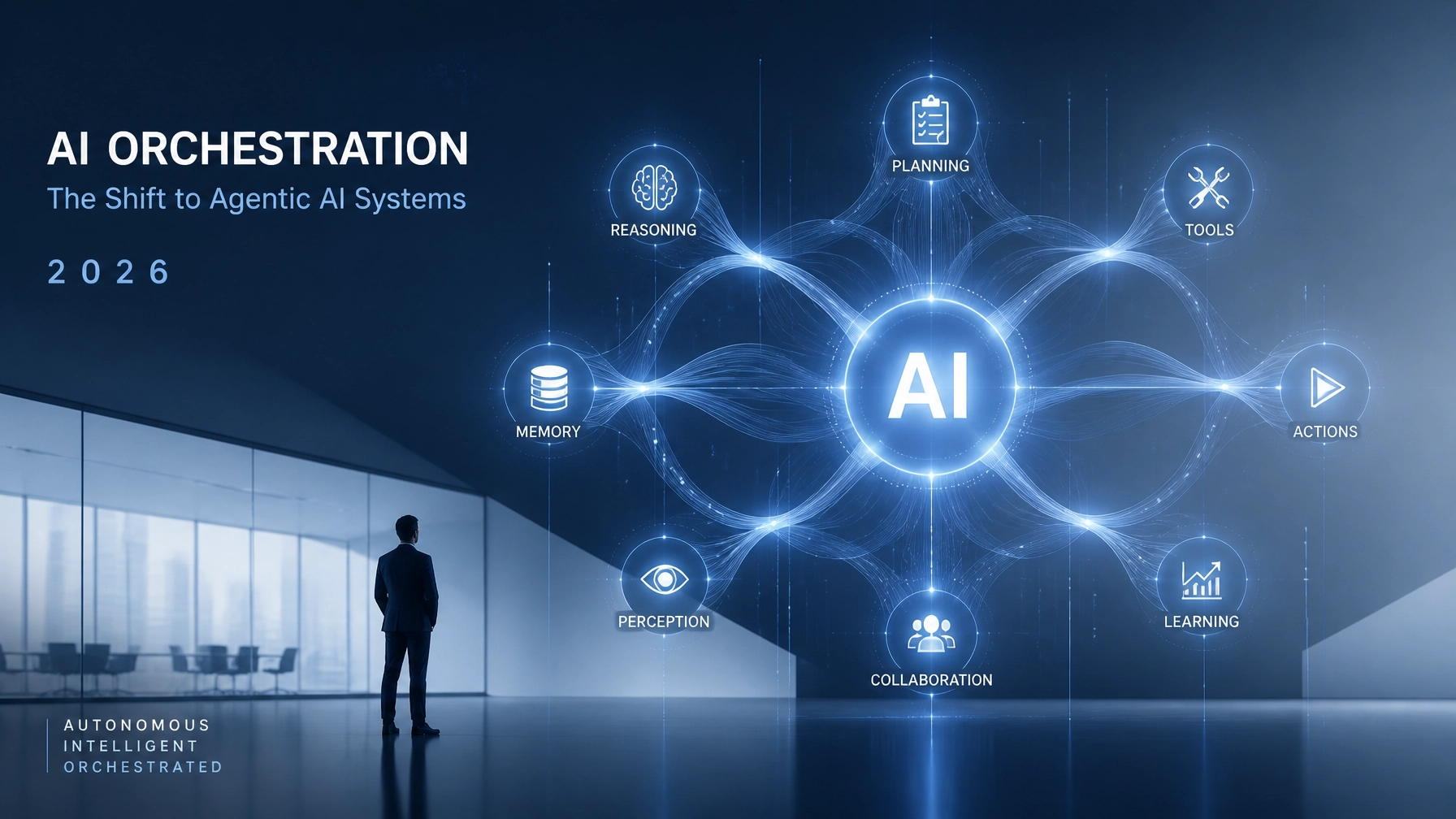
The landscape of business technology has undergone a tectonic shift. In 2026, the question is no longer whether you should automate your service business, but how that automation should think, learn, and act. For years, the gold standard was "traditional automation": the deterministic, "if-this-then-that" logic that streamlined repetitive tasks. However, as we navigate a new era of digital transformation consulting, a more sophisticated contender has moved from the experimental fringe to the operational core: Agentic AI.
At Pure Technology Consulting (PTC), we see this transition not as a replacement of old tools, but as an evolution of the business operating model. The shift from rigid workflows to autonomous agents is redefining how high-growth service firms scale. Whether you are managing a multi-location healthcare clinic or a specialized legal practice, understanding the nuance between these two approaches is the difference between incremental efficiency and exponential leverage.
The Deterministic Anchor: Traditional Automation
Traditional automation is the bedrock of the modern office. It is built on scripts, rules, and triggers. When a lead fills out a form on your website, a traditional system moves that data into your CRM, sends a pre-written email, and notifies your sales team.
This is deterministic technology. It is predictable, auditable, and reliable. For business process automation consulting, these systems are ideal for high-volume, low-complexity tasks where the rules never change.
Where Traditional Automation Excels:
- Structured Data Processing: Invoicing, payroll, and standardized reporting.
- Linear Workflows: Moving data from Point A to Point B without the need for interpretation.
- Compliance-Heavy Steps: Actions that require a strict audit trail and zero deviation from a set protocol.
However, traditional automation has a "fragility" problem. If the format of the incoming data changes slightly, or if a customer asks a question that wasn't pre-programmed, the workflow breaks. This is where enterprise automation consulting has pivoted toward a more resilient architecture.
The Orchestration Layer: Agentic AI
Agentic AI represents a leap from execution to orchestration. Unlike its predecessor, an AI agent doesn't just follow a list of instructions; it understands a goal.
If traditional automation is a train on a fixed track, Agentic AI is an autonomous vehicle. It knows its destination, can interpret traffic patterns, navigate around obstacles, and choose the most efficient route in real-time. In the context of bespoke AI solutions, this means a system that can reason through complex customer inquiries, research missing information across multiple databases, and execute multi-step processes without human hand-holding.

Why 2026 is the Year of the Agent
In 2026, the cost of inference has plummeted, and the reasoning capabilities of large language models have matured to a level where they can be trusted with operational authority. Industry leaders are no longer building simple "bots"; they are investing in AI-powered business systems that act as digital employees.
According to recent market analysis, nearly 40% of enterprise applications now embed task-specific agents. These systems don't just "complete a task": they "achieve an outcome." For a service business, this means moving from "sending a reminder" to "ensuring the appointment is confirmed and the intake paperwork is 100% complete before the patient arrives."
Pure Technology Consulting: Proven Capabilities in Complex Automation
At PTC, we don't just talk about the future of AI; we build the infrastructure that powers it. Our history in custom web application development has allowed us to create proprietary platforms that serve as high-performance blueprints for our clients. These are not just SaaS products; they are proof-of-concept examples of how scalable technology can solve industry-specific bottlenecks.
1. Healthcare: Precision Intake and Matching
In the healthcare sector, our work with systems like EHRIO Pro demonstrates the power of "agentic-like" logic. By building 70-question intake engines that can intelligently route data based on complex medical logic, we’ve shown how ai workflow automation can handle high-stakes, HIPAA-adjacent environments. This isn't just data entry; it’s a matching engine that understands the nuance of patient needs vs. provider availability.

2. Local SEO: Dynamic Orchestration
Our experience with AI Local Boost showcases how we automate the Google Business Profile ecosystem. Instead of manual updates, we’ve developed systems that can autonomously manage digital visibility across hundreds of locations. This is ai consulting services in action: building a system that monitors local search trends and adjusts strategy without human intervention.
3. Fintech and Operations: High-Volume Accountability
Whether it's call attribution for debt collection agencies or GPS-logged accountability for field sales teams, PTC’s custom builds are designed for sectors where data integrity and operational oversight are non-negotiable. These platforms serve as the technical backbone, allowing businesses to scale without a corresponding increase in manual labor.
Choosing Your Path: Strategy and Roadmap
For the growth-focused local business owner or the operationally constrained service firm, the choice isn't always binary. The most successful digital transformation consulting strategies today utilize a hybrid model.
When to Choose Custom Traditional Automation:
- Your process is 100% predictable.
- You require a strict, immutable audit trail for every action.
- The primary goal is cost-reduction of simple, repetitive tasks.
When to Invest in Bespoke Agentic AI Solutions:
- Your workflows involve "unstructured" data (emails, voice notes, PDFs).
- You deal with high exception rates that currently require human intervention.
- You want a system that can cross-reference multiple platforms (CRM, Billing, EHR) to solve a single customer problem.
The Executive Roadmap to AI Orchestration
Transitioning to a high-leverage operating model requires more than just buying software; it requires a partner who understands the intersection of code and business strategy. Pure Technology Consulting specializes in identifying the friction points in your current workflow and building the custom web application development solutions to eliminate them.
The journey begins with a workflow audit. We look at where your staff is currently acting as the "connective tissue" between disconnected systems. By replacing these manual bridges with business automation consulting and agentic orchestration, we unlock hidden capacity within your existing team.

In 2026, the competitive advantage belongs to those who own their technology stack. Off-the-shelf SaaS can only take you as far as your competitors. A bespoke solution, built on the foundations of proven automation and the intelligence of agentic AI, provides a proprietary advantage that cannot be easily replicated.
Ready to Build Your Future?
The shift toward autonomous business systems is an investment in your company’s long-term scalability. At Pure Technology Consulting, we bring proven capabilities from healthcare, fintech, and professional services to help you navigate this transition.
Let’s design your roadmap to 2026.
Contact Pure Technology Consulting:
Phone: +1 (803) 921-0969
Website: https://puretechconsult.com
Discovery: Book a Workflow Audit
Amin Said, Founder of Pure Technology Consulting LLC
https://puretechconsult.com
Leave a Reply