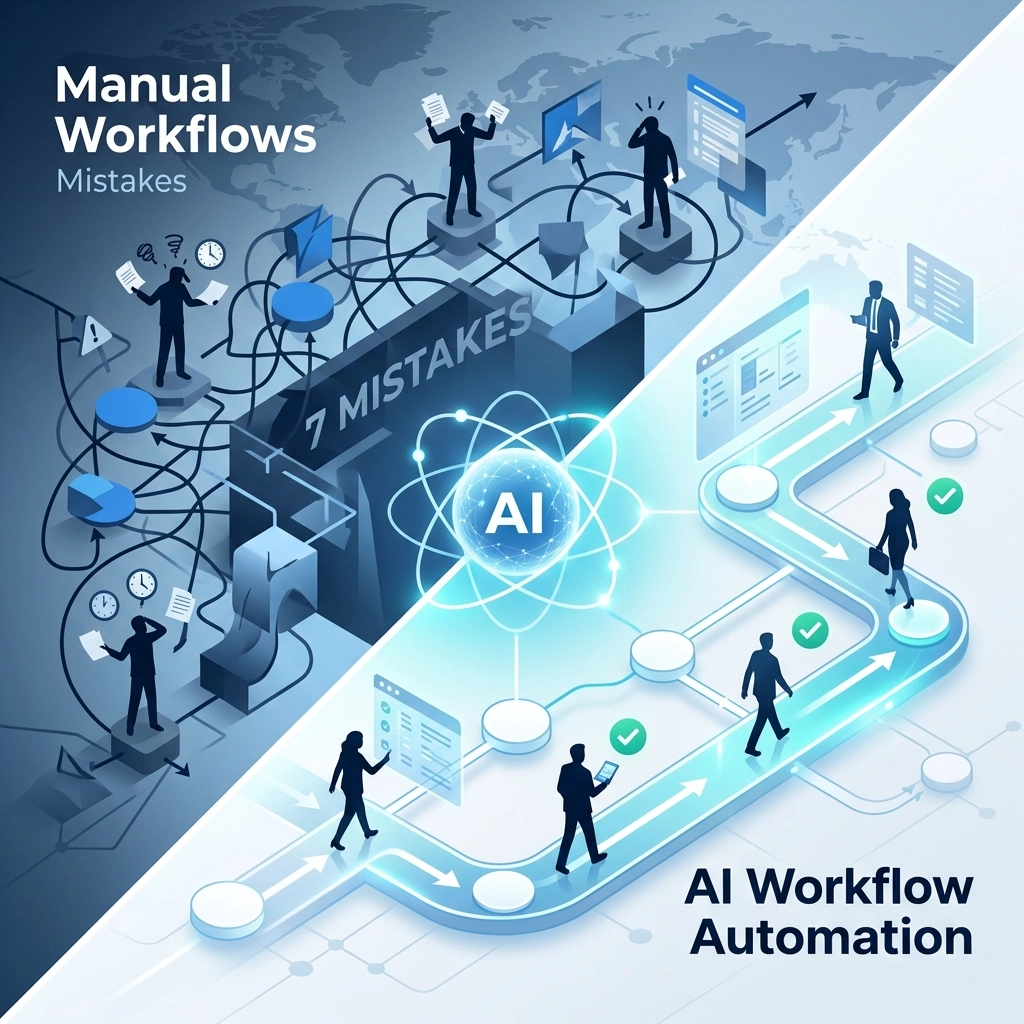
In the modern enterprise, the silent killer of growth isn’t a lack of vision; it’s the "manual drag." We see it every day: brilliant teams bogged down by spreadsheet maintenance, frantic email threads, and the repetitive "data shuffle" that keeps them from high-value strategic work.
At Pure Technology Consulting, we believe that software should serve humanity, not the other way around. When we look at manual workflows, we don't just see tasks; we see lost opportunities for innovation. If your business relies on "tribal knowledge" and manual intervention to keep the lights on, you are operating at a fraction of your potential capacity.
Here are the seven most common mistakes businesses make with manual workflows and how visionary AI automation: the kind we build every day: can turn those liabilities into your greatest competitive advantages.
1. Treating Data Entry as a "Necessary Evil"
The most common mistake is accepting manual data entry as a cost of doing business. When your staff spends hours moving data from a CRM to a spreadsheet or from a lead form to a database, you aren't just paying for their time: you’re paying for the inevitable human errors that follow.
The AI Fix: Automation doesn't just copy-paste; it validates and enriches. AI-powered systems can extract data from unstructured sources (like emails or PDFs) and instantly populate your core systems with 100% accuracy.
Proof in Action: AI Local Boost
Our proprietary tool, AI Local Boost, demonstrates this perfectly. Instead of manually managing local SEO signals and Google Business Profile updates: a task that is notoriously tedious and prone to being forgotten: AI Local Boost automates the local presence of a business. It takes the manual "guesswork" out of local visibility, ensuring that data is consistent and optimized without a human ever having to click "submit."

2. The "Silent Handoff" Failure
In manual workflows, work often dies in the "in-between." A salesperson finishes a lead, but the operations team doesn't know it's ready. A lawyer completes a draft, but the paralegal is buried in other tasks and misses the notification. These manual handoffs create bottlenecks that slow down your entire revenue cycle.
The AI Fix: Intelligent workflow orchestration. Instead of relying on someone to remember to send an email, an automated system monitors task completion and instantly triggers the next phase of the project, complete with the necessary context and documentation. This ensures that "idle time" is virtually eliminated.
3. Scaling via Headcount Rather Than Systems
When a business grows, the instinct is often to hire more people to handle the increased volume of manual tasks. This is a linear growth model that eventually erodes profit margins. If your operational costs grow at the same rate as your revenue, you aren't scaling: you’re just getting bigger and more complex.
The AI Fix: Building a digital nervous system. By automating the core logic of your business, you allow your existing team to handle 10x the volume. You move from a linear growth model to an exponential one.
Proof in Action: ChainHQ
We developed ChainHQ to solve this exact problem for complex operations. Whether it's managing supply chains or intricate project milestones, ChainHQ acts as an automated backbone. It replaces the need for dozens of "check-in" meetings and manual status updates by providing a single, automated source of truth that scales infinitely without requiring a proportional increase in staff.
4. Relying on "Tribal Knowledge"
If your business stops functioning because one key employee is on vacation, you have a manual workflow crisis. Manual processes often live inside people's heads rather than in code. This makes your organization fragile and difficult to audit.
The AI Fix: Codifying your expertise. When we build custom web applications, we take the "logic" used by your best employees and bake it into the software. This ensures that every task is performed according to your highest standards, every single time, regardless of who is at the desk.

5. Overlooking High-Stakes Complexity
Many businesses shy away from automating complex workflows: like healthcare intakes or legal discovery: because they believe these tasks require a "human touch." The mistake here is confusing "human judgment" with "manual processing." Humans are great at judgment; they are terrible at remembering 70 different compliance checkboxes.
The AI Fix: High-logic intake and matching engines. We build systems that handle the complexity so the human can focus on the decision.
Proof in Action: EHRIO Pro
In the healthcare space, we built EHRIO Pro to handle incredibly complex patient intakes and matching. By using a 70-question intake logic, the system automates the heavy lifting of compliance and data gathering. It ensures that no detail is missed, adhering to HIPAA-adjacent workflows that would be impossible to manage manually at scale without significant risk.
6. Managing File Transfers and Data Silos Manually
We still see executives manually downloading CSV files from one portal and uploading them to an FTP server or a different SaaS tool. This is a waste of executive brainpower and a massive security risk. Manual file handling is where data leaks and version control issues thrive.
The AI Fix: Automated data pipelines. Your data should flow like water: unseen and frictionless: between your various platforms.
Proof in Action: FTP Inform
Our solution, FTP Inform, was designed specifically to bridge these gaps. It provides automated monitoring and alerts for file movements, ensuring that critical data is where it needs to be, when it needs to be there. It turns a manual, "hope-based" file transfer process into a governed, automated utility. You can explore more about how we handle these integrations at ftpinform.puretechconsult.com/help.

7. Ignorance of the "Blind Spots"
With manual workflows, you can’t improve what you can’t measure. How long does it take to onboard a client? Where do most leads drop off? In a manual system, finding these answers requires more manual work (audits and reports). Most businesses simply guess.
The AI Fix: Real-time operational visibility. Because every step of an automated workflow is logged, you gain instant access to bottlenecks and performance metrics. You move from "management by intuition" to "management by data."
The Visionary Path Forward
The transition from manual to automated isn't just about software; it’s about a change in leadership philosophy. It’s about deciding that your team’s time is too valuable to spend on tasks that a machine can do faster, cheaper, and more accurately.
At Pure Technology Consulting, we specialize in building the bespoke tools that make this transition possible. Whether it's integrating complex telephony for fintech firms or building GPS-logged accountability systems for field operations, our goal is to provide the operational leverage you need to dominate your market.
We don't just build apps; we build "operating models" for the future. We bring proven capabilities from healthcare, fintech, and professional services to help you eliminate the manual drag once and for all.
Are you ready to audit your workflows and see where AI can unlock your next level of growth?
If you're ready to move beyond the manual mistakes of the past, let’s talk. We offer deep-dive discovery calls to map your current processes and identify the high-leverage points where custom automation can transform your bottom line.
Next Steps:
- Audit: Review your team’s weekly schedule. Any task repeated more than five times a week is a candidate for automation.
- Strategize: Book a discovery call with our team to explore a custom roadmap.
- Execute: Move from manual drag to automated momentum.
The future is automated. The only question is whether you will build it or be left behind by those who do.
Amin Said, Founder of Pure Technology Consulting LLC
https://puretechconsult.com
Phone: +1 (803) 921-0969
Leave a Reply