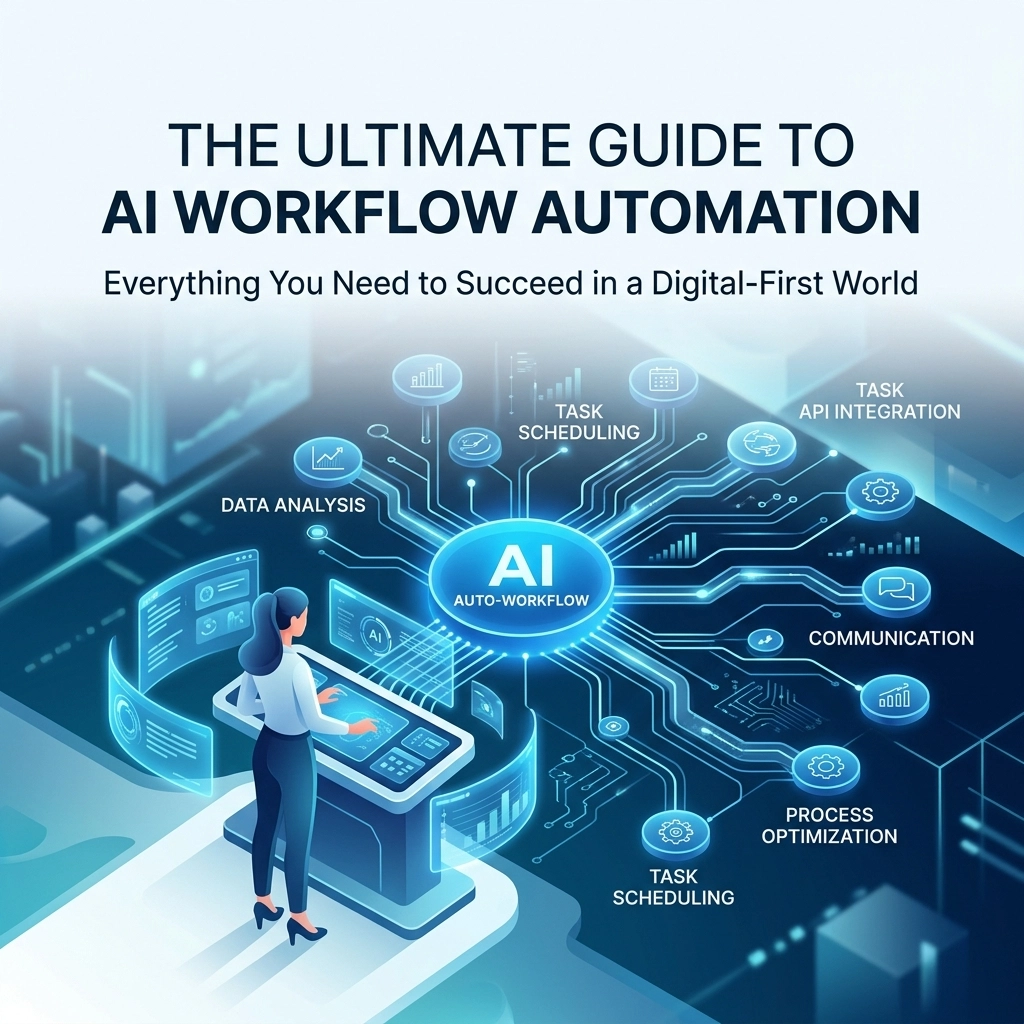
The landscape of modern business is no longer defined by who has the most data, but by who can move that data with the greatest speed and intelligence. As we navigate the complexities of 2026, the term "digital transformation" has evolved from a corporate buzzword into a fundamental survival mechanism. For executives in high-stakes industries like legal, accounting, and healthcare, the challenge is clear: legacy manual processes are the anchors holding back institutional growth.
AI workflow automation represents the next frontier of operational excellence. It is the shift from simple, rule-based task execution to intelligent, adaptive systems that think, learn, and optimize in real-time. This guide explores how bespoke automation and custom-built software solutions are redefining the modern operating model, allowing firms to achieve unprecedented scale without the proportional increase in overhead.
The Evolution of Automation: From RPA to Agentic Intelligence
Early iterations of automation focused on Robotic Process Automation (RPA): software "bots" that mimicked human keystrokes to complete repetitive tasks. While effective for simple data entry, RPA lacks the cognitive flexibility required for complex decision-making.
Today, we have entered the era of Agentic AI. This involves creating intelligent agents capable of understanding context, interpreting unstructured data, and executing multi-step workflows across disparate systems. In a digital-first world, success is found in the orchestration of these agents. Instead of a human manually moving a PDF from an email to a CRM, an intelligent workflow identifies the document type, extracts relevant metadata, checks it against compliance rules, and updates the necessary databases: all while alerting the relevant stakeholders of any anomalies.

Strategic Pillars of High-Impact Automation
To successfully implement AI workflow automation, organizations must focus on three core pillars: integration, intelligence, and governance. At Pure Technology Consulting, we view these not just as technical requirements, but as strategic assets.
1. Intelligent Document Processing (IDP)
In sectors like law and accounting, documents are the primary currency. Manual review is slow, prone to error, and expensive. IDP leverages natural language processing (NLP) to turn unstructured text into actionable data. This is a capability we have refined through projects like EHRIO Pro, where complex 70-question intake forms are processed and matched against healthcare provider networks with surgical precision.
2. Decision Orchestration
Automation is most valuable when it handles the "grey areas" of business. Decision orchestration uses machine learning models to determine the next best action in a workflow. Whether it is routing a high-value lead or flagging a suspicious transaction in a fintech application, the system adapts based on real-time inputs.
3. Unified Communication Loops
Data silos are the enemy of efficiency. A truly automated workflow ensures that information flows seamlessly between the front-end user experience and back-end operations. Our work with FTP Inform demonstrates this perfectly, providing a secure, automated bridge for file management and communication that ensures stakeholders are never left in the dark.
Where Custom Software Beats Off-the-Shelf SaaS
Many organizations fall into the trap of trying to force their unique business processes into the rigid structures of "one-size-fits-all" SaaS platforms. While these tools have their place, they often create "integration debt": the cost of building workarounds to make the software do what you actually need.
Bespoke web applications and custom automation allow for a "fit-to-purpose" architecture. For example, in our work within the fintech and debt recovery space, we have integrated complex telephony systems with call attribution models. This isn't something a standard CRM can handle out of the box; it requires a deep understanding of how data must move to drive rep accountability and GPS logging, similar to our D2D Tracking solutions for field operations.
When you build custom, you are not just buying a tool; you are building an intellectual property asset that provides a competitive moat.

Industry Spotlight: Bringing Proven Capabilities to Legal and Accounting
The pivot toward AI-driven automation is particularly urgent for professional services. We are seeing a massive trend where legal and accounting firms are adopting technologies originally perfected in high-volume sectors like healthcare and field ops.
- The Healthcare Blueprint: Our experience with EHRIO Pro and HIPAA-adjacent workflows has taught us how to manage sensitive data under strict regulatory scrutiny. These same principles of secure data matching and automated intake are now being applied to legal discovery and client onboarding.
- The Fintech Connection: The telephony and call attribution integrations we’ve built for debt agencies are being repurposed for law firms to track billable hours and client interactions automatically, removing the burden of manual time-tracking.
- The Local Authority: Through AI Local Boost (AILB), we have mastered the art of Google Business Profile automation. For professional service firms, this means maintaining a dominant local SEO presence and managing reputation without a dedicated marketing team.
The Roadmap to Implementation: A Consultative Approach
Implementing high-level AI automation is not a weekend project; it is a strategic engagement. At Pure Technology Consulting, we follow a rigorous roadmap to ensure that every custom build delivers a clear ROI.
- Discovery & Workflow Audit: We begin by mapping your current processes to identify bottlenecks and "low-hanging fruit" for automation. This is where we determine if a custom build or an integration of our existing proprietary assets like ChainHQ is the best path forward.
- Architecture & Scoping: We design a solution that fits your existing tech stack while allowing for future scalability. This involves selecting the right AI models and defining the data governance framework.
- Bespoke Development: Our team builds the custom web applications and automation engines. We focus on creating intuitive interfaces that ensure high internal adoption.
- Integration & Testing: We connect the new system to your legacy databases, CRM, and communication tools, ensuring a "single source of truth" for your data.
- Deployment & Optimization: Post-launch, we monitor the system’s performance, using real-world data to fine-tune the AI models for even greater accuracy.

Quantifying the Value of Automation
The impact of AI workflow automation is measured in more than just hours saved. It is measured in:
- Cycle Time Reduction: Moving a client from intake to service delivery 40% faster.
- Error Reduction: Eliminating the "human element" in data entry, which can lead to costly compliance risks.
- Throughput: Enabling a small team to handle a volume of work typically reserved for an enterprise-level department.
- Strategic Leverage: Freeing your senior partners to focus on high-level advisory work rather than administrative oversight.
Building for the Future
As we look toward the remainder of 2026 and beyond, the gap between automated firms and manual firms will only widen. The question for leadership is no longer if you should automate, but how fast you can do so while maintaining the integrity of your brand and the security of your data.
Pure Technology Consulting specializes in building these bridges. Whether you are looking for a bespoke matching engine, a custom CRM integration, or a complete overhaul of your digital operating model, we bring the expertise of a seasoned consultancy with the agility of a cutting-edge software house.
The future is automated. Let's build it together.
To explore how bespoke AI workflow automation can transform your operations, schedule a discovery call or reach out to our team at +1 (803) 921-0969.
Explore more of our insights on our official blog or learn about our specific solutions like FTP Inform.
Amin Said, Founder of Pure Technology Consulting LLC
https://puretechconsult.com
Leave a Reply