By Amin Said, Founder of Pure Technology Consulting LLC
In the world of physical therapy and chiropractic care, we talk a lot about the "magic hands." We talk about the clinical breakthroughs, the moment a patient regains their range of motion, and the relief on their face when the chronic pain finally subsides. But there’s a quieter, more systemic challenge happening behind the front desk that most clinic owners are hesitant to address: the leaky bucket.
You spend thousands on local SEO, Facebook ads, and community outreach to get a new patient through the door. They show up for the initial evaluation, maybe attend two or three sessions, and then… they vanish. They become a "dormant" file in your EMR.
This is the Patient Retention Paradox. In an industry built entirely on human connection and physical presence, the key to keeping those human connections alive isn't more manual labor: it’s smarter automation.
At Pure Technology Consulting, we’ve seen this play out across various high-touch industries. Whether it’s healthcare or complex fintech workflows, the bottleneck is always the same: human beings are inconsistent, but systems are relentless.
The High Cost of the "New Patient" Obsession
Marketing studies consistently show that it costs 5–7 times more to attract a new patient than to keep an existing one. For a physical therapy clinic or a wellness center, this gap is even more pronounced. A new patient requires a full intake, a diagnostic overhaul, and a period of building trust from scratch.
An existing patient already knows your name. They know where to park. They know your value. Yet, many clinics treat retention as a "nice-to-have" secondary goal. They invest heavily in acquisition through aggressive lead flow but overlook the higher-value opportunity of keeping current patients engaged throughout their entire recovery journey.
If your retention rate drops, your acquisition cost effectively doubles. You aren't just losing a session fee; you’re losing the lifetime value (LTV) of that patient, their potential referrals, and the stability of your practice.

Why Manual Follow-Ups are Failing Your Staff
I’ve sat in plenty of clinics where the front-desk staff is heroic. They are answering phones, checking people in, handling insurance verifications, and trying to remember to call "Mrs. Jones" because she missed her Tuesday appointment.
But heroism doesn't scale.
When follow-ups depend on manual effort, gaps are inevitable. Life happens. The phones get busy, a staff member calls in sick, or the post-it note with the reminder gets buried under a stack of files. Research shows that clinics relying on manual systems suffer from significantly higher no-show rates.
When a patient misses a session without a prompt follow-up, they feel two things: guilt and a lack of accountability. If the clinic doesn't seem to notice they’re gone, they assume their presence (and their recovery) isn't that important. This is where the "drop-off" happens.
The Secret Weapon: Automated Follow-Ups
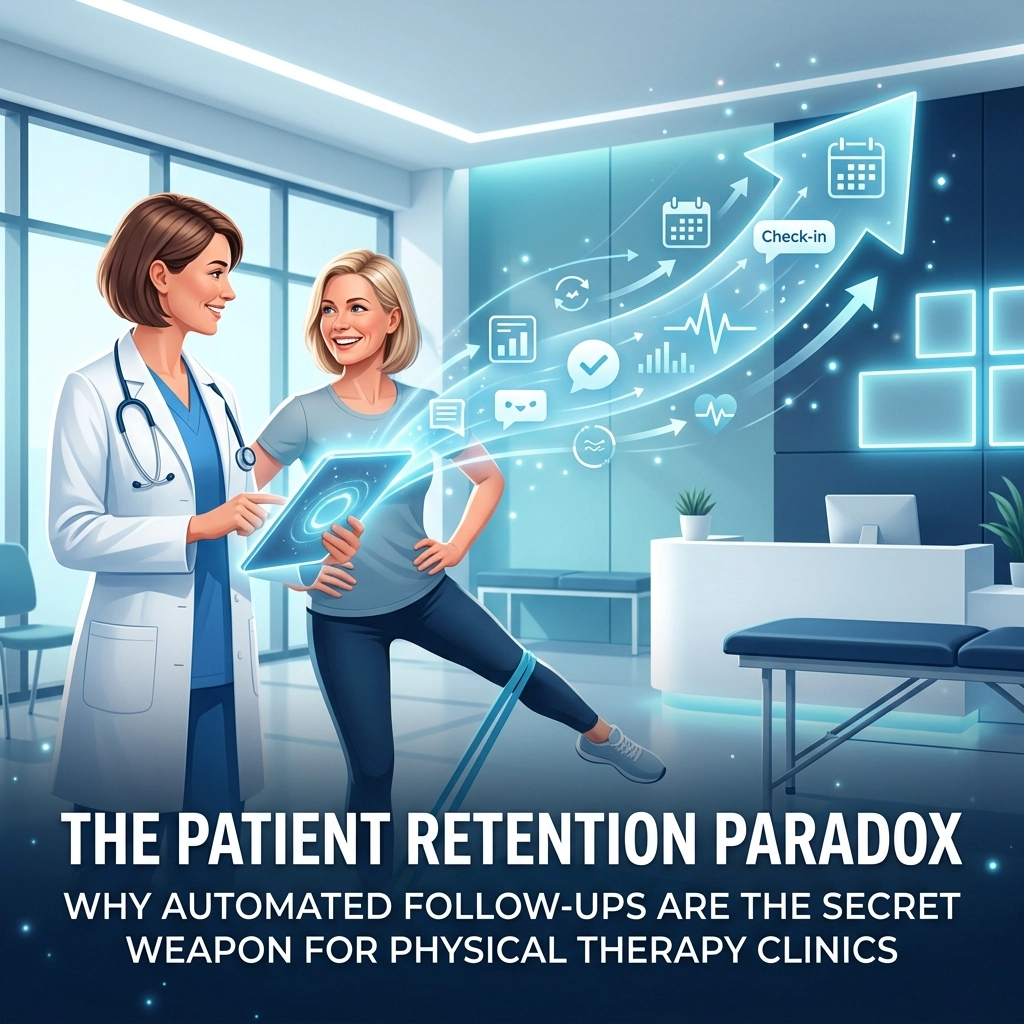
Automation isn't about replacing the warm greeting at the door; it’s about ensuring the conversation continues when the patient is at home. Modern CRM integration and automated workflows allow a clinic to maintain a "persistent presence" in the patient’s life without adding a single task to the staff’s to-do list.
1. Reducing No-Shows by 38%
The data is clear: clinics using automated reminder systems can reduce no-show rates by up to 38%. But a simple "See you tomorrow" text is just the baseline. The real "secret weapon" is the sequence that triggers when an appointment is missed.
An automated "We missed you" message sent within 15 minutes of a missed appointment: complete with a link to reschedule online: dramatically increases the likelihood of a rebooking before the patient has time to feel "checked out."
2. Reactivating the "Dormant" Patient
Every clinic has a goldmine of past patients who finished 80% of their treatment and then stopped. Automated "Check-in" sequences can reach out to these patients at the 30, 60, and 90-day marks.
Imagine a system that automatically emails a patient three months after their last visit: "Hi Sarah, it's been a few months since your last shoulder session. How are you feeling? If you're noticing any stiffness returning, you can book a quick tune-up here." One functional medicine practice we studied saw an 18% reactivation of dormant patients within 60 days just by implementing this one sequence.
3. Data-Driven Progress Tracking
One of the biggest reasons patients drop out of therapy is because they feel they aren't improving fast enough. Automation allows you to send objective progress reports or digital outcome tools (like the Oswestry Disability Index) directly to their phone.
When a patient sees a visual chart showing their mobility has increased by 25% over three weeks, their "buy-in" resets. Digital platforms provide the ongoing validation that continuing therapy is worth the time and money.

Resolving the Paradox: Automation + Human Touch
The fear most practitioners have is that automation will make their practice feel "cold" or "robotic." In reality, the opposite is true.
By automating the routine: reminders, intake forms, and basic follow-ups: you free up your staff to be more human. Instead of spending three hours a day playing phone tag, your front desk can spend three hours focusing on the person standing right in front of them.
We call this Humanized Automation. It’s a hybrid approach:
- Automated: Routine reminders, re-engagement emails, and lead nurturing.
- Human: Personalized clinical care, addressing complex concerns, and building the emotional bond.
At Pure Technology Consulting, we specialize in building these bespoke workflows. Whether it's integrating your EMR with a high-performance CRM or setting up AI Local Boost to ensure your clinic is the first one people see when they search for care, we focus on the operating model that drives actual revenue.
The Competitive Advantage
Less than half of independent clinics currently use advanced automation tools for patient communication. This represents a massive opportunity for the visionary clinic owner.
When you implement a system that ensures no patient is ever "forgotten," you aren't just running a more efficient business: you’re providing better care. Consistency is a clinical tool. If a patient completes their treatment plan because your system kept them engaged, their clinical outcome is better.
Better outcomes lead to more five-star reviews, which feeds into your local SEO through tools like AI Local Boost, creating a virtuous cycle of growth. You can see how these pieces fit together in our video walkthroughs.

The Path Forward: Strategy Over Hustle
If you find yourself on the treadmill of constant patient acquisition but your total patient volume isn't growing, it’s time to look at your retention strategy. You don't need more "hustle" from your staff; you need a more robust digital infrastructure.
At Pure Technology Consulting, we help clinics move from "episodic" care to a "relationship-based" business model through custom software and automation. We’ve done this for healthcare providers, field operations, and fintech firms, bringing a high-level consultative approach to every build.
Your patients deserve a recovery journey that doesn't have cracks in it. And you deserve a business that grows predictably, even when you aren't watching every single file.
Ready to stop the leak in your clinic’s bucket?
Let’s talk about building a system that works as hard as you do. We can audit your current workflow and show you exactly where automation can save your staff time and increase your patient lifetime value.
Book a discovery call with our team or explore our latest insights to see how we’re transforming the way local businesses operate.
Amin Said, Founder of Pure Technology Consulting LLC
puretechconsult.com
+1 (803) 921-0969
Visionary software development and custom automation for the modern enterprise.
Leave a Reply