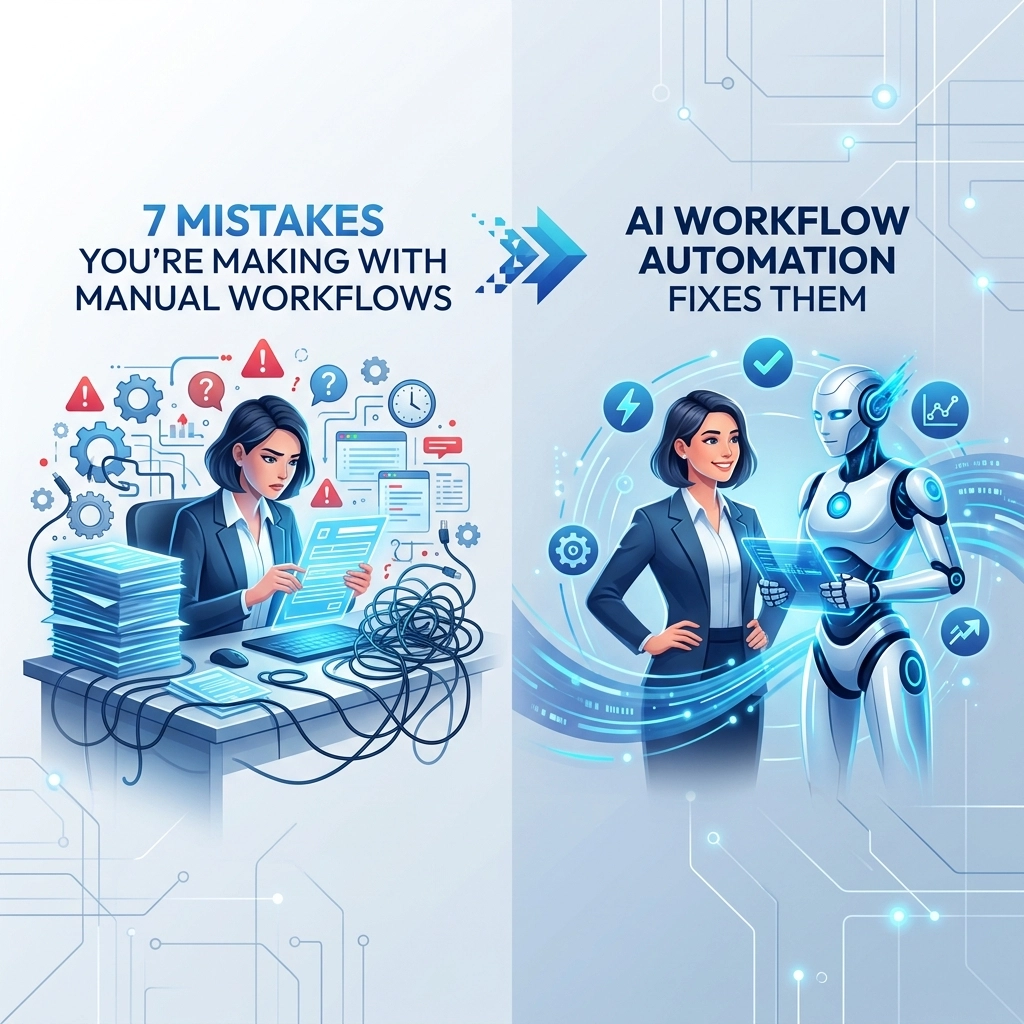
In the modern enterprise, the difference between a market leader and a struggling competitor often comes down to the efficiency of their underlying operating model. For years, businesses have relied on the grit and adaptability of their teams to navigate complex manual workflows. While human intuition is invaluable, using it to bridge the gaps in broken processes is a recipe for stagnation.
At Pure Technology Consulting, we view digital transformation not as a buzzword, but as a strategic necessity. We help high-ticket clients transition from "spaghetti infrastructure" to streamlined, AI-powered ecosystems. The goal is to move beyond the constraints of manual labor and unlock true operational leverage.
If your organization is still managing critical operations via spreadsheets, email chains, and manual data entry, you are likely falling into one of these seven common traps. Here is how AI workflow automation: and bespoke software development: can fix them.
1. Automating an Inherently Broken Process
One of the most frequent mistakes we see is the desire to "automate what we already do." If your manual process is inefficient, convoluted, or contains redundant steps, automating it as-is only results in making mistakes faster. Humans are remarkably good at working around "broken" steps through improvisation. AI, however, requires a logical roadmap.
The Fix: Before we write a single line of code, we engage in workflow mapping. We identify where steps can be eliminated rather than just digitized. This is the philosophy behind how we built EHRIO Pro. By taking complex healthcare intake processes: sometimes involving 70+ data points: and refining the matching engine logic first, we ensured the automation served a clean, optimized strategy rather than a legacy mess.
2. Ignoring the High Cost of Data Inconsistency
Manual workflows are notoriously prone to data fragmentation. One team member enters a phone number in one format; another misses a required field in a different spreadsheet. Over time, this "dirty data" creates a massive bottleneck. When you try to scale, your systems can’t talk to each other because the foundation is unstable.
The Fix: AI workflow automation enforces data integrity at the point of entry. In our custom builds, we implement intelligent validation and standardization layers. For instance, our work in the fintech and debt agency sectors involves complex telephony integrations where data attribution must be flawless. By automating the capture and formatting of call data, we eliminate the variance that human entry introduces, providing a "single source of truth" for the executive team.

3. The Hidden "Tax" of Manual Task Burden
Your highest-paid employees shouldn't be spending 20% of their week moving data between platforms or sending follow-up emails. This "manual task burden" is a silent tax on your profitability. It leads to burnout and, more importantly, distracts your talent from high-value strategic work.
The Fix: We design custom web applications that handle the "grunt work" autonomously. A prime example is AI Local Boost. In the local SEO space, managing Google Business Profiles manually across dozens of locations is a logistical nightmare. We automated the heavy lifting: from post scheduling to engagement tracking: allowing business owners to focus on growth rather than admin. This same principle applies to any industry; if a task is repetitive and rule-based, it belongs to the machine.
4. Fragmented "Spaghetti Infrastructure"
As companies grow, they often adopt "point solutions": a CRM here, a project management tool there, and a stack of Zapier "band-aids" in between. This results in a fragmented ecosystem where data is siloed and maintenance becomes a nightmare. When a key employee leaves, the tribal knowledge of how these systems connect often leaves with them.
The Fix: We advocate for centralized hubs and bespoke integrations. Our product FTP Inform was born from this exact need. In complex environments where data must move securely between disparate systems, FTP Inform provides the necessary visibility and centralized monitoring. It transforms fragmented data transfers into a transparent, governed process, ensuring that your infrastructure is an asset, not a liability.
5. Lack of Scalability: The Headcount Trap
If your only way to handle 20% more business is to hire 20% more people, your business model isn't scalable: it's just larger. Manual workflows create a linear relationship between volume and headcount. This limits your ability to capitalize on sudden market opportunities because your "human engine" can't rev any faster.
The Fix: AI-powered automation decouples output from headcount. By building bespoke web apps tailored to your specific operations, we create a system that can handle 10x the volume with the same team size. Whether it’s automating GPS logging and rep accountability in field operations or streamlining supply chain management through tools like ChainHQ, our goal is to build an engine that scales infinitely.

6. The Governance and Visibility Gap
In a manual workflow, it is nearly impossible to get a real-time view of your operations. Where are the bottlenecks? Which department is lagging? Without centralized monitoring, leadership is flying blind, making decisions based on "gut feeling" rather than hard data.
The Fix: Automated workflows provide built-in governance and performance dashboards. When we develop custom solutions, we integrate real-time reporting that tracks every step of the process. This level of visibility: similar to what we provide in our fintech telephony and call attribution builds: allows executives to identify and resolve friction points before they impact the bottom line. You can see a video walkthrough of how we approach these complex architectures to gain better insight.
7. Failing to Standardize the Operating Model
"The way we do things" should not vary from employee to employee. Manual workflows often lack standardization, meaning your quality of service is dependent on who is handling the file that day. This inconsistency erodes client trust and makes training new hires an uphill battle.
The Fix: We bake your "Best Practices" into the software itself. By using standardized logic and mandatory workflow stages, we ensure that every client experience is identical. Our work with legal and accounting firms focuses on this exact transition: taking the expertise of senior partners and codifying it into an automated system that the rest of the team follows. This is how you move from a "practice" to a "platform."
Moving from Discovery to Execution
Transitioning from manual workflows to AI-powered automation is a strategic evolution. It requires a partner who understands the nuance of your industry: whether it's the high-compliance world of healthcare and legal or the fast-paced environment of fintech and local SEO.
At Pure Technology Consulting, we don't just sell software; we build the custom operating models that drive the next decade of your growth. Our proprietary assets like ChainHQ, EHRIO Pro, and AI Local Boost serve as proof of our ability to solve complex, high-ticket operational challenges.
Are you ready to audit your current workflows and identify where manual drag is costing you? The path to a visionary operating model begins with a single conversation.

Next Steps for Your Transformation
- Audit your stack: Identify the three most repetitive tasks your team performs daily.
- Map your data: Determine if your systems are currently talking to each other or operating in silos.
- Consult the experts: Let’s discuss how a bespoke build can replace your manual bottlenecks.
To explore how we can tailor these solutions to your specific business needs, schedule a discovery call with our team. We specialize in high-level automation consulting and bespoke web app development designed for those who refuse to settle for "business as usual."
For more insights on digital transformation and custom software strategy, visit our blog.
Amin Said, Founder of Pure Technology Consulting LLC
https://puretechconsult.com
+1 (803) 921-0969
Leave a Reply