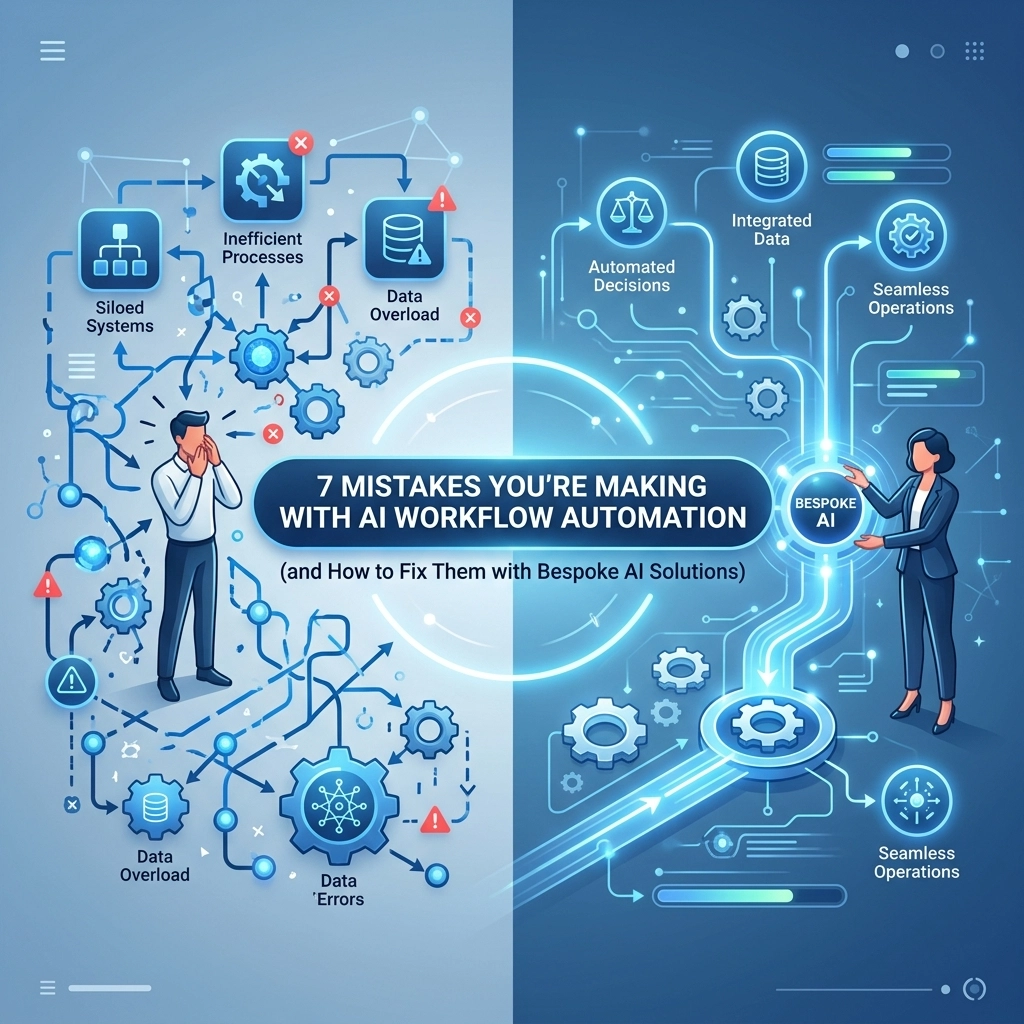
In the current landscape of 2026, Artificial Intelligence has moved beyond the realm of "innovation" and into the core infrastructure of every high-performing enterprise. However, as the initial hype settles, a stark divide is emerging between companies that have simply "added AI" and those that have fundamentally re-engineered their operating models through bespoke automation.
The promise of AI workflow automation is immense: reduced cycle times, eliminated manual errors, and the ability to scale output without linearly increasing headcount. Yet, many organizations find themselves trapped in a cycle of high costs and diminishing returns. They are discovering that off-the-shelf "wrappers" and generic prompt-engineering are insufficient for the complexities of professional services, healthcare, and specialized SaaS.
At Pure Technology Consulting, we’ve seen these pitfalls firsthand while architecting high-ticket custom solutions. To help you navigate this transition, we’ve identified the seven most critical mistakes leadership teams make when implementing AI automation: and more importantly, how to fix them with a visionary, bespoke approach.
1. Automating Broken or Opaque Processes
The most expensive way to fail is to automate a process that shouldn't exist in the first place. This is the "Garbage In, Garbage Out" principle accelerated to machine speed. When you take an inefficient manual workflow and apply AI, you don't solve the problem; you simply create automated chaos.
In manual environments, human judgment often acts as a "buffer" for broken steps. AI lacks that intuitive safety net. Without a rigorous audit, your automation will produce technically correct but contextually useless outputs at a rate your team cannot keep up with.
The Bespoke Fix: Before a single line of code is written, we advocate for "Process Mining." At Pure Technology Consulting, we work with clients to document every keystroke and decision point. By running the process manually five times and documenting the friction, we identify where the workflow actually breaks down. Only once the logic is sound do we layer in automation, ensuring the system scales efficiency rather than errors.
2. Over-Engineering with "Model Overkill"
A common mistake is assuming that the most powerful model (like GPT-4o or its successors) is the right tool for every task. Using a massive, high-reasoning model for simple data extraction or classification is like using a surgical laser to cut a piece of cardboard. It’s effective, but the compute costs will erode your ROI within months.
In 2026, compute costs still represent 70-80% of total AI expenses. Organizations that fail to implement model routing find themselves with ballooning monthly bills and slow latency.
The Bespoke Fix: Implement strategic model routing. We demonstrate this capability through our proprietary work with ChainHQ. By building custom orchestration layers, we route simple tasks to lightweight, hyper-fast models and reserve the "heavy hitters" for complex reasoning. This architectural choice ensures that your custom web application remains both performant and cost-effective.

3. Ignoring the "Data Gravity" and Integration Gap
AI is only as visionary as the data it can access. Many firms try to build automation in a vacuum, separated from their legacy data silos. This leads to "integration friction," where the AI cannot fetch the real-time information it needs to make accurate decisions.
Whether it’s legal discovery, accounting ledgers, or healthcare records, if the data isn't flowing securely and consistently, the automation will stall.
The Bespoke Fix: Focus on the "Data Plumbing." For example, our work with FTP Inform showcases how we solve the challenge of secure, automated data movement. By ensuring that disparate data sources are unified and accessible via secure protocols, we allow custom AI agents to act as a single source of truth. A bespoke solution doesn't just "talk" to your data; it integrates into the very fabric of your file systems and databases.
4. Poor Context Management and "Token Bloat"
When firms build their own internal AI tools, they often fall into the trap of passing too much context in every prompt. They send entire histories, irrelevant documents, and bloated instructions, hoping the AI will "figure it out." This results in high token usage (higher costs) and increased hallucinations as the model struggles to identify what is actually relevant.
The Bespoke Fix: Treat prompts as versioned, engineered assets. We use context compression: summarizing previous exchanges and defining explicit output schemas. This ensures the AI agent returns only exactly what is needed for the next step of the workflow. By engineering the context at a foundational level, we reduce operational drag and increase the precision of the output.
5. Deploying Without a Governance Framework
In high-stakes industries like healthcare and law, "close enough" isn't good enough. Yet, 68% of successful AI projects owe their victory to mature governance, while those without it see failure rates as high as 70%. Without a framework to monitor spend, accuracy, and compliance, your AI initiative can quickly become a liability.
The Bespoke Fix: Build-in validation layers. When we developed EHRIO Pro, we focused on high-compliance healthcare environments requiring 70-question intake logic and HIPAA-adjacent workflows. We apply this same rigor to every custom build, establishing monitoring dashboards that track task completion rates and error thresholds in real-time. Governance shouldn't be an afterthought; it should be a feature.

6. Vague Scoping: The "Just Use AI" Mandate
Executive leadership often issues a mandate to "improve efficiency with AI" without defining what success looks like. This leads to engineering teams building toward technical completeness rather than business impact. A project that "works" technically but doesn't move the needle on your KPIs is a failure of strategy.
The Bespoke Fix: Define hyper-specific outcomes. Instead of "improving onboarding," we target goals like "reducing trial-to-paid abandonment by 15% through automated Salesforce integration setups." At Pure Technology Consulting, we frame every engagement around these executive-level outcomes. We don’t just build software; we solve specific business bottlenecks.
7. Scaling Too Fast (Automation Sprawl)
Success in one department often leads to a rush to automate everything at once. This creates "automation sprawl": a disconnected web of triggers, branches, and conflicting workflows that eventually require more human intervention to manage than the manual processes they replaced.
The Bespoke Fix: Adopt a modular, repeatable framework for growth. Look at how we approached local SEO with AI Local Boost. We didn't try to automate the entire marketing department at once. We built a specific, repeatable engine for Google Business Profile automation that delivers measurable ROI. Once that "module" was perfected, it could be scaled. We help our clients identify these "high-leverage" modules first, ensuring each step of the transformation pays for itself.
The Path Forward: From Strategy to Execution
The transition to an AI-powered enterprise is not a single leap but a series of calculated, strategic moves. The mistakes listed above are common, but they are also avoidable with the right architectural approach.
Bespoke AI solutions are not just about code; they are about understanding the unique DNA of your business operations. Whether you are in legal, accounting, or specialized field services, the goal is to build a system that acts as a force multiplier for your expertise.
At Pure Technology Consulting, we specialize in bringing these proven capabilities to life. We don't just provide tools; we provide the roadmap to ensure your automation is visionary, inspirational, and: most importantly: profitable.
Ready to Audit Your Workflow?
If you’re ready to move beyond generic automation and build a bespoke AI infrastructure that fits your specific operations, let’s define your roadmap. We offer comprehensive workflow audits to identify your highest-leverage opportunities for custom development.
Connect with us today:
- Schedule a Discovery Call: https://puretechconsult.com/schedule
- Phone: +1 (803) 921-0969
- Explore our Case Studies: https://puretechconsult.com/video-walkthroughs
The future of your industry is being coded right now. Don't just participate in the transformation: lead it.
Amin Said, Founder of Pure Technology Consulting LLC
https://puretechconsult.com
Leave a Reply