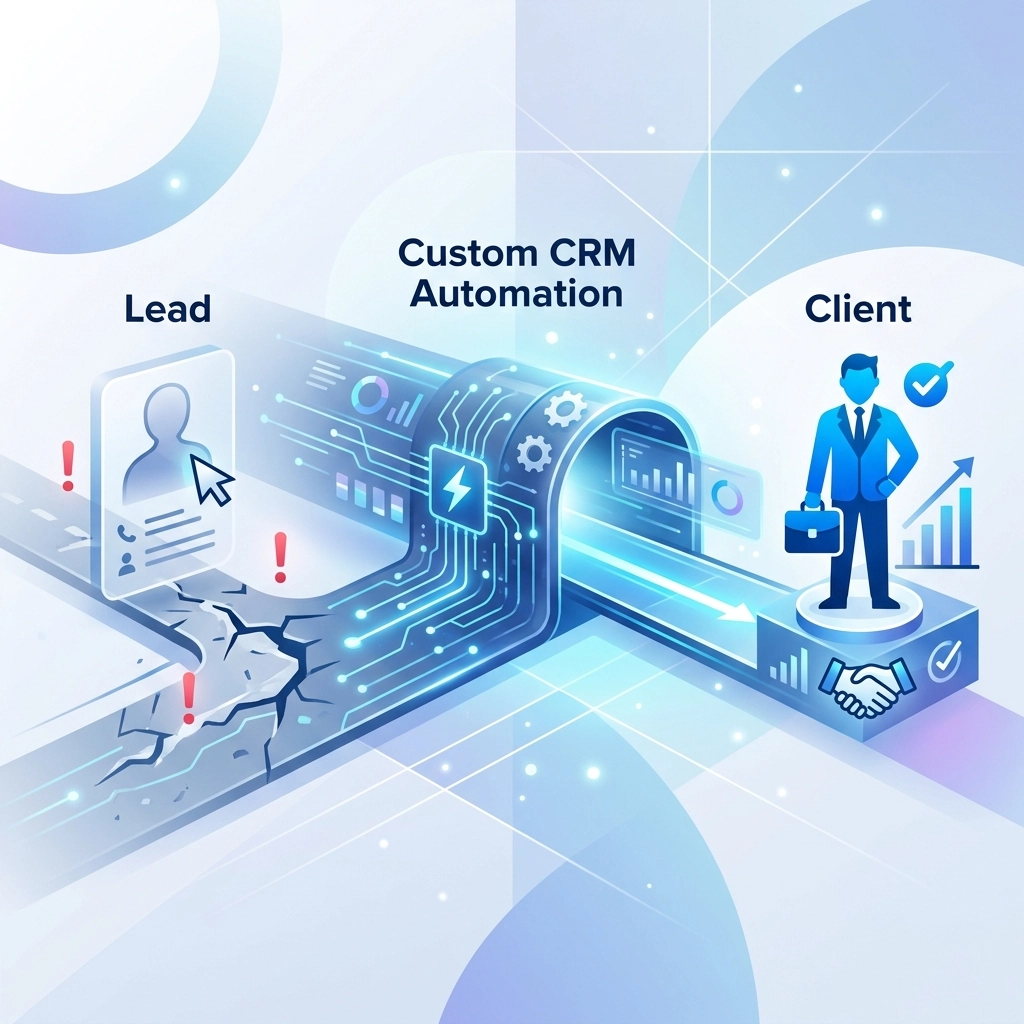
It’s April 2026, and the digital landscape has shifted again. If your business is still operating on the "we’ll get back to you in 24 hours" model, you’re not just behind: you’re likely invisible to your best prospects.
In my years leading Pure Technology Consulting, I’ve seen the same pattern repeat across industries: a mid-sized company spends thousands on high-tier marketing, drives quality traffic to a landing page, and then lets those leads die a slow death in a disconnected spreadsheet or a rigid, off-the-shelf CRM that no one actually enjoys using.
The gap between a "lead" and a "client" has never been thinner, yet the friction standing in the way has never been more costly. In 2026, the winner isn't necessarily the company with the biggest ad budget; it’s the one with the most frictionless intake ecosystem. This is where custom CRM automation moves from a "nice-to-have" luxury to a fundamental operating requirement.
The High Cost of Disconnected Systems
Most mid-sized businesses today are suffering from what I call "The Fragmented Stack." You have a CRM for data storage, a separate tool for scheduling, another for billing, and perhaps a third-party app for initial lead capture.
When these systems don't talk to each other, friction is the immediate byproduct. A prospect fills out a form, waits four hours for a manual email, replies with their availability, waits another six hours for a calendar link, and by the time the first appointment is actually booked, the "buying heat" has cooled.
This operational drag does more than just annoy prospects; it kills your conversion rates. When data is siloed, your sales team spends 40% of their day on administrative data entry rather than relationship-building. They are chasing missing info instead of closing deals. This is exactly why business process automation consulting has become our most requested service: because businesses are realizing that their "software" is actually a bottleneck.

Architecting the Bridge: From Lead Capture to First Appointment
The most critical moment in the customer journey is the seconds immediately following a lead capture. In 2026, the standard is no longer a "Thank You" page; it is an immediate, automated transition into the next stage of the funnel.
Custom CRM automation allows us to build a bridge that feels human but operates with machine precision. Imagine this workflow:
- Instant Enrichment: A lead submits a form. Before your team even sees the notification, the system has already performed a data sweep, appending company size, industry, and firmographic details.
- Smart Routing: The lead isn't just dumped into a general inbox. It’s scored and routed to the specific consultant or account executive best suited for that industry.
- The Frictionless Calendar: Instead of the back-and-forth email dance, the lead is immediately presented with an integrated scheduling interface tailored to their specific needs.
By the time a human on your team picks up the phone, the lead is already qualified, enriched, and booked. This isn't just about speed; it’s about governance. It ensures that no lead falls through the cracks, regardless of how busy the office gets.
Why Off-The-Shelf Hits a Ceiling
I often talk to CEOs who are frustrated that their $200/month SaaS subscription isn't solving their problems. The reality is that "standard" CRMs are built for the average user. But your business isn't average. Your workflows in legal, accounting, or specialized field services have nuances that a template cannot capture.
Generic platforms often lead to "workarounds": the manual steps your team takes to force the software to do what they actually need. These workarounds are where the friction lives.
Our approach at Pure Technology Consulting is to build bespoke solutions or heavily customized integrations that fit your operations like a glove. Whether it’s integrating complex telephony for call attribution in fintech or building 70-question intake engines for HIPAA-adjacent healthcare workflows (similar to our work with Thrive and EHRIO), the goal is the same: eliminate the manual touchpoints that don't add value.

The Revenue Impact: Beyond the Spreadsheet
The data in 2026 is clear: companies that prioritize custom automation see a massive delta in their bottom line. We aren't just talking about saving a few hours of manual labor: we’re talking about a fundamental shift in pipeline velocity.
Research indicates that AI-driven automation in the intake process can lead to a 45% increase in qualified leads and a 20% reduction in time-to-first-contact. When you double your conversion rate through structured crm automation, you effectively double your marketing ROI without spending an extra cent on ads.
For a mid-sized firm, that 10% to 20% jump in conversion isn't just incremental growth; it’s the difference between scaling and stagnating. Our data integration services focus on ensuring that every piece of data collected during the intake process flows seamlessly into your billing and project management systems, creating a "single source of truth" that executives can actually use to make decisions.
Proven Capabilities: Bringing Sophistication to High-Stakes Industries
We’ve spent years refining these capabilities in high-pressure environments before pivoting our focus to the legal and accounting sectors. We know what it takes to manage accountability and data integrity at scale.
- In Healthcare: We’ve built matching engines and complex intake workflows that handle sensitive data while maintaining high conversion.
- In Field Ops: Our work on GPS logging and rep accountability for D2D Tracking proves that we can automate the most "human" elements of a sales process.
- In Fintech: We’ve integrated telephony and call attribution for debt agencies where every second of a lead's attention is worth thousands of dollars.
When we bring this level of engineering to a mid-sized law firm or an accounting practice, the results are transformative. We aren't just installing a CRM; we are architecting a revenue engine.
The 2026 Strategy: Audit, Integrate, Scale
If you feel like your current systems are holding you back, the answer isn't to buy more software. The answer is to evaluate your strategy.
We recommend a three-step roadmap for any business looking to remove friction:
- The Workflow Audit: Identify exactly where leads are stalling. Is it between the form and the call? Is it during the qualification phase?
- Custom Integration: Use data integration services to connect your siloed apps. If your scheduler doesn't update your CRM in real-time, you have a leak.
- Automated Governance: Set up triggers that recalculate lead scores and re-engage dormant prospects without human intervention.
Your Move: Transitioning from Lead to Client
The difference between a lead and a client in 2026 is the absence of friction. Every hurdle you place in front of a prospect: a slow response, a manual form, a confusing scheduling process: is an invitation for them to call your competitor.
At Pure Technology Consulting, we specialize in building the custom web applications and automation frameworks that make your business the easiest choice for your clients. We don't just provide tools; we provide the strategic roadmap to operational excellence.
If you’re ready to see what a frictionless intake process looks like for your firm, let’s talk. My assistant, Emily, can help you find a time on my calendar for a high-level discovery call. We can dive into your current stack, identify the bottlenecks, and map out a custom solution that positions you as the leader in your market.
You can schedule a consultation here or view some of our video walkthroughs to see our work in action.
The future of your business is automated. Let’s make sure it’s built to win.
Amin Said, Founder of Pure Technology Consulting LLC
https://puretechconsult.com
+1 (803) 921-0969
Leave a Reply