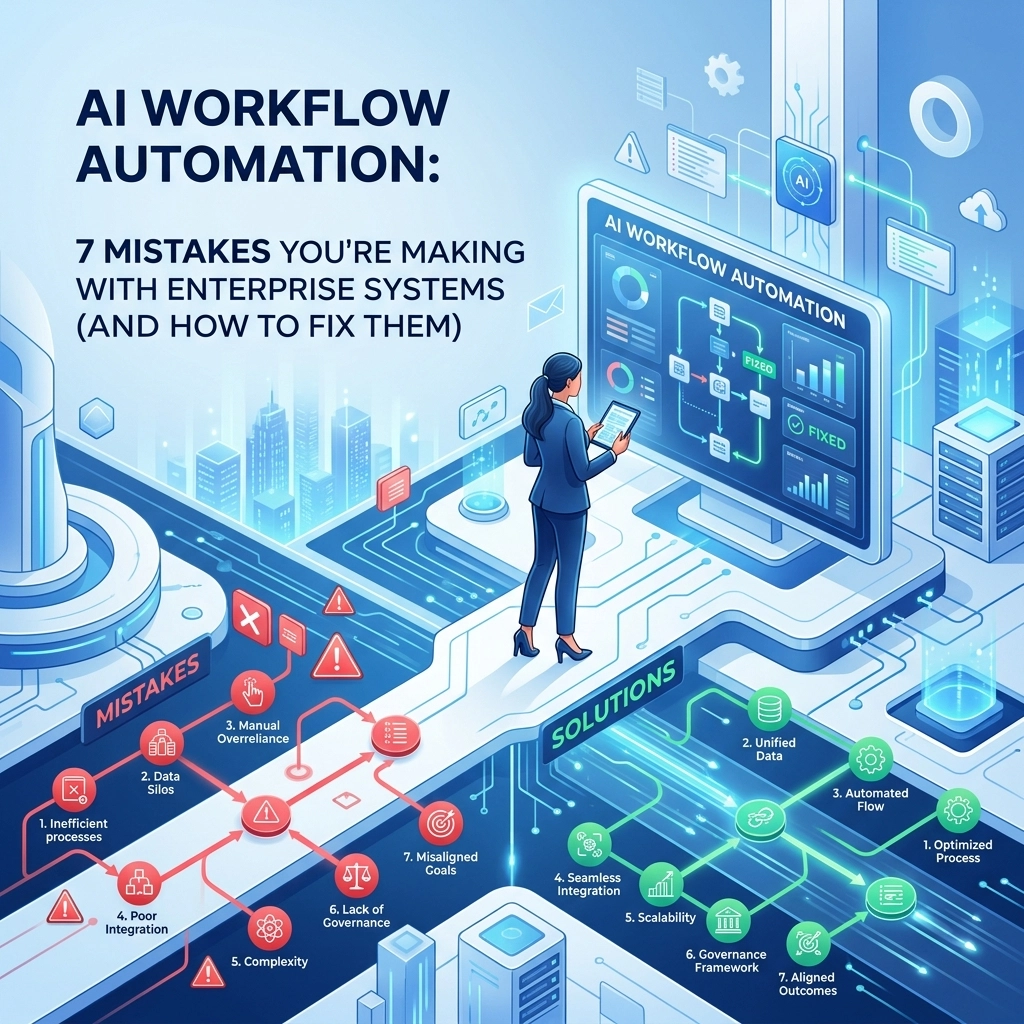
The promise of AI in 2026 isn't just about "doing things faster": it’s about doing things that were previously impossible. We’ve moved past the novelty of simple chatbots and into the era of the autonomous enterprise. However, as I sit down with executives across the legal, accounting, and healthcare sectors, I see a recurring pattern: organizations are throwing sophisticated AI at archaic workflows and wondering why the ROI isn’t hitting the bottom line.
Automation is a force multiplier. If you multiply a zero, you still get zero. If you multiply a mess, you get a monumental, automated disaster.
At Pure Technology Consulting, we don’t just build "apps"; we architect operating models. Whether we are deploying high-level matching engines like we did with EHRIO Pro or securing sensitive data transfers, the strategy precedes the software. If you want to move from "tinkering with AI" to "dominating with AI," you need to stop making these seven critical mistakes.
1. The "Faster Chaos" Trap: Automating Broken Processes
The most frequent error I see is the rush to automate a workflow that is fundamentally flawed. If your current manual intake process for a law firm is redundant and prone to human error, applying an AI agent to it will only generate errors at the speed of light.
Research shows that automating inefficient workflows without fixing the underlying logic is the fastest way to frustrate your team and your clients. Enterprises often skip the "process discovery" phase because it feels slow.
The Fix: Before a single line of code is written, map your workflow. We take this approach with every bespoke project, such as our work in the healthcare space with EHRIO Pro. By mapping the 70-question intake and matching engines first, we ensure the AI is optimizing a streamlined path, not paving a cow path. Look for redundant steps and eliminate them before you automate them.
2. The $3.1 Trillion Data Trust Deficit
Bad data costs U.S. businesses trillions annually. In the enterprise world, AI is only as visionary as the data feeding it. If your CRM is a graveyard of duplicate entries and your ERP is siloed, your AI-powered insights will be hallucinations at best and liabilities at worst.
Many organizations expect AI to "clean" the data automatically. While AI can help, it requires a robust governance framework to be effective.
The Fix: Implement data validation rules at the point of entry. Think of how we handle fintech integrations for debt agencies: every call attribution and data point is validated against a central source of truth. When we build custom web applications, we prioritize data integrity through master data management (MDM) practices. If you don't trust your data, you can't trust your automation.

3. Rebuilding the Wheel in Every Department
I often see large firms where the accounting department is building one AI tool for document processing, while the legal team is building a nearly identical one for contract review: using two different platforms. This fragmentation leads to "Shadow AI," where data is trapped in department-level silos.
When workflows aren't standardized across the enterprise, you lose the ability to scale horizontally. You end up paying for the same development work twice, and your systems can’t talk to each other.
The Fix: Create a shared infrastructure. This is why we developed ChainHQ. It serves as a proof-of-concept for how an enterprise can unify disparate data flows into a single, coherent stream. By using a centralized "brain" for your automations, you ensure that a win in one department can be scaled across the entire organization without starting from scratch.
4. Neglecting the "Security-First" Architecture
In high-stakes industries like legal and finance, a "good enough" security posture is a ticking time bomb. Many off-the-shelf AI tools and quick-fix automations don't meet the rigorous compliance standards (like HIPAA-adjacent workflows) required for enterprise-grade operations.
Ignoring security during the development phase leads to massive technical debt and regulatory risk. If your automated workflow handles sensitive client files without end-to-end encryption or role-based access control, you aren't innovating: you're gambling.
The Fix: Security must be baked into the architecture, not bolted on. When we consult on custom builds, we lean on the principles behind FTP Inform. It’s our benchmark for how enterprise data should be moved: securely, transparently, and with full audit trails. Every automated trigger should have a corresponding security check.
5. Designing for the "Now" and Ignoring the "Next"
Scalability is the silent killer of enterprise AI. A script that works for 100 entries might fail spectacularly when asked to handle 100,000. Many businesses build "brittle" automations that are hard-coded to specific software versions or data volumes.
As your business grows, your AI must scale horizontally across systems. If your automation can't handle the addition of new cloud applications or emerging tools, it will become a legacy anchor within 18 months.
The Fix: Build with an API-first mindset. For example, our D2D Tracking system for field operations was built to handle GPS logging and rep accountability at scale. It’s a testament to building systems that can handle high-velocity data without breaking. When you build custom software, ensure it’s modular so you can swap out parts as the technology evolves.

6. The "Out-of-the-Loop" Syndrome (Automation Bias)
There is a dangerous tendency to trust AI blindly once it’s deployed. This is known as automation bias. Over time, "operator drift" occurs: the human team stops monitoring the outputs, assuming the machine is always right. But systems change, data environments evolve, and AI models can drift.
Without human-in-the-loop (HITL) checkpoints, hidden flaws can stay buried for months, causing compounding damage to your reputation or bottom line.
The Fix: Establish regular audit intervals. Automation should augment your experts, not replace their judgment. In our legal and accounting pivots, we emphasize that AI handles the heavy lifting of data retrieval and synthesis, but the final strategic decision remains with the professional. High-level automation is a partnership between human intuition and machine precision.
7. Fragmented Architectures and Legacy Friction
The final mistake is trying to run a 2026 AI strategy on a 2015 architecture. Legacy ERPs, spreadsheets, and fragmented cloud silos create "data gravity" that slows down AI agents. Real-time automation requires real-time data access. If your AI has to wait for a nightly batch process to sync, it’s already obsolete.
The Fix: Modernize the middleware. You don't always have to rip and replace your legacy systems, but you do need a modern data platform to bridge the gap. We see this often in local SEO and visibility automation. With AI Local Boost, we demonstrate how complex, fragmented data from Google Business Profiles can be unified and automated for maximum impact. The goal is to create a seamless flow from your legacy core to your modern AI frontend.
Moving Toward Bespoke Excellence
The common thread in all these mistakes is the attempt to use "cookie-cutter" solutions for complex, high-ticket problems. In the enterprise world, the most successful AI implementations are those that are custom-tailored to the specific friction points of the business.
At Pure Technology Consulting, we specialize in building these bespoke engines. We don’t just look at the code; we look at the culture, the compliance requirements, and the long-term vision of your company. Whether it's a matching engine for a healthcare provider or a secure telephony integration for a debt agency, our approach is always the same: Strategy first. Scalability always.
If you’re ready to move beyond basic automation and build a custom web application that truly fits your operations, let's talk. My assistant, Emily, can help you schedule a discovery call to audit your current workflows and identify where custom development can provide your biggest competitive advantage.
Stop automating your mistakes. Start architecting your future.
Amin Said, Founder of Pure Technology Consulting LLC
https://puretechconsult.com
Phone: +1 (803) 921-0969
Request a workflow audit or schedule a call here
Leave a Reply