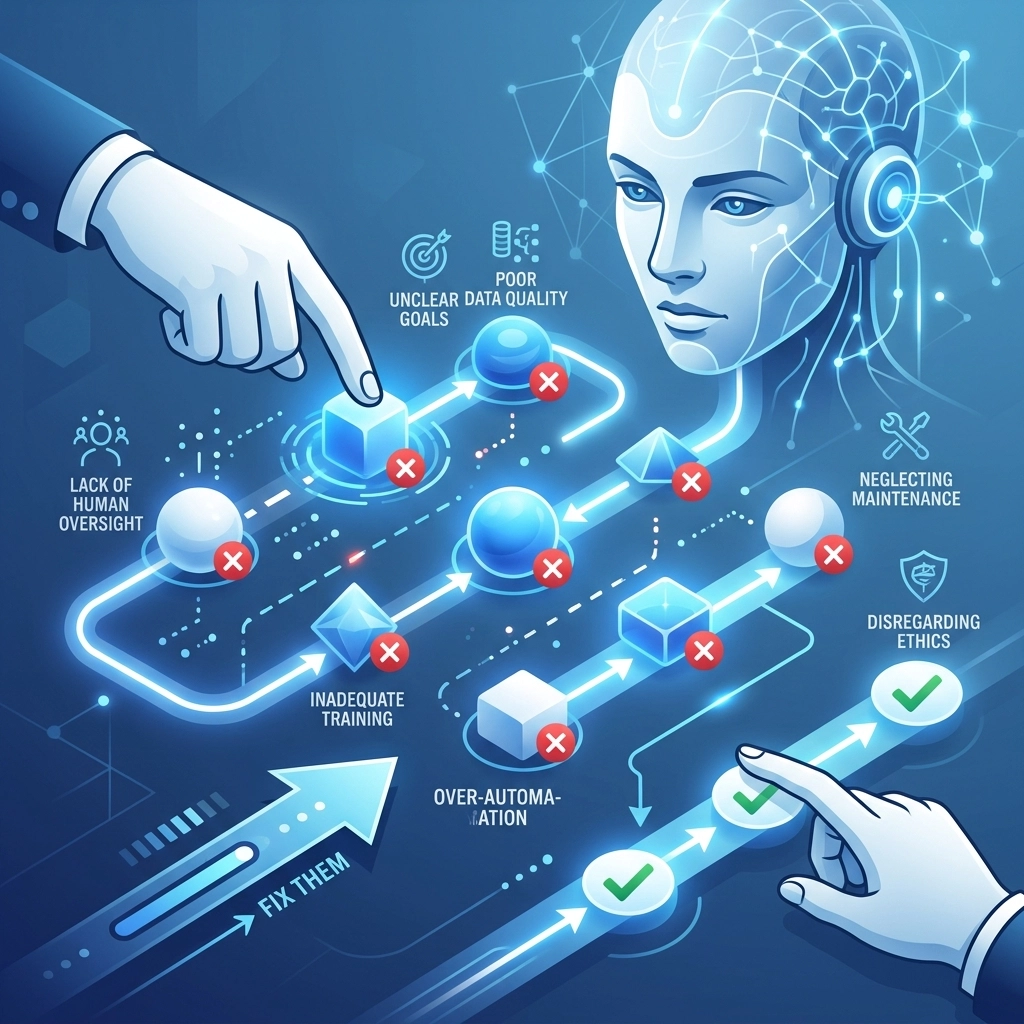
In 2026, the novelty of "AI for the sake of AI" has finally evaporated. We are no longer in the era of simple experimentation; we are in the era of operational excellence. For modern enterprises, the question is no longer if they should automate, but how they can do so without creating a digital house of cards.
At Pure Technology Consulting, we’ve spent years architecting high-stakes systems: from HIPAA-adjacent healthcare engines in EHRIO Pro to complex lead attribution for fintech. What we’ve discovered is that while the tools have become more accessible, the architectural pitfalls have become more dangerous. AI workflow automation promises exponential leverage, but without a visionary roadmap, it often delivers little more than expensive technical debt.
If your automation efforts feel brittle, unpredictable, or prohibitively expensive, you are likely falling into one of these seven common traps. Here is how to navigate them.
1. Using Enterprise-Grade Models for Simple Tasks
The most frequent drain on an automation budget isn’t the development time: it’s the compute. We see organizations deploying "frontier" models like GPT-4 or Claude Opus to perform basic data extraction or simple classification tasks.
Research indicates that compute costs can represent 70–80% of total AI expenses. Using a high-reasoning model for a task that a lightweight, specialized model could handle is like hiring a senior architect to hammer nails. It’s effective, but it’s an operational disaster.
The Fix: Strategic Model Routing
Implement a multi-tier model strategy. Use lightweight models for initial classification and routing. Only when a task triggers a specific "complexity flag" should it be escalated to a more expensive, high-reasoning model. Our proprietary orchestration layer, ChainHQ, was designed specifically for this purpose: ensuring that every token spent is tied to a specific business value, rather than wasted on "over-thinking" simple data points.

2. Poor Context Management and "Token Snowballing"
When agents interact within a workflow, there is a tendency to pass the entire conversation history or massive background datasets through every single handoff. This is what we call "token snowballing." As the workflow progresses, the context window expands, and the costs explode. More importantly, the model’s focus begins to drift.
The Fix: Context Compression and Explicit Schemas
Treat prompts as versioned assets. Instead of passing raw data, implement summarization and compression steps between agents. Define explicit output schemas so that each agent returns only the structured data necessary for the next step. By keeping the context lean, you maintain both model accuracy and fiscal responsibility.
3. Deploying Without Governance or Validation
In the rush to achieve "digital transformation," many businesses skip the most critical step: the validation layer. Organizations with mature AI governance see a 68% success rate, while those without often hover around 32%. AI agents can produce technically correct but contextually catastrophic results. If your workflow doesn't have a "sanity check," those errors will compound as they move downstream.
The Fix: The "Human-in-the-Loop" Hybrid
Build validation into the DNA of your workflow. For high-ticket industries like legal or accounting, we implement automated data quality checks that flag anomalies before they reach a human reviewer. This is the approach we took with EHRIO Pro, where complex 70-question medical intakes are processed through a matching engine that prioritizes accuracy over raw speed, ensuring that high-stakes data is never left to chance.
4. Inadequate Error Handling: The "Perfect Path" Fallacy
Too many developers build automations assuming a "happy path": the idea that APIs will always respond, payloads will always be formatted correctly, and events will always arrive on time. In a production environment, this is a dangerous assumption. When an API times out or a field goes missing, a poorly designed workflow simply breaks, often leaving a trail of corrupted data in its wake.
The Fix: "Guilty Until Proven Innocent" Inputs
Every input must be validated and sanitized. Treat your automation as a series of defensive barriers. Implement comprehensive error handling that includes retries, back-off strategies, and fallback routes. At Pure Technology Consulting, we don’t just build for the success state; we architect for the failure state. This ensures that even if a third-party tool goes down, your core business operations remain intact.

5. Ignoring Multi-Agent Coordination Complexity
Single-agent automations are straightforward. However, as you scale toward complex web apps, you begin using multi-agent systems where agents pass tasks back and forth. Without a centralized "conductor," these systems can enter decision loops or duplicate work, leading to massive inefficiencies.
The Fix: Centralized State Management
Before writing a single line of code, design your multi-agent architecture. Use a centralized state management system to ensure agents share a "source of truth." This prevents agents from working in silos and ensures that the workflow moves toward a resolution rather than circling a problem. We’ve used this strategy to build custom GPS logging and rep accountability tools for field operations, where multiple data streams must be synchronized in real-time.
6. Building "Monster Workflows"
Enthusiasm is the enemy of reliability. It is tempting to build one massive, all-encompassing workflow that handles everything from lead capture to final billing. We call these "Monster Workflows." They are impressive to look at on a whiteboard but are a nightmare to maintain. When one small branch breaks, the entire system grinds to a halt.
The Fix: Modular Micro-Automations
Break your processes down into small, "boring," and reliable modules. Each module should do one thing exceptionally well. These modules can then be linked together. This modularity allows you to update specific parts of your tech stack: like your reporting engine or your SEO automation: without risking your entire operation.
For instance, our AI Local Boost tool focuses specifically on Google Business Profile automation. By keeping the scope focused, we ensure the highest possible reliability for local SEO, which can then be integrated into a larger marketing ecosystem if needed.

7. Underestimating Total Implementation Costs
The biggest mistake executives make is budgeting only for the "API fees." They assume that because an AI model is inexpensive, the automation is too. In reality, the AI is only about 10% of the solution. The remaining 90% is engineering: building the missing APIs, creating secure data pipelines, implementing permission logic, and establishing monitoring infrastructure.
The Fix: Consultative Scoping and Monitoring
Budget for the integration, not just the intelligence. A truly visionary automation strategy requires ongoing monitoring to track per-feature spend, error rates, and user satisfaction. We utilize tools like FTP Inform to provide our clients with secure, transparent data reporting. This allows leadership to see the actual ROI of their custom builds and adjust their roadmap based on production performance, not just theoretical potential.
The Visionary Path Forward
The transition from manual processes to AI-powered automation is the most significant competitive advantage of our decade. However, the winners won't be those who move the fastest, but those who build the most resilient foundations.
At Pure Technology Consulting, we don't just "plug in" AI. We bring proven capabilities from healthcare, fintech, and field operations to help legal and accounting firms build bespoke web applications that fit their unique operations. We believe in high-leverage, custom software that acts as a force multiplier for your team.
If you are ready to move past brittle automations and build a scalable, AI-driven operating model, we are here to guide that transformation. Our approach is consultative, professional, and focused on one thing: delivering premium, high-ticket solutions that stand the test of time.
To discuss your roadmap or request a workflow audit, we invite you to take the next step toward operational excellence.
Contact us today to schedule a discovery call.
Phone: +1 (803) 921-0969
Website: puretechconsult.com/schedule
Amin Said, Founder of Pure Technology Consulting LLC
https://puretechconsult.com
Leave a Reply