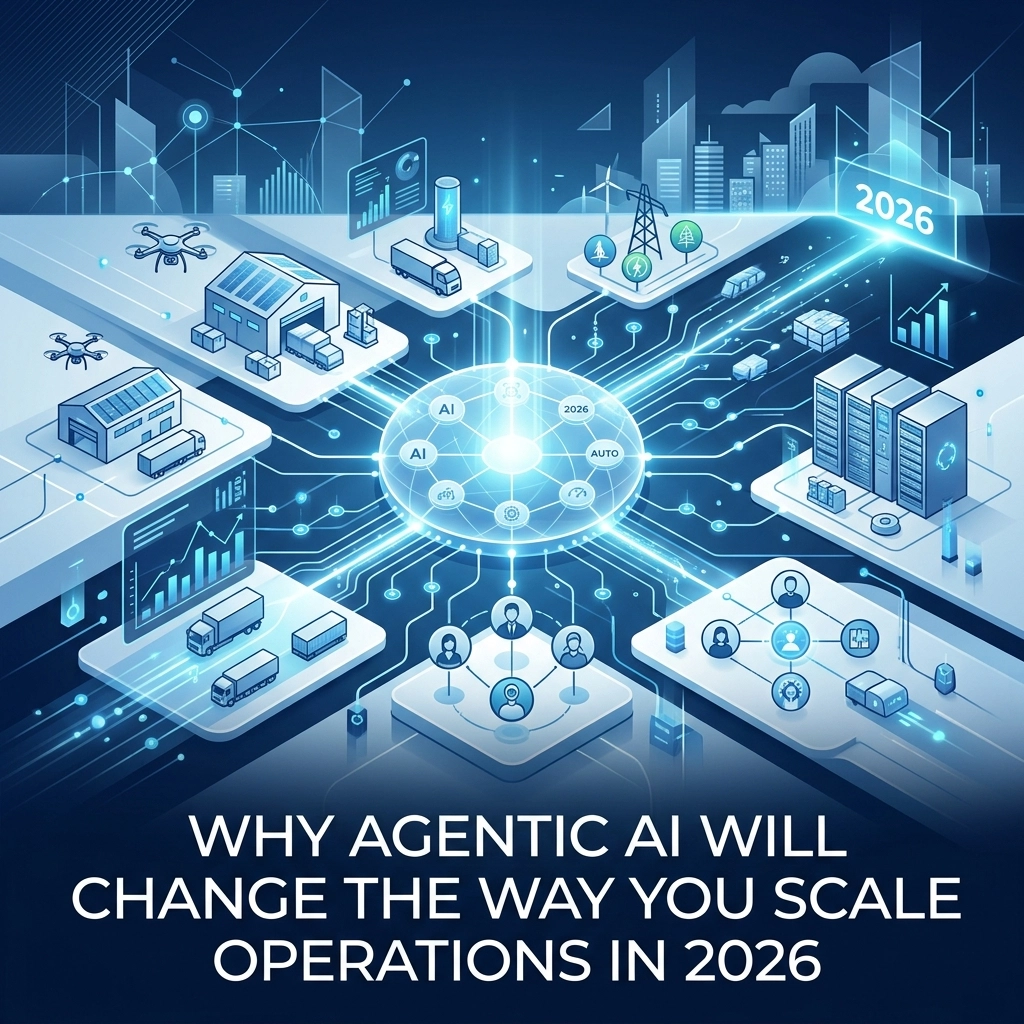
As we cross the first quarter of 2026, the conversation around Artificial Intelligence has shifted from "What can it write?" to "What can it execute?" For the modern enterprise, the honeymoon phase with simple generative chatbots is over. We have entered the era of Agentic AI: a paradigm shift that is fundamentally rewriting the playbook for operational scaling.
At Pure Technology Consulting, we have spent the last few years moving beyond the hype of Large Language Models (LLMs) to build functional, autonomous systems. In 2026, scaling is no longer about hiring more heads to manage more tasks; it is about deploying intelligent agents capable of goal-oriented reasoning and independent decision-making.
From Assistance to Autonomy: The Agentic Evolution
Traditional AI automation followed a linear, "if-this-then-that" logic. While effective for simple repetitive tasks, it lacked the flexibility to handle the nuances of real-world business operations. If a step in the process changed, the automation broke.
Agentic AI changes this by operating autonomously to pursue high-level goals. Instead of waiting for a human to prompt every step, an agent is given an objective: such as "onboard this client and ensure all compliance documents are verified against state-specific regulations": and it determines the path to get there. It reasons, it plans, and most importantly, it acts across your entire digital infrastructure.

The Architecture of Orchestration: Multi-Agent Systems
One of the most significant insights we’ve gained while developing bespoke solutions for our clients is that a single agent is rarely enough to scale a complex operation. The real breakthrough in 2026 is multi-agent orchestration.
Think of this as an architectural shift similar to the move from monolithic software to microservices. Instead of one giant, clunky AI trying to do everything, we deploy a "team" of specialized agents.
- The Researcher Agent gathers data.
- The Compliance Agent checks the data against legal frameworks.
- The Coordinator Agent sequences the work and manages the handoffs.
This mirrors the human organizational structure but operates at a speed and precision level that was previously impossible. This is the foundation upon which we built ChainHQ, our proprietary orchestration framework. By using ChainHQ, we allow these specialized agents to communicate and execute complex workflows without manual intervention, ensuring that as your business grows, your overhead doesn't grow with it.
Redesigning Workflows for an Agentic Future
To truly leverage Agentic AI, organizations must resist the urge to simply layer AI on top of legacy processes. The winners in 2026 are those who are reimagining their workflows specifically for autonomous agents.
When we consult with high-ticket clients in the legal, accounting, and healthcare sectors, we often find that their current workflows are designed to accommodate human limitations: such as the need for frequent breaks, the potential for manual data entry errors, or the slow pace of cross-departmental communication.
An agentic workflow removes these constraints. For example, in our work with healthcare-adjacent platforms like EHRIO Pro, we’ve seen how AI-powered matching engines can handle 70-question intakes and HIPAA-compliant data routing in seconds. When the system is designed for agents, the bottlenecks disappear. The goal is to treat agents as intellectual workers capable of making decisions that reflect the strategic values of the business.

Governance: The Guardrails of Scale
As agents gain more autonomy, the importance of governance increases exponentially. You cannot scale what you cannot control or trust. In 2026, "Agentic Governance" has become a mandatory pillar of software development.
At Pure Technology Consulting, we emphasize a "Security by Design" approach for all custom builds. Scaling with Agentic AI requires:
- Identity-Aware Access Controls: Ensuring an AI agent only has access to the specific data silos required for its task.
- Traceability: Every decision made by an agent must be logged and auditable. If an agent reroutes a supply chain or approves a financial transaction, the "why" must be as clear as the "what."
- FinOps for AI: An autonomous agent can trigger thousands of API calls and LLM tokens in a single afternoon. Without embedded cost controls, scaling can become prohibitively expensive. We integrate runtime policy enforcement to ensure agents operate within budget and safety parameters.
The Emerging Role of the "Agentic Manager"
The rise of Agentic AI doesn't eliminate the need for human leadership; it evolves it. The C-suite is transitioning from managing people who do tasks to managing systems that achieve outcomes.
We are seeing the emergence of the "Agentic Manager": leaders who possess a blend of strategic judgment and technical oversight. Their job is to monitor agent behavior, handle edge-case escalations, and refine the goals that agents are pursuing. HR teams are now recruiting for roles that didn't exist two years ago, focusing on individuals who can supervise the "digital workforce" and ensure ethical alignment.

Why Custom Development Beats Off-the-Shelf SaaS in 2026
While many SaaS providers are rushing to add "AI features" to their platforms, these generic solutions often fall short of the deep integration required for true operational scaling. A custom-built agentic system is mapped to your specific business logic, your proprietary data, and your unique competitive advantages.
Whether it’s a bespoke web application for a debt agency requiring complex telephony integrations or a field operations tool like our D2D Tracking systems that require GPS logging and rep accountability, the value is in the customization. Off-the-shelf tools are built for the average user; bespoke agentic systems are built for the market leader.
If you are looking to see how these technologies look in action, you can view our video walkthroughs to see how we bridge the gap between visionary strategy and technical execution.
Building Your Roadmap for 2026 and Beyond
Scaling operations in 2026 is a journey toward greater leverage. Every hour your team spends on manual data movement or routine decision-making is an hour stolen from high-level strategy and client relationships.
Agentic AI is the tool that gives those hours back. By moving toward autonomous execution and multi-agent orchestration, you aren't just improving your business: you are future-proofing it.
At Pure Technology Consulting, we specialize in building the custom web applications and automation engines that make this possible. We don't just provide software; we provide the architectural foundation for your next stage of growth.
If you are ready to explore how agentic workflows can transform your specific operating model, we invite you to book a discovery call with our team. We can conduct a thorough workflow audit to identify where custom automation will provide the highest ROI.
The future of operations is autonomous. The only question is how quickly your organization will adapt to lead the way.
Amin Said, Founder of Pure Technology Consulting LLC
https://puretechconsult.com
Phone: +1 (803) 921-0969
Leave a Reply