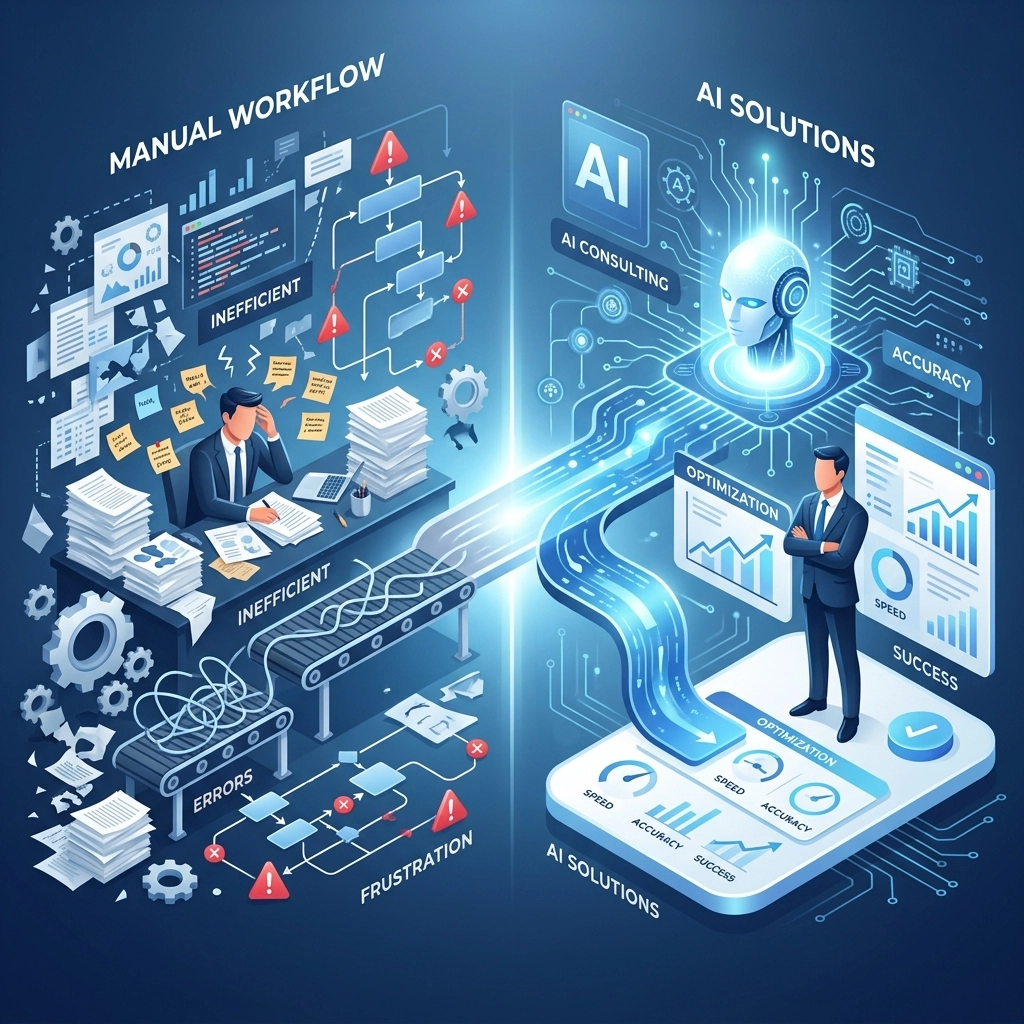
In the rapidly evolving landscape of 2026, the gap between businesses that thrive and those that merely survive is defined by operational leverage. For years, many organizations have relied on "the way we’ve always done it": a patchwork of spreadsheets, email threads, and manual data entry. However, as complexity scales, these manual processes transform from familiar routines into a silent tax on your growth, innovation, and profitability.
At Pure Technology Consulting, we view manual workflows not just as an inconvenience, but as a strategic bottleneck. When you are operating at a high level: whether in legal, accounting, healthcare, or fintech: every minute spent on a repetitive task is a minute stolen from high-value strategy.
Here are 10 reasons why your manual workflow is failing your business, and how bespoke AI consulting and custom software development provide the roadmap to a more scalable future.
1. The Financial Gravity of Human Error
Manual data entry is inherently prone to error. Whether it’s a mistyped figure in a financial ledger or a misfiled patient record, the "human element" in repetitive tasks often leads to cascading financial losses. In high-stakes industries like healthcare, these errors aren't just costly: they are a compliance risk.
We addressed this specific challenge when developing EHRIO Pro. By building a proprietary matching engine and automated 70-question intake systems, we demonstrated how custom software can virtually eliminate the "fat-finger" errors common in healthcare workflows. AI consulting doesn't just fix the error; it re-engineers the process so the error becomes impossible to commit.
2. The Invisible Opportunity Cost of Time
Time is the only non-renewable resource in your business. When your senior staff spends hours forwarding emails, chasing approvals, or printing documents, your "talent ROI" plummets.
Inspirational leadership requires focusing your team on what humans do best: empathy, strategy, and creative problem-solving. AI-powered automation takes the "robotic" work away from the humans, allowing your experts to function at the top of their licenses.
3. Structural Lack of Visibility
If your workflow lives in private email inboxes or local spreadsheets, you have a visibility crisis. Executives often lack a single source of truth to track progress, identify bottlenecks, or forecast capacity.
A bespoke web application provides a centralized dashboard that reflects the pulse of your business in real-time. This is why we focus on building custom platforms that integrate with your existing tech stack, providing the transparency needed for visionary decision-making.

4. Data Inconsistency and Silos
When data is moved manually between systems, it fragments. One department might be looking at an outdated version of a client file while another uses the current one. This lack of standardization prevents the use of advanced analytics or AI.
Through our work with FTP Inform, we’ve shown how secure, automated data movement and integration can bridge these silos. Custom automation ensures that when a piece of data changes in one system, it ripples accurately through your entire infrastructure, maintaining a unified data integrity that manual processes simply cannot achieve.
5. Inefficient Communication and "The Handoff Fail"
Manual workflows rely on informal conversations and long email threads. These are the graveyards of productivity. Important information gets buried, and task ownership becomes vague.
AI consulting allows us to design "intelligent handoffs." Imagine a workflow where, upon completion of a task, the system automatically validates the work, updates the CRM, and alerts the next stakeholder with all the necessary context. No "checking in," no "just following up": just seamless execution.
6. The Scalability Ceiling
Manual processes do not scale linearly; they scale exponentially in complexity. If it takes one person to manage 10 clients manually, managing 100 clients doesn't just require 10 people: it requires a massive management layer to coordinate those 10 people.
We see this frequently in the SaaS space. Our work on ChainHQ exemplifies how we build scalable architectures that allow companies to increase throughput without a corresponding increase in headcount. Custom software allows your operations to grow horizontally while your overhead stays manageable.
7. Disconnection from Business-Critical Systems
A manual workflow is often an island. It doesn't "talk" to your ERP, your CRM, or your accounting software. This creates a "swivel-chair" effect where employees spend their day moving data from Screen A to Screen B.
Our approach to custom development focuses on deep integration. We don't just build an app; we build a connective tissue for your business. Whether it’s integrating telephony for fintech debt agencies or GPS logging for field operations, we ensure your tools work as one cohesive unit.

8. Unclear Roles and Task Ownership
In a manual system, responsibility is often assumed rather than assigned. This leads to the "bystander effect," where critical deadlines slip because everyone thought someone else was handling it.
When we build custom automation solutions, we embed governance into the code. Every task has an owner, a deadline, and an automated escalation path. This clarity transforms company culture from one of "searching for answers" to one of "executing with confidence."
9. Technical Debt and Legacy Tool Friction
Many manual workflows are built around outdated tools that were never meant to handle today’s data loads. Relying on legacy software is like trying to win a modern race in a vintage car; it might look familiar, but it’s going to break down under pressure.
Visionary business leaders recognize when it’s time to move from "patching" to "pivoting." AI consulting services help you identify which legacy systems are holding you back and replace them with bespoke web apps designed for the 2026 economy.
10. The Trap of Overcomplication
Ironically, manual workflows often become more complicated over time as "fix-it" steps are added to solve previous errors. You end up with a process that has 20 steps, 15 of which are redundant.
AI doesn't just automate your current process; it simplifies it. During our discovery phase, we often find that 40% of a client’s manual steps can be eliminated entirely through smart architectural design. This was the philosophy behind AI Local Boost, where we automated complex Google Business Profile management into a streamlined, high-impact workflow.

How AI Consulting Services Fix the Foundation
At Pure Technology Consulting, we don’t just sell software; we deliver strategic operational transformation. When you engage with our team for a custom build or an automation audit, we follow a rigorous roadmap:
- Workflow Mapping: We dive deep into your current operations to find the hidden frictions.
- Strategic Simplification: Before we automate, we optimize. We remove the redundancies that manual systems accumulate.
- Bespoke Development: We build a custom web application tailored specifically to your business logic. We don't force your business into a SaaS box; we build the box around your business.
- AI Integration: We leverage Large Language Models and custom algorithms to handle the cognitive load of data categorization, matching, and reporting.
- Ongoing Governance: We ensure the system is scalable, secure, and compliant with your industry standards (be it HIPAA, GDPR, or financial regulations).
The Visionary Path Forward
The transition from manual to automated is not just a technical upgrade: it is a leadership move. It signals to your team, your clients, and your competitors that you are building for the future.
Whether you are in the legal sector needing automated document generation, an accounting firm looking to streamline audit trails, or a healthcare provider aiming to optimize patient intake, the solution isn't "more people." The solution is a smarter system.
Pure Technology Consulting specializes in these high-ticket, high-impact transformations. Our experience in healthcare, fintech, and field operations allows us to bring a seasoned perspective to your unique challenges. We don't start from scratch; we start with a foundation of proven capabilities and build upwards to your specific vision.
Ready to audit your workflow and unlock your organization's true capacity?
Stop paying the "manual tax" on your growth. Let’s build the custom infrastructure your vision deserves.
Contact us today to schedule a discovery call and begin your digital transformation.
Phone: +1 (803) 921-0969
Website: https://puretechconsult.com/schedule
Amin Said, Founder of Pure Technology Consulting LLC
https://puretechconsult.com
Leave a Reply