Category: Blog

Your blog category

  • The Technical Backbone: Why Industry Leaders are Licensing AI Local Boost for Their Ecosystems

    The Technical Backbone: Why Industry Leaders are Licensing AI Local Boost for Their Ecosystems

    In the current landscape of digital commerce, the bridge between a global brand and a local consumer is often the most fragile part of the infrastructure. For industry leaders: ranging from massive franchise groups to global equipment manufacturers: maintaining a cohesive, high-performing digital presence across thousands of local touchpoints is no longer just a marketing challenge; it is a complex engineering hurdle.

    As these organizations look to scale their ecosystems, they are increasingly moving away from the "build-it-from-scratch" mentality. Instead, they are seeking proven, sophisticated technical backbones to power their local visibility. This is where the licensing of AI Local Boost comes into play. By integrating this advanced AI-powered engine into their own proprietary platforms, industry leaders are effectively bypassing years of development cycles and technical debt.

    At Pure Technology Consulting (PTC), we have observed a definitive shift. Strategic leaders are no longer asking how they can build an SEO tool; they are asking how they can integrate a world-class automation engine into their existing workflow to provide immediate value to their dealers, franchisees, and partners.

    The "Limited In-house Dev" Dilemma

    Every large-scale organization eventually hits the "Innovation Wall." While a company may have a robust IT department, that team is often consumed by maintaining legacy systems, ensuring cybersecurity compliance, or managing internal ERPs. Building a specialized, AI-driven local SEO and Google Business Profile management suite requires a very specific set of competencies that are rarely found in generalist in-house teams.

    Developing a tool like AI Local Boost requires deep expertise in:

    • API Orchestration: Maintaining constant, stable connections with Google Business Profile, Facebook, Instagram, TikTok, and YouTube.
    • AI Integration: Implementing LLMs that don't just "write text" but understand local context, sentiment analysis, and search intent for platforms like ChatGPT, Bing Copilot, and Perplexity.
    • Data Governance: Managing thousands of unique location datasets without cross-contamination or synchronization errors.

    When industry leaders attempt to build these capabilities in-house, they often face "Scope Creep" and "Technical Drag." A project slated for six months turns into two years. By the time the tool is ready, the AI landscape has already shifted. Licensing the technical backbone of AI Local Boost allows these organizations to focus on their core business while we handle the specialized software development.

    AI Local Boost technical backbone integrating into a sophisticated corporate software framework.

    Rapid Deployment: From Vision to Execution in Weeks, Not Years

    In a competitive market, speed is a strategic moat. For an equipment manufacturer with a network of 500 independent dealers, the ability to roll out a high-level SEO and social media automation suite in a matter of weeks: not years: is a game-changer.

    Licensing AI Local Boost as a white-label or integrated solution provides an "instant-on" capability. Because the backend is already battle-tested and optimized for local search ecosystems, the integration process focuses on the user experience and data mapping rather than foundational architecture.

    This rapid deployment enables:

    • Immediate ROI for Partners: Franchisees see their Google Maps rankings and AI-driven search visibility improve almost instantly.
    • Brand Consistency: Corporate leaders can ensure that every local post, review response, and profile update meets brand standards through automated governance.
    • Market Agility: As search engines update their algorithms (moving from traditional search to AI-driven "answers"), the licensed backbone is updated centrally by PTC, ensuring the entire ecosystem remains at the cutting edge without any effort from the licensee.

    The Technical Architecture of AI Local Boost

    To understand why industry leaders trust this backbone, one must look under the hood. AI Local Boost isn't just a dashboard; it is a sophisticated automation engine designed for high-volume data processing.

    1. The Multi-Platform Sync Engine

    The core of the system is designed to push optimized content and profile updates across the entire digital landscape. Whether it’s updating store hours for 1,000 locations or syndicating a promotional video to TikTok and YouTube, the engine handles the heavy lifting of API rate limits and platform-specific formatting.

    2. AI-Driven Local Optimization

    The "Boost" in the name comes from our proprietary implementation of AI. We have moved beyond simple automation. The system analyzes local search trends and tailors content to ensure businesses appear not only in Google Maps but also in the emerging "AI Search" results. This is a critical distinction for the 2026 market, where consumers increasingly rely on voice assistants and AI chat interfaces to find local services.

    3. Reliable Backend Support from PTC

    When a franchise group licenses our technology, they aren't just getting code; they are gaining a partner. Pure Technology Consulting provides the ongoing maintenance, security updates, and performance tuning required to keep a global ecosystem running. Our background in bespoke web development means we understand how to make our tools "talk" to your existing CRM or dealer portal.

    Luminous data hub representing high-speed backend synchronization for a global business ecosystem.

    Beyond the Tool: A Vision for Ecosystem Expansion

    Licensing technology is a strategic move toward becoming a platform-centric business. For an equipment manufacturer, providing a tool like AI Local Boost to their dealers transforms the relationship from a simple supplier-vendor dynamic to a true strategic partnership. You are providing the "Digital Oxygen" your partners need to survive and thrive in their local markets.

    This model of ecosystem expansion is a core pillar of our philosophy at Pure Technology Consulting. We believe that the most successful organizations of the next decade will be those that provide the best technical infrastructure to their networks. By leveraging our proven capabilities: the same ones we've used to build complex matching engines in healthcare and accountability systems in field operations: we help you build a moat around your brand.

    Whether you are looking to enhance a franchise portal or provide value-add services to a professional association, the "Technical Backbone" approach minimizes risk and maximizes throughput.

    Strategic Integration: How We Work With You

    Integrating a licensed technology like AI Local Boost into a large-scale ecosystem is a consultative process. We don't just "hand over the keys." Our team works with your executive leadership to ensure the implementation aligns with your broader digital strategy.

    We often start with a high-level scoping session to determine:

    • Data Architecture: How will your existing dealer data flow into the AI Local Boost engine?
    • User Permissions: What level of control do individual franchisees have versus the corporate office?
    • Reporting Dashboards: What metrics matter most to your stakeholders (e.g., call volume, review sentiment, AI search share)?

    This consultative approach is what sets Pure Technology Consulting apart. We aren't just selling a SaaS product; we are offering a bespoke automation and development partnership. We bring the same rigor to these licensing arrangements that we bring to our $10k+ custom web application builds.

    Interconnected holographic roadmap illustrating a strategic path for bespoke automation development.

    Building for the Future of Search

    The shift from "Search Engines" to "Answer Engines" is the most significant change in digital marketing in twenty years. If your ecosystem is still relying on manual profile updates and basic SEO tactics, you are falling behind. Licensing the AI Local Boost backbone ensures your entire network is prepared for the era of Perplexity, ChatGPT, and AI-driven local discovery.

    By choosing to license rather than build, you are choosing stability, speed, and specialized expertise. You are choosing to let your internal team focus on your core product while we provide the engine that drives your local visibility.

    If you are ready to explore how licensing AI Local Boost can transform your ecosystem and provide a competitive edge for your partners, let's start a conversation. Our team, led by myself and supported by my assistant Emily, is ready to help you map out a technical roadmap that scales.

    Next Steps for Your Ecosystem

    Transitioning to a high-performance technical backbone is a significant strategic move. We invite you to:

    1. Request a Scoping Call: Visit our scheduling page to book a consultation.
    2. Review Our Capabilities: Explore how we handle custom web development and automation for high-ticket clients.
    3. Analyze the Impact: Let us show you how AI Local Boost can be integrated into your existing platforms via our video walkthroughs.

    The future of ecosystem management is automated, AI-driven, and highly localized. Don't build it from scratch: license the backbone that's already winning.


    Amin Said, Founder of Pure Technology Consulting LLC
    https://puretechconsult.com
    Direct: +1 (803) 921-0969
  • 7 Mistakes You’re Making with Business Process Automation (and How to Fix Them)

    7 Mistakes You’re Making with Business Process Automation (and How to Fix Them)

    Business process automation (BPA) is no longer a luxury reserved for Silicon Valley giants. Today, it is the bedrock of operational excellence for law firms, accounting practices, and healthcare providers who recognize that manual data entry is a tax on growth. When implemented with vision, automation transforms a stagnant "operating model" into a high-velocity engine.

    However, the path to digital transformation is littered with the remains of failed "auto-pilot" projects. Many executives view automation as a "set it and forget it" solution, only to find that they have simply accelerated their errors. At Pure Technology Consulting, we specialize in building bespoke systems that avoid these pitfalls, ensuring that every line of code serves a strategic business outcome.

    Here are the seven most common mistakes businesses make with automation and the strategic roadmap to fix them.


    1. Automating Broken or Inefficient Processes

    The most dangerous thing you can do is automate a mess. If a workflow is convoluted, redundant, or prone to human error, digitizing it only ensures that those errors happen faster and at a much larger scale.

    The Fix: Conduct a rigorous process audit before a single script is written. We advise our clients to map out their current workflows in a "current state" diagram. Identify the bottlenecks: where does the data get stuck? Where is the double-entry happening? Streamline the logic first. Once the process is lean and logical, then: and only then: do we apply custom automation.

    2. Setting Vague, Non-Quantifiable Objectives

    "We want to be more efficient" is a sentiment, not a strategy. Without specific, measurable goals, your automation project will drift. You’ll find yourself with a collection of "cool" tools that don't actually move the needle on your bottom line.

    The Fix: Define Key Performance Indicators (KPIs) from the outset. Are you looking to reduce response times by 40%? Do you need to eliminate 20 hours of manual data reconciliation per week? By setting hard targets, you create a framework for accountability.

    Digital visualization of a growth trajectory through data panels for business process automation goals.

    3. Ignoring the "Single Source of Truth" (The Silo Trap)

    Many organizations approach automation in a piecemeal fashion. They automate the marketing department’s intake but leave the accounting department to manually pull that data into their ledgers. This creates "data silos" where information is trapped in disconnected apps.

    The Fix: Adopt an integrated ecosystem mindset. This is where our proprietary capabilities, such as FTP Inform, come into play. When we work with high-ticket clients, we often find they struggle with moving sensitive data between legacy systems and modern web apps. We developed FTP Inform specifically to bridge this gap: providing a secure, automated layer for data transmission that ensures information flows seamlessly across the entire enterprise architecture, rather than staying locked in a single folder.

    4. Neglecting Comprehensive Planning and Architecture

    In the rush to see results, many businesses skip the architectural phase. They buy off-the-shelf SaaS products and try to "duct-tape" them together. This leads to a fragile system that breaks the moment a third-party API updates or a business rule changes.

    The Fix: Invest in a roadmap. At Pure Technology Consulting, we treat every automation project as a custom build. Whether we are integrating telephony for a fintech firm or GPS logging for field operations, we start with a robust technical architecture. We don't just "connect apps"; we build an infrastructure designed for longevity and compliance.

    Interconnected digital nodes representing a stable infrastructure for custom automation software systems.

    5. Excluding Key Stakeholders and End-Users

    The best automation in the world is useless if your team refuses to use it. If the people on the front lines: the paralegals, the accountants, or the clinical staff: feel that the system makes their job harder or more confusing, they will find workarounds.

    The Fix: Involvement is the key to buy-in. We facilitate discovery sessions with end-users to understand their actual pain points. For example, when developing EHRIO Pro, we focused heavily on the user experience of healthcare providers. By automating complex, 70-question intake forms and matching engines, we didn’t just "automate a task"; we improved the daily workflow of the people using the system. When users see that automation removes the "drudgery" of their day, adoption follows naturally.

    6. Scaling Too Quickly Without a Pilot Phase

    There is a temptation to automate every department at once. This "Big Bang" approach usually leads to systemic failure, as the organization cannot handle the cultural and technical shift all at once.

    The Fix: Start with a high-impact, low-complexity "Quick Win." This allows you to validate the technology and the ROI before expanding. Once a pilot project is successful: like automating local SEO signals via AI Local Boost: the confidence gained allows for a smoother rollout of more complex systems, such as supply chain management via ChainHQ. By scaling in phases, you ensure that each layer of automation is stable before building the next.

    A staircase of digital cubes representing the phased scaling of business process automation projects.

    7. Skipping Rigorous Testing and Error Handling

    What happens when the internet goes out? What happens when a user inputs a date in the wrong format? Without robust error handling and "graceful degradation," a single glitch can bring your entire operation to a halt.

    The Fix: Build for failure. Our development process includes extensive edge-case testing. We implement automated alerts so that if a process fails, the right person (or our support team) is notified instantly. This "fail-safe" mentality is what separates a hobbyist script from an enterprise-grade solution.


    Beyond the Script: The Pure Technology Approach

    Automation is not just about code; it is about leverage. Whether we are deploying AI Local Boost to automate Google Business Profile signals for a local law firm or architecting a bespoke matching engine like EHRIO Pro for a healthcare network, our goal is to give you back your time.

    We bring proven capabilities from highly regulated industries: Healthcare, Fintech, and Legal: into your specific business context. We don't start from scratch; we build upon a foundation of successful implementations, such as our D2D Tracking systems for field accountability or our call attribution integrations for debt agencies.

    If you are tired of "automated" systems that require more manual oversight than the processes they replaced, it is time for a visionary approach. We invite you to move beyond the "mistakes" phase and into a future of streamlined, high-ticket custom software.

    Let’s build the engine that drives your growth.

    To discuss your custom web application or automation roadmap, contact our team today at +1 (803) 921-0969 or visit our schedule page to book a discovery call.

    Amin Said, Founder of Pure Technology Consulting LLC
    https://puretechconsult.com

  • White-Label Innovation: How Agencies are Scaling Recurring Revenue with PTC Proprietary Tech

    White-Label Innovation: How Agencies are Scaling Recurring Revenue with PTC Proprietary Tech

    For the modern agency, the "time-for-money" trap is a constant shadow. You win a client, you deliver the project, and then you start the hunt all over again. While project-based revenue can keep the lights on, it rarely builds the kind of enterprise value that leads to long-term stability or a high-multiple exit. To break the cycle, visionary agencies are shifting their operating model from being strictly service providers to becoming technology-enabled partners.

    The most efficient way to make this transition isn't by hiring a dozen expensive in-house developers and spending two years in a "build-and-pray" cycle. Instead, it’s through white-label innovation: leveraging proprietary technology to launch branded software products that generate high-margin, recurring revenue from day one.

    At Pure Technology Consulting (PTC), we’ve spent years refining the "Technical Backbone" that allows agencies, franchise groups, and industry vendors to deploy custom SaaS products rapidly. By using our proprietary engine, ChainHQ, our partners are transforming their business models and securing their place in their clients' permanent tech stacks.

    The Strategic Shift: From Service Provider to Software Owner

    The agency landscape is more crowded than ever. Whether you are in marketing, specialized consulting, or operational coaching, your clients are looking for more than just advice; they are looking for systems. When you provide a service, you are an expense. When you provide the software that runs their business, you are an infrastructure.

    Adding software value to an existing ecosystem creates "stickiness." Research suggests that retainer-heavy agencies experience significantly lower churn compared to those relying on one-off projects. By introducing a white-labeled SaaS product, you aren't just adding a line item to an invoice; you are building a proprietary asset.

    Professional strategist visualizing a white-label SaaS blueprint to build proprietary agency assets.

    Why Building from Scratch is a Strategic Risk

    Many agency owners believe that to "own" their tech, they have to build it from the ground up. This is often where the dream of recurring revenue dies. The hidden costs of custom software development: maintenance, security patches, server architecture, and feature debt: can quickly outpace the revenue generated by the software itself.

    A typical SaaS build can take 12 to 24 months and require a seven-figure investment before the first customer even signs up. For most agencies, this isn't a pivot; it’s a gamble.

    This is where the PTC approach changes the math. We provide the architecture, the governance, and the foundational code via ChainHQ. We handle the "heavy lifting" under the hood so you can focus on the user experience and the market-specific features that your clients actually need. This reduces the time-to-market from years to weeks, allowing you to validate your product and start scaling recurring revenue almost immediately.

    ChainHQ: The Engine Behind Branded SaaS

    The core of our white-label offering is ChainHQ. Think of it as a sophisticated "SaaS-in-a-box" framework that is fully customizable. It isn't a rigid template; it’s a high-performance engine designed for scalability and security.

    When an agency partners with us to use ChainHQ, they get:

    1. Rapid Deployment: We use pre-built modules for user management, billing, and core data structures, allowing us to spend 90% of our time on the custom features that define your brand.
    2. Scalable Infrastructure: As your client base grows from 10 to 1,000, the system scales with them. You don't have to worry about server crashes or performance lag.
    3. Seamless Integration: Whether you need to pull data from CRMs or push automations to field teams, the API-first design ensures your software plays well with others.
    4. Brand Ownership: To the end-user, the technology is yours. Your logo, your colors, your domain.

    By positioning PTC as your technical backbone, you gain the capabilities of a 50-person engineering team without the overhead.

    A powerful digital pillar representing the technical backbone for scaling white-label software.

    Transforming Industry Expertise into Software Assets

    The most successful white-label products are born from deep industry knowledge. We don't just build generic tools; we build solutions that solve specific operational "drags." Our track record across various sectors demonstrates the power of applying proven tech to niche markets.

    Healthcare and Compliance

    We have developed complex matching engines and intake systems, such as the EHRIO Pro workflows. By building 70-question intake forms and HIPAA-adjacent workflows, we’ve shown that we can handle the most sensitive data environments. For an agency serving medical clinics, white-labeling a specialized patient management portal is a multi-million dollar opportunity.

    Operations and Field Services

    Through our work with D2D Tracking, we developed GPS logging and representative accountability tools. This tech can be white-labeled for any industry that manages mobile workforces: from landscaping franchises to home security providers.

    Local SEO and Automation

    Our AI Local Boost (AILB) platform demonstrates how Google Business Profile automation can be packaged into a subscription service. Agencies can take these automation capabilities and bundle them into their existing service tiers, providing instant value with zero manual labor.

    Modular technology core illustrating automated software delivery for scaling agency service tiers.

    The Economics of Scaling Recurring Revenue

    Let’s look at the numbers. In a traditional agency model, scaling usually requires hiring more people. This means your margins stay relatively flat as you grow. In a white-label SaaS model, your margins expand as you scale.

    Once the product is launched on the ChainHQ engine, the cost of adding your 50th or 100th client is marginal. This allows for:

    • Higher Multiples: Software companies are valued at significantly higher multiples of revenue than service companies.
    • Predictable Cash Flow: Monthly recurring revenue (MRR) allows you to plan your business growth with confidence.
    • Reduced Churn: Once a client’s data and daily workflows are housed in your platform, the cost of switching to a competitor becomes too high.

    For agencies targeting high-ticket clients, a custom-branded software solution can easily command $1,500 to $5,000 per month, depending on the complexity and the value delivered.

    Ascending staircase of light symbolizing the growth of recurring revenue through proprietary tech.

    Positioning Your Agency for the Future

    The move toward white-label innovation isn't just about revenue; it’s about positioning. In the age of AI and hyper-automation, "doing the work" is becoming commoditized. The value is moving toward "owning the system."

    When you approach a prospect not just with a pitch for services, but with a proprietary technology platform that solves their specific pain points, you change the dynamic of the conversation. You are no longer a vendor; you are a strategic partner. You are providing the digital infrastructure that will power their business for the next decade.

    At Pure Technology Consulting, we specialize in this transition. We bring our proven capabilities in web development and bespoke automation to legal, accounting, and service-based industries, ensuring they don't have to start from scratch.

    Your Roadmap to a Scalable SaaS Offering

    Scaling recurring revenue through white-label tech is a journey of three phases:

    1. Discovery & Strategy: Identifying the specific operational drag in your niche that software can solve.
    2. The Build (Leveraging ChainHQ): Customizing our proprietary tech to fit your brand and your clients' needs.
    3. Deployment & Growth: Rolling out the product to your existing ecosystem and scaling the user base.

    If you are ready to stop trading time for money and start building a high-value software asset, the time to act is now. The "technical backbone" is already built: you just need to put your brand on it.

    To explore how we can help you build your branded SaaS product, schedule a discovery call with our team. We’ll walk you through our video walkthroughs of existing builds and discuss how we can adapt our technology for your specific market.

    Building the future of your agency doesn't have to be a solo mission. Let’s build it together.

    Amin Said, Founder of Pure Technology Consulting LLC
    https://puretechconsult.com
    +1 (803) 921-0969

  • How to Automate Your Local SEO in 5 Minutes with AI Local Boost

    How to Automate Your Local SEO in 5 Minutes with AI Local Boost

    In the current landscape of digital commerce, the bridge between a potential client’s search intent and your physical or service-based location is narrower than ever. For professional service firms: particularly in the legal, accounting, and healthcare sectors: local visibility is no longer a "marketing task" to be delegated to a junior staffer; it is a core operational requirement.

    However, the manual labor required to maintain a dominant local presence often creates significant operational drag. Managing Google Business Profiles, ensuring NAP (Name, Address, Phone) consistency across disparate directories, and responding to client reviews in real-time requires a level of consistency that human teams often struggle to maintain. At Pure Technology Consulting, we view these challenges not as hurdles, but as opportunities for high-level automation.

    Our proprietary tool, AI Local Boost, was engineered to solve this specific friction point. By leveraging AI-driven automation, we enable firms to transform their local SEO from a manual chore into a self-optimizing asset in under five minutes.

    The Strategic Stakes of Local Search

    For high-ticket service providers, the local "Map Pack" is the most valuable real estate on the internet. When a prospective client searches for a "tax attorney near me" or a "specialized pediatric clinic," they are signaling high intent. If your firm isn’t in the top three results, you are effectively invisible to a significant portion of your market.

    Traditional local SEO strategies involve a grueling cycle of keyword research, manual post scheduling, and meticulous monitoring of competitor rankings. This approach is reactive and scales poorly. As firms grow to multiple locations, the complexity of managing these profiles increases exponentially.

    The visionary approach to local search isn't about doing more work; it’s about building a system that works for you. This is where bespoke automation becomes a competitive advantage.

    A glowing digital beacon over a city map symbolizing dominant local search presence through automation.

    AI Local Boost: A Proof-of-Concept for Workflow Automation

    At Pure Technology Consulting, we don’t just build software; we build operating models. AI Local Boost serves as a prime example of how we translate complex manual workflows into streamlined, AI-powered systems.

    While many off-the-shelf SaaS products offer "reminders" or "dashboards," AI Local Boost is designed for execution. It integrates directly with your Google Business Profile (GBP) to automate the most time-consuming aspects of local SEO:

    1. Automated Review Synthesis: Instead of manual responses, the system uses natural language processing to generate professional, keyword-rich responses to client reviews, maintaining your brand voice while boosting SEO signals.
    2. Dynamic Post Scheduling: AI Local Boost analyzes local search trends to automatically generate and publish updates, offers, and events to your profile, ensuring your business looks active and engaged 24/7.
    3. Real-Time Rank Tracking: The system monitors your position in local search results across various geographical coordinates, providing a heat map of your visibility.
    4. NAP Governance: It ensures that your firm’s data remains consistent across the web, protecting your authority in the eyes of search algorithms.

    This capability is a direct evolution of our work in complex industries. For instance, our experience building EHRIO Pro: a healthcare matching engine with 70-question intakes and HIPAA-adjacent workflows: taught us the importance of data integrity and automated precision. We applied those same principles to local SEO to create a tool that is both powerful and effortless to deploy.

    The 5-Minute Setup: From Manual to Automated

    The hallmark of a well-architected automation system is its ease of integration. To transition your firm to an automated local SEO model using AI Local Boost, the process is designed to be completed in a single session.

    1. Connection and Architecture

    The first step involves connecting your existing Google Business Profiles to the AI Local Boost environment via secure API. Whether you have one location or fifty, the system aggregates your data into a single governance dashboard. This eliminates the "tab-switching" fatigue that plagues most marketing managers.

    2. Strategy Alignment

    Rather than asking you to write content, the system asks for your strategic parameters. You define your core services, target demographics, and preferred brand tone. This allows the AI to align its automated outputs with your firm’s professional standards.

    3. Workflow Activation

    Once the parameters are set, you activate the automation engine. From this point forward, the system begins generating localized content, responding to inquiries, and monitoring your competitors.

    In less than five minutes of active configuration, you have moved from a manual operating model to an automated one. This is the definition of operational leverage.

    A digital hourglass illustrating the transition from manual tasks to streamlined AI workflow automation.

    Beyond SEO: The Ecosystem of Custom Automation

    While local SEO is a critical touchpoint, it is only one part of a firm’s digital ecosystem. At Pure Technology Consulting, we specialize in connecting these touchpoints into a unified, bespoke web application.

    Consider how local SEO automation interacts with other facets of your business. For a legal firm, a lead generated via AI Local Boost could be automatically funneled into a custom CRM, where ChainHQ manages the project lifecycle, or FTP Inform handles the secure transfer of sensitive client documentation.

    Our work in the fintech and debt collection space: where we integrated telephony systems and call attribution: demonstrates our ability to handle high-stakes data and complex integrations. We bring this same level of rigor to every project, whether we are optimizing a local search profile or building a proprietary enterprise platform from scratch.

    Why Custom Web Apps Beat Generic SaaS

    Many businesses fall into the trap of "SaaS Sprawl": subscribing to dozens of different tools that don't talk to each other. This creates data silos and increases the risk of error.

    The visionary path is to move toward bespoke development. By building custom web apps that fit your specific operations, you gain:

    • Total Ownership: You own the code and the data architecture.
    • Seamless Integration: Your SEO tools, your client intake forms, and your internal project management live in the same environment.
    • Scalability: Custom software grows with you, without the "per-user" or "per-location" fees that make traditional SaaS expensive at scale.

    AI Local Boost is a component of this vision. It is a proven capability that we can integrate into a larger, custom-built solution for your firm.

    Interlocking modular blocks representing an integrated custom web application and software ecosystem.

    Engineering Your Firm’s Future

    Transformation is not a single event; it is a commitment to continuous improvement through technology. By automating your local SEO, you free up your team to focus on high-value activities: like client strategy and business development: while the "engine" of your digital presence runs in the background.

    Pure Technology Consulting is here to serve as your strategic partner in this journey. We don't just provide tools; we provide the roadmap for a fully automated, digitally-mature enterprise. Whether you are looking to deploy AI Local Boost across multiple locations or you need a bespoke web application to manage complex internal workflows, our team has the expertise to execute your vision.

    Our background in healthcare (EHRIO), field operations (D2D Tracking), and fintech gives us a unique perspective on the intersection of data, compliance, and user experience. We bring that deep industry knowledge to every engagement, ensuring that your custom software is not just functional, but a true driver of business growth.

    Request a Workflow Audit

    The first step toward automation is identifying the bottlenecks in your current operating model. We invite you to schedule a consultation to discuss your firm's specific needs. Whether it's optimizing your local search presence or building a full-scale custom web app, our team will help you define a strategy that delivers measurable impact.

    Contact us today to explore how we can build the custom automation solutions your business deserves.

    Pure Technology Consulting LLC
    Phone: +1 (803) 921-0969

    Website: https://puretechconsult.com
    Schedule a Discovery Call: https://puretechconsult.com/schedule

    Amin Said, Founder of Pure Technology Consulting LLC
    https://puretechconsult.com

  • Scaling Beyond Logic Gaps: Why High-Growth Service Firms Need Custom Assignment Automation

    Scaling Beyond Logic Gaps: Why High-Growth Service Firms Need Custom Assignment Automation

    Growth is the primary objective of every service-based enterprise, yet for many, it becomes the very thing that destabilizes the foundation. When a debt collection agency expands from ten agents to a hundred, or a multi-location service operator scales from three cities to thirty, the "logic gaps" in how work is assigned begin to widen.

    What worked at a smaller scale: manual oversight, basic round-robin scheduling, or a "good enough" off-the-shelf CRM: suddenly becomes a source of friction. These gaps result in missed revenue, operational drag, and a frustrated workforce. To move beyond these plateaus, visionary leaders are turning away from generic software and toward custom assignment automation.

    The Invisible Wall: When Scaling Creates Friction

    In the early stages of a service firm, the owner or a senior operations manager often acts as the "central nervous system." They know which debt collector is best at handling high-balance medical accounts, or which HVAC technician is most efficient with specific industrial boilers.

    However, as volume increases, this human-centric model breaks down. You hit an invisible wall where the complexity of the business outpaces the capability of your tools. We call these "logic gaps": the points in your workflow where a decision must be made, but the current system lacks the nuance to make the right one.

    For instance, consider a high-growth debt collection firm. If your system simply dumps new accounts into a general pool, you are likely misallocating resources. A "logic gap" occurs when a high-priority, time-sensitive file is assigned to a junior agent who lacks the specific expertise to close it, while your top closer is busy with low-value administrative follow-ups.

    A beam of light bridging an operational logic gap between manual complexity and custom assignment automation.

    Why Off-the-Shelf Software Often Fails the High-Growth Test

    The market is flooded with "all-in-one" SaaS platforms for service businesses. While these tools are excellent for getting a company off the ground, they are designed for the "average" user. They prioritize broad functionality over deep, specific logic.

    For a firm with a unique operating model, "average" is a liability.

    1. The "Feature Set" Ceiling

    Generic software provides a rigid framework. If your competitive advantage relies on a proprietary way of matching technicians to job sites: perhaps based on a combination of real-time GPS data, skill certifications, and historical performance: most off-the-shelf tools simply won't allow for those variables. You end up bending your process to fit the software, rather than the software supporting your strategy.

    2. Integration Fragility

    High-growth firms often use a "best-of-breed" stack. You might use one tool for telephony, another for billing, and a third for lead generation. Generic assignment software often struggles to talk to these disparate systems with the required depth. When data isn't moving seamlessly between your telephony integrations and your assignment engine, you lose the "single source of truth" necessary for true automation.

    3. Scalability of Complexity

    Scaling isn't just about doing more of the same; it’s about managing more complexity. As you add locations or service lines, the permutations of your assignment logic grow exponentially. Off-the-shelf systems often slow down or become prone to errors when the rule sets become too dense.

    The Architecture of Custom Assignment Automation

    At Pure Technology Consulting, we view custom automation not just as a piece of code, but as a strategic asset. A custom assignment engine acts as the brain of your operation, processing vast amounts of data in milliseconds to ensure that every task is handled by the optimal resource.

    Defining the Matching Engine

    A sophisticated assignment system utilizes a "Matching Engine" approach. This is something we’ve implemented across various high-stakes industries, from Healthcare matching engines to specialized debt agency workflows.

    The engine evaluates multiple layers of data simultaneously:

    • Capacity: Who is available right now?
    • Competency: Who has the specific credentials or historical success rate for this specific task?
    • Context: Is this a high-priority client? Is there a geographic proximity advantage?
    • Compliance: Does the assignment meet legal or regulatory requirements (crucial for debt collection and healthcare)?

    By automating these decisions, you eliminate the "human bottleneck" and ensure that your most valuable resources are always focused on the most impactful work.

    A glowing sphere constrained by a rigid box, illustrating the friction of off-the-shelf software for scaling.

    Reducing Missed Revenue from Process Gaps

    The most immediate impact of custom assignment automation is found on the bottom line. In service-based industries, time is literally money.

    In a debt collection environment, the "speed to lead" or "speed to file" is a critical metric. If a new file sits unassigned for four hours because the manual supervisor was in a meeting, the likelihood of recovery drops. A custom automation system can ingest that file from an FTP Inform data drop, analyze its characteristics, and route it to an agent's dialer in seconds.

    Similarly, for multi-location service operators, inefficient scheduling leads to "windshield time": technicians spending more time driving than billing. Custom automation that integrates GPS logging and intelligent routing ensures that your field reps are deployed with maximum efficiency. We have seen this transform operations through tools like our D2D Tracking systems, where rep accountability and location data are synced in real-time.

    From Friction to Flow: The Visionary Operating Model

    Moving toward custom software is a shift in mindset. It is an investment in your firm's intellectual property. When you build a custom assignment engine, you are codifying your "secret sauce": the specific logic that makes your firm better than the competition.

    Leveraging Proven Capabilities

    You don't have to start from scratch. Our approach at Pure Technology Consulting is to bring proven frameworks from complex sectors: like our work with 70-question intakes in HIPAA-adjacent healthcare workflows or call attribution in fintech: and apply them to your specific operational constraints.

    Whether it's building bespoke web applications or integrating complex telephony systems, the goal is the same: to create a seamless flow of work that requires zero manual intervention for standard operations.

    The Roadmap to Automation

    1. Workflow Audit: Identify where the "logic gaps" currently exist. Where are your managers spending the most time making manual decisions?
    2. Logic Codification: Translate those manual decisions into a set of rules and variables that a system can understand.
    3. Integration Mapping: Ensure that all your data sources: from your CRM to your field sensors: are communicating correctly.
    4. Bespoke Development: Build the engine that handles the heavy lifting of assignment and scheduling.
    5. Refinement: Use the data generated by the system to constantly tweak and improve the assignment logic.

    Data layers in a custom matching engine ensuring precise task assignment for high-growth service firms.

    Conclusion: Empowering Your Scale

    Scaling a service firm is inherently difficult. The logistical hurdles of managing people, locations, and varying client needs can quickly overwhelm even the most talented leadership teams. But you don't have to be limited by the constraints of generic software.

    Custom assignment automation allows you to scale beyond the logic gaps that hold others back. It transforms your operations from a source of friction into a source of competitive advantage. By investing in a system that truly understands your business, you free your team to focus on high-level strategy and client relationships, while the software ensures that the "gears" of your business never stop turning.

    If you are ready to see how custom automation can bridge the gaps in your operations, let’s start a conversation. We specialize in building the high-level infrastructure that enables high-growth firms to reach their full potential.

    Ready to optimize your workflow?
    Request a discovery call or a workflow audit today.

    Amin Said, Founder of Pure Technology Consulting LLC
    https://puretechconsult.com
    +1 (803) 921-0969
  • 7 Mistakes You’re Making with AI Workflow Automation (and How to Reclaim Your Time)

    7 Mistakes You’re Making with AI Workflow Automation (and How to Reclaim Your Time)

    The promise of Artificial Intelligence is often framed as a "magic wand": a tool that, once waved over a business, instantly dissolves inefficiency and grants founders back their most precious resource: time. However, the reality for many executives is far more complex. Instead of reclaiming their schedule, they find themselves managing a new, more complicated set of digital problems.

    Automation is not a commodity you buy; it is a strategic architecture you build. When executed with vision, it creates a moat around your business. When rushed, it simply accelerates your mistakes. At Pure Technology Consulting, we’ve seen that the difference between a high-performing automated enterprise and a "broken" one lies in the strategy behind the software.

    Here are the seven most common mistakes leaders make with AI workflow automation and the roadmap to fixing them.

    1. Automating an Inherently Broken Process

    The most fundamental error in digital transformation is the belief that AI can fix a bad workflow. If your current manual process for onboarding a client or processing an invoice is convoluted, adding AI will only allow you to fail faster. This is the "Garbage In, Garbage Out" principle scaled to machine speed.

    Before we write a single line of code for a custom web application, we look at the underlying logic. Automating an inefficient process embeds that inefficiency into your digital infrastructure, making it harder to fix later.

    The Fix: Conduct a thorough process audit. Map every touchpoint. If a step doesn't add value when a human does it, it certainly won't add value when a bot does. Simplify first, then automate. Our work with EHRIO Pro is a prime example of this; we didn't just automate medical intakes; we built a 70-question logic engine that ensures only the most relevant, high-quality data reaches the provider, streamlining the entire patient journey before the automation even triggers.

    Visual representation of AI streamlining chaotic data into organized and efficient automated workflows.

    2. The "One-Size-Fits-All" SaaS Trap

    Many businesses try to force their unique operational DNA into a standard, off-the-shelf SaaS product. While these tools are excellent for general tasks, they often lack the nuance required for high-ticket industries like law, accounting, or specialized healthcare. When you rely solely on generic platforms, you are forced to change your business to fit the software.

    The Fix: Transition toward bespoke development for your core value drivers. Custom web apps allow the technology to wrap around your specific expertise. At Pure Technology Consulting, we specialize in building these proprietary bridges. Whether it’s integrating complex telephony for debt agencies or creating GPS-logged accountability systems for field operations, custom builds ensure your automation is a competitive advantage, not a generic utility.

    3. Ignoring Data Quality and Integration Integrity

    AI is only as intelligent as the data it can access. A common mistake is building an automation layer on top of siloed or "dirty" data. If your CRM doesn't talk to your accounting software, or if your lead generation data is riddled with duplicates, your AI will produce hallucinations and errors that require more human intervention to fix than the original manual task.

    The Fix: Prioritize data hygiene and seamless integration. We often utilize solutions like FTP Inform to demonstrate how secure, structured data movement is the backbone of any automation. By ensuring that data is transmitted reliably and monitored for errors in real-time, you create a "source of truth" that your AI can actually trust. This transforms your workflow from a series of disconnected tasks into a unified digital ecosystem.

    4. Scaling Too Fast Without a Governance Framework

    Success in a small automation pilot often leads to "automation sprawl." Organizations begin automating every department simultaneously without a central strategy or governance model. This leads to redundant tools, security vulnerabilities, and "shadow IT" where different teams are using different AI protocols.

    The Fix: Implement a structured governance roadmap. You need a central "brain" for your automation efforts. We developed ChainHQ to showcase how complex, multi-step AI "chains" can be managed with logic and oversight. Instead of a dozen disconnected scripts, you should have a managed architecture that allows you to scale your operations without losing control of the technical debt.

    A central digital hub representing structured AI governance and scalable software architecture.

    5. Overestimating "Out-of-the-Box" AI Intelligence

    There is a common misconception that LLMs (Large Language Models) "know" your business. They don't. Relying on standard AI prompts for specialized tasks: like legal document review or accounting audits: is a recipe for professional risk. AI requires context, proprietary data, and "Human-in-the-loop" (HITL) checkpoints to be effective.

    The Fix: Build "context-aware" systems. This involves RAG (Retrieval-Augmented Generation) and custom API integrations that feed your business-specific knowledge into the AI. When we work with clients in the legal or accounting space, we don't just give them a chatbot; we build a custom engine that understands their specific case law or tax codes, ensuring the AI operates as a senior advisor rather than a junior intern.

    6. Neglecting Local Presence in the Automation Mix

    For many businesses, automation is focused entirely on internal back-office tasks, neglecting the most important part of the funnel: the customer's first impression. If your internal workflows are high-tech but your local digital presence is stagnant, you are automating a leaky bucket.

    The Fix: Align your automation with your growth strategy. Use technology to bolster your visibility. Our AI Local Boost protocol is a testament to this; we use automation to manage Google Business Profiles and local SEO, ensuring that while your back-office is reclaiming time through custom apps, your front-office is consistently attracting new high-value leads. True operational leverage happens when the "work" of getting clients is as automated as the "work" of serving them.

    7. Lack of Monitoring and Proactive Maintenance

    The final mistake is the "set it and forget it" mentality. Digital environments are fluid. APIs change, software updates break integrations, and data formats evolve. An automation that works today might fail silently tomorrow, leading to lost leads or missed compliance deadlines.

    The Fix: Move from reactive to proactive management. Every automation requires a dashboard and an alert system. You should be able to see at a glance the health of your digital workflows. This is why we focus on building robust administrative panels for our custom web apps: so you have a "cockpit" to monitor your business performance in real-time.

    Digital cockpit interface for real-time monitoring of AI automation and business performance.

    Reclaiming Your Time: The Visionary Path Forward

    The goal of AI workflow automation isn't just to do things faster; it’s to do things better, more accurately, and at a scale that was previously impossible. When you move away from fragmented SaaS tools and toward a unified, custom-built digital strategy, you stop being a manager of software and start being an architect of growth.

    At Pure Technology Consulting, we don’t just build apps; we engineer operational freedom. We bring proven capabilities from highly regulated industries like healthcare and fintech into the legal and accounting sectors, ensuring your automation is secure, compliant, and visionary.

    The transition from manual drag to automated leverage is a journey of 1,000 steps, but it begins with a single strategic decision: to build something that lasts.

    If you are ready to audit your current workflows and move toward a bespoke automation strategy that genuinely reclaims your time, we are here to guide that transformation.

    Ready to explore a custom build for your business?
    Request a workflow audit or call us at +1 (803) 921-0969 to discuss your vision.

    Amin Said, Founder of Pure Technology Consulting LLC
    https://puretechconsult.com

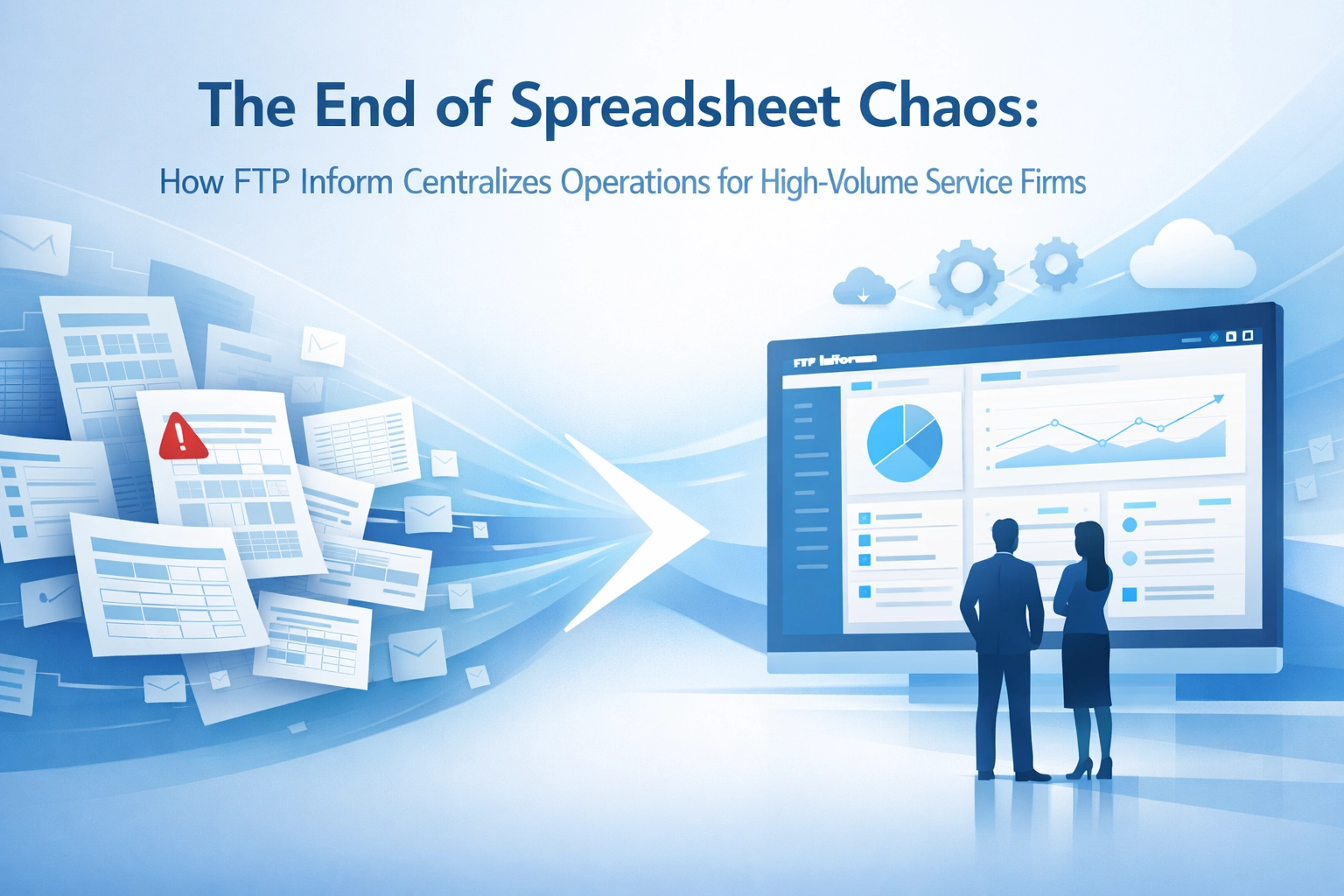
  • The End of Spreadsheet Chaos: How FTP Inform Centralizes Operations for High-Volume Service Firms

    The End of Spreadsheet Chaos: How FTP Inform Centralizes Operations for High-Volume Service Firms

    For high-volume service firms: particularly those in debt collection, legal services, and large-scale professional consulting: the spreadsheet is both a lifeline and a liability. In the early days of a firm’s growth, a well-constructed Excel sheet or a shared Google Doc feels like the ultimate flexible tool. It’s accessible, customizable, and requires no specialized training.

    However, as volume scales into the thousands of records per day, that flexibility turns into "Spreadsheet Chaos." Data silos begin to form. Different departments operate off different versions of the same file. Reporting becomes a "post-mortem" exercise: looking at what happened last week rather than what is happening right now. For executives, this lack of visibility is more than an inconvenience; it is a strategic bottleneck that prevents effective assignment logic, resource scheduling, and profit maximization.

    At Pure Technology Consulting, we view software not just as a set of features, but as an operating model. Centralizing operations requires moving away from manual file management and toward automated, real-time data ingestion. Tools like FTP Inform serve as the foundation for this transformation, acting as the bridge between fragmented data sources and a unified operational truth.

    The High Cost of the "Spreadsheet Status Quo"

    In the debt collection and fintech sectors, data is the primary asset. Every CSV, XLS, or XLSX file received from a client represents potential revenue. Yet, many firms still rely on manual processes to monitor FTP servers, download files, and update internal trackers.

    When your operation is constrained by manual data handling, you face three primary risks:

    1. Reporting Latency: By the time a manager aggregates five different spreadsheets into a master report, the data is already 24 to 48 hours old. In high-velocity environments, old data leads to poor decision-making.
    2. Version Fragmentation: When multiple team members edit shared files, "Version 2_Final_Updated" quickly becomes the standard. This creates data silos where the left hand doesn't know what the right hand is doing.
    3. Human Error in Assignment Logic: If you are manually assigning accounts or tasks based on spreadsheet data, a single sorting error or a broken macro can result in thousands of missed opportunities or compliance risks.

    Centralized data visualization showing the transition from fragmented silos to organized operational clarity.

    Breaking the Silos: Why Manual Reporting Is Your Biggest Operational Bottleneck

    Visionary leadership requires a clear line of sight into every corner of the organization. When data is trapped in silos: isolated folders on an FTP server or disconnected spreadsheets on a local drive: that sightline is broken.

    High-volume service firms often struggle with "Reporting Limitations" because their tech stack isn't integrated. They might have a sophisticated telephony system for collections or a robust case management system for legal work, but the inputs to those systems are still handled via manual file transfers.

    This is where the transition from "manual" to "automated" becomes a competitive advantage. By implementing automated monitoring systems, firms can ensure that every new file arrival triggers an immediate notification or a direct data injection into their core systems. This eliminates the "waiting period" between data arrival and data action.

    Centralization as a Strategic Operating Model

    Centralizing operations isn't just about putting all your files in one folder. It’s about creating a roadmap where data flows seamlessly from the point of origin to the point of execution.

    For a debt collection agency, this might mean that as soon as a client uploads a new batch of accounts to an FTP server, the system identifies the file, validates the format, and alerts the management team. This allows for immediate assignment logic: determining which agents are best suited for these specific accounts based on real-time capacity and historical performance.

    For professional services firms, centralization enables more accurate scheduling. When you have a real-time view of project data and resource availability, you can move away from "gut-feeling" scheduling and toward data-driven workforce management.

    Interconnected digital network symbolizing automated scheduling and streamlined data flow for high-volume firms.

    How FTP Inform Provides the Needed Visibility

    While we specialize in bespoke web development and complex automation, we developed FTP Inform as a specific solution to the common problem of FTP-based data fragmentation.

    In many high-ticket industries, clients still prefer FTP transfers for security and volume reasons. FTP Inform serves as a sentinel, monitoring these servers for CSV, XLS, and XLSX files. Instead of a staff member checking the server every hour, the system provides real-time notifications.

    This capability is a proof-of-concept for how custom automation can solve broader operational drag. When you know exactly when data arrives, you can build workflows around that arrival. You move from a reactive stance ("Did the client send the file yet?") to a proactive stance ("The file is here; let's execute the strategy.").

    Real-Time Reporting vs. Manual Post-Mortems

    The difference between a firm that survives and a firm that leads is the speed of its feedback loop. Manual spreadsheets encourage a culture of "looking back." You look at the weekly report on Friday to see what went wrong on Monday.

    A centralized, automated system encourages a culture of "looking forward." Real-time reporting allows you to:

    • Identify bottlenecks as they occur.
    • Pivot resources to high-priority tasks mid-day.
    • Provide clients with instant updates on file processing status.

    This level of transparency is inspirational for both the team and the clients. It signals that the firm is not just a service provider, but a technology-forward partner capable of handling complex, high-volume requirements with precision.

    Modern silhouette looking toward a clear horizon of data-driven insights and strategic operational clarity.

    From Data Silos to Data-Driven Decisions

    The ultimate goal of ending spreadsheet chaos is to empower leadership to make data-driven decisions. In our work with fintech and healthcare clients, we’ve seen how moving to custom-built dashboards and automated ingestion engines changes the executive mindset.

    Instead of asking "What is the status of the files?", leaders start asking "How can we optimize our output based on this data?"

    This shift requires a commitment to a custom-tailored tech stack. Off-the-shelf SaaS products often solve 80% of the problem, but for high-volume firms, the remaining 20%: the specific way you handle your unique data workflows: is where the profit lies. This is why we focus on custom software development that fits your specific operations, rather than forcing your operations to fit a generic tool.

    The Vision for the Modern Service Firm

    The firm of the future is an automated firm. It is an organization where the "operating model" is baked into the software architecture. By centralizing data and automating the monitoring of your most critical inputs, you free your human capital to focus on high-value strategy rather than low-value data entry.

    If your firm is currently drowning in spreadsheets or struggling with the limitations of manual FTP management, it’s time to audit your workflow. The transition from chaos to centralization is not just a technical upgrade; it is a strategic evolution.

    At Pure Technology Consulting, we bring proven capabilities from healthcare, fintech, and professional services to help you build the infrastructure needed for high-volume success. Whether it's through targeted tools like FTP Inform or comprehensive custom web applications, our mission is to eliminate operational drag and replace it with visionary efficiency.

    Taking the Next Step

    Ending spreadsheet chaos begins with a single decision: the decision to stop accepting "manual" as the standard.

    If you’re ready to explore how custom automation and centralized data management can transform your service firm, we invite you to take a closer look at our approach to workflow audits and custom builds.

    Don’t let your data stay siloed. Don’t let your growth be capped by the limits of a spreadsheet. It’s time to centralize, automate, and lead.


    Amin Said, Founder of Pure Technology Consulting LLC
    https://puretechconsult.com
    Phone: +1 (803) 921-0969

  • Why AI Workflow Automation Will Change the Way You Scale Your Service Business

    Why AI Workflow Automation Will Change the Way You Scale Your Service Business

    For decades, the service industry has operated under a fundamental law: to grow revenue, you must grow your headcount. This linear relationship between capacity and human capital has created a "growth ceiling" for professional services, legal firms, and accounting practices. The more successful you become, the more complex your management overhead becomes, and the thinner your margins often grow.

    At Pure Technology Consulting, we view this not as a permanent reality, but as a technical challenge waiting for a visionary solution. AI-powered workflow automation is the catalyst that is currently decoupling business growth from manual labor. It is shifting the operating model from one of human endurance to one of algorithmic leverage.

    The End of the Linear Growth Model

    Traditionally, scaling a service-based business meant navigating a hiring headache. If you wanted to double your client load, you had to double your staff, or risk a catastrophic drop in service quality. This approach is inherently fragile. It relies on finding, training, and retaining talent in a competitive market where labor costs are constantly rising.

    AI automation introduces "elastic capacity." Imagine a system that can process 1,000 intake forms as easily as ten, without a single additional hire. Organizations that integrate AI into their core operations are reporting 30–40% improvements in workflow efficiency. This isn’t just about doing things faster; it’s about changing the fundamental physics of how a business expands.

    Abstract visualization of scaling a service business using AI workflow automation and digital leverage.

    Strategic Resource Allocation: Moving Beyond Routine

    The most expensive resource in any high-ticket service business is the expertise of its professionals. When a senior partner at a law firm or a lead consultant at an accounting firm spends hours on data entry, document sorting, or routine client follow-ups, the business is leaking value.

    By implementing bespoke automation, we enable these professionals to focus on high-value, high-intent work. This shift maximizes the ROI on your payroll. Instead of paying for time, you are paying for outcomes.

    Our approach involves building custom web applications that act as the central nervous system for your operations. For example, our work with AI Local Boost demonstrates how complex, repetitive tasks, like managing local SEO signals and Google Business Profile optimizations, can be automated to maintain a high-standard digital presence across hundreds of locations without a massive marketing team. This is the same logic we apply when building custom solutions for our legal and accounting clients: automate the visibility and the routine, so you can dominate the strategy.

    Bespoke Intake and the "High-Stakes" Workflow

    In sectors like healthcare, legal, and fintech, the "intake" phase is often the most significant bottleneck. A manual intake process is prone to human error, slow response times, and data silos.

    We have addressed this through proprietary engines like EHRIO Pro. Originally designed to handle complex healthcare matching and 70-question intake flows, this technology proves that automation can handle highly nuanced, HIPAA-adjacent data with precision. When we bring this capability into a legal or accounting context, we aren't starting from scratch. We are applying a proven framework for high-stakes data management.

    A custom-built intake application doesn’t just collect data; it validates it, categorizes it, and triggers the next step in the workflow, whether that’s generating a contract, scheduling a consultation via https://puretechconsult.com/schedule, or alerting a specific department.

    Digital illustration of an automated intake process organizing complex data for service business efficiency.

    24/7 Service Delivery Without the Burnout

    In a global economy, the traditional 9-to-5 operating model is a liability. Clients expect instant gratification and proactive communication. AI-driven workflows allow a service business to operate 24/7 without requiring a night shift.

    Automated customer workflows can resolve issues, provide status updates, and qualify leads in real-time. Statistics show that businesses deploying these systems see a 30–50% increase in customer satisfaction. This is because the "wait time" is eliminated.

    Consider how we utilize ChainHQ to maintain governance over complex supply chains and workflows. By having an automated "overseer" that monitors every step of a process, we ensure that nothing falls through the cracks, regardless of the time of day. This level of oversight is what allows a business to scale confidently, knowing that the quality of service is baked into the software architecture itself.

    Secure Data Management and FinTech Integration

    Scaling a service business also means scaling the volume of sensitive data you handle. For accounting firms or debt agencies, the security of file transfers and the accuracy of telephony integrations are non-negotiable.

    We have built frameworks like FTP Inform to solve the specific challenge of secure, automated data movement. Whether it’s integrating call attribution for a debt agency or managing secure document portals for a CPA firm, the goal is to remove the "human middleman" from the data transfer process. This reduces risk, ensures compliance, and accelerates the decision-making cycle. Research indicates that AI-supported decision cycles are 40–60% faster than manual ones, allowing your firm to pivot and respond to opportunities in real-time.

    Minimalist circular interface representing 24/7 service delivery and faster automated decision cycles.

    The Financial Impact of Automation

    The transition to an AI-automated workflow is an investment in the equity of your business. While the initial setup of a custom web application or a bespoke automation suite is a significant undertaking, the long-term ROI is profound.

    • Cost Reduction: Service businesses typically see a 25–50% reduction in costs for targeted processes.
    • Improved Margins: As your revenue grows, your costs remain relatively flat, leading to dramatic margin expansion.
    • Higher Valuation: A business with automated, proprietary workflows is worth significantly more to an acquirer than one dependent on the "tribal knowledge" of a few key employees.

    Building Your Roadmap to Transformation

    The question for visionary leaders is no longer if they should automate, but how they should structure their automation roadmap. Many businesses make the mistake of buying off-the-shelf SaaS products that don’t talk to each other, creating more "tech debt" and fragmented data.

    At Pure Technology Consulting, we specialize in building the "glue", the custom web apps and deep integrations that turn disparate tools into a unified, scalable engine. Our expertise spans from GPS logging and rep accountability in field operations to complex telephony integrations in fintech. We don't just provide software; we provide the architectural blueprint for your next stage of growth.

    The path to scaling your service business is through digital transformation. It requires a partner who understands the nuances of high-stakes industries and has the technical capability to build bespoke solutions that fit your unique operations.

    Crystalline shield symbolizing secure data management and high-level protection for fintech automation.

    Consultative Discovery

    If you are ready to explore how custom automation can redefine your operating model, we invite you to begin a discovery process with us. We focus on identifying the specific bottlenecks in your current workflow and designing a roadmap that delivers immediate efficiency while building a foundation for exponential scale.

    To discuss your project or to see a demo of our capabilities in action, please reach out to our team.

    Pure Technology Consulting LLC
    Phone: +1 (803) 921-0969

    Website: https://puretechconsult.com
    Discovery: https://puretechconsult.com/schedule

    Amin Said, Founder of Pure Technology Consulting LLC
    https://puretechconsult.com

  • The Local SEO Edge: How AI-Powered Workflow Automation is Helping Wellness Practices Dominate Search

    The Local SEO Edge: How AI-Powered Workflow Automation is Helping Wellness Practices Dominate Search

    For many wellness practice owners: whether you are operating a multi-location physical therapy clinic, a boutique mental health collective, or a specialized medical spa: the digital landscape often feels like a treadmill that never stops. You know that visibility on Google is the lifeblood of new patient acquisition, yet the path to achieving that visibility is usually paved with high agency retainers, fragmented workflows, and the exhausting "SEO agency grind."

    In 2026, the gap between practices that are merely surviving and those that are dominating their local markets is no longer defined by who has the largest marketing budget. Instead, it is defined by who has the most efficient operating model for digital authority.

    At Pure Technology Consulting, we view local SEO not as a series of creative "hacks," but as a data-driven workflow that can be engineered, automated, and scaled. By integrating AI-powered automation into your practice’s growth strategy, you can move from reactive survival mode to a proactive growth trajectory that compounds over time.

    The Friction of the Traditional SEO Agency Grind

    Traditional SEO models are often built on manual labor. An agency assigns an account manager who manually updates business listings, writes one or two blog posts a month, and slowly builds out location pages. For a multi-location wellness practice, this manual approach is inherently flawed. It is slow, prone to human error, and prohibitively expensive to scale.

    When you are trying to grow, you cannot afford to wait six months for a manual citation cleanup or a slow drip of content. This "grind" keeps business owners stuck in a loop of paying for effort rather than outcomes. The risk is high: if your NAP (Name, Address, Phone) data is inconsistent across the web, search engines lose trust in your practice. If your location pages are generic, Google won't prioritize you in the "Local Pack" (the top three map results).

    Digital transformation of manual SEO tasks into organized, automated workflows for wellness clinics.

    Moving from Survival to Growth: The Automation Strategy

    The shift to AI-powered workflow automation changes the fundamental unit of SEO. Instead of thinking in terms of "tasks," visionary leaders think in terms of "systems."

    Automation allows a wellness practice to maintain a dominant presence across dozens of zip codes without increasing their administrative overhead. This is the core philosophy behind our custom builds and frameworks, such as our AI Local Boost (AILB) ecosystem. We don’t just "do SEO"; we build the infrastructure that automates visibility.

    1. Location Page Creation at Scale

    For a wellness practice with five, ten, or fifty locations, creating unique, high-quality content for each neighborhood is a massive undertaking. Manual creation often leads to "content cannibalization" or duplicate content that search engines penalize.

    With automated workflows, we can generate dozens of unique, SEO-optimized location pages using structured data and dynamic templates. These pages aren't just shells; they are populated with localized service language, provider bios, and neighborhood-specific context that signals high relevance to Google's algorithms.

    2. Eliminating the NAP Consistency Barrier

    One of the largest barriers to local search dominance is the "fragmented identity" problem. If your practice moved three years ago, or if a provider changed their name, those old citations still haunt your search rankings.

    AI-driven systems automate the detection and correction of these inconsistencies across hundreds of directories. By strengthening your citation profile automatically, you build a durable local footprint that AI search systems: including Google’s Gemini and OpenAI’s SearchGPT: rely on when making recommendations to potential patients.

    The ROI of Automated Digital Visibility

    When we discuss digital strategy with executive-level clients, the conversation always centers on operating leverage. How much output can we generate for every unit of input?

    The data is clear: wellness practices utilizing AI-driven SEO automation can publish 20–30 optimized pages monthly, compared to the 2–4 pages typically produced by a manual agency. Furthermore, because the automation handles the "heavy lifting" of data entry and technical schema markup, the cost of acquisition typically drops by up to 75% compared to traditional healthcare SEO models.

    Isometric city map illustrating automated search visibility across multiple wellness practice locations.

    Faster Time-to-Market

    In the world of custom software and high-level automation, speed is a competitive advantage. Traditional SEO results are often promised in 6 to 12 months. With an automated roadmap, we typically see measurable movement in search rankings within 4 to 6 weeks. This speed allows practices to capture market share in new territories before competitors can even finish their manual keyword research.

    Focus on High-Value Patient Acquisition

    Automation doesn't just save money; it saves cognitive bandwidth. By removing the "SEO Agency Grind" from your plate, you can focus on high-ticket service lines: such as specialized surgeries, long-term wellness programs, or elective procedures: that drive the highest revenue. Your digital presence becomes an automated engine that feeds the practice, rather than a project that requires constant babysitting.

    Building for the Future: AI-Ready Local Authority

    The future of search is increasingly conversational and intent-based. When a mother in your city asks her phone, "Where is the best pediatric wellness center near me that specializes in holistic nutrition?", the answer isn't determined by who has the most keywords. It’s determined by structured data.

    AI systems look for clear signals:

    • Schema Markup: Technical code that tells search engines exactly what services you offer and where.
    • Sentiment Analysis: Automated monitoring of patient reviews to understand the "vibe" of your practice.
    • Real-time Availability: Integrating your booking systems directly into your search profile.

    At Pure Technology Consulting, we specialize in building these types of complex, bespoke integrations. Whether it is our work in healthcare with matching engines like EHRIO Pro or our local SEO automation via AI Local Boost, our goal is to ensure your practice’s data is the most reliable and accessible in your market.

    A connected digital ecosystem of healthcare data points powering local search authority and growth.

    Taking the Next Step in Your Growth Roadmap

    Dominating local search in the wellness sector is no longer a matter of luck or simply having "good content." It is a matter of engineering. By replacing manual effort with intelligent workflows, you transform your practice from a local business into a dominant market force.

    If you are a growth-focused business owner tired of the traditional agency model and ready to explore how custom automation can scale your visibility, it is time to shift your strategy. We invite you to move beyond the grind and into a model of automated authority.

    How to Begin

    Every successful transformation starts with a clear understanding of the current technical landscape. We recommend a comprehensive workflow audit to identify where manual friction is slowing your growth and where automation can provide the highest immediate ROI.

    To discuss a bespoke development roadmap for your practice, you can schedule a discovery call with our team. We focus on building high-ticket, scalable solutions that integrate seamlessly with your existing operations.

    Amin Said, Founder of Pure Technology Consulting LLC
    https://puretechconsult.com
    +1 (803) 921-0969

    More Resources for Growth-Minded Executives:

  • Why AI Workflow Automation Will Change the Way You Manage Your Operations

    Why AI Workflow Automation Will Change the Way You Manage Your Operations

    In the current landscape of enterprise evolution, we have moved past the era where digital transformation was a luxury. As of March 2026, it has become the fundamental baseline for survival. For executives and operational leaders, the challenge is no longer about "going digital," but about how to orchestrate a complex web of data, human talent, and machine intelligence into a cohesive, high-performance operating model.

    The traditional approach to operations management: relying on manual oversight, fragmented SaaS tools, and reactive troubleshooting: is reaching its breaking point. This "operational drag" costs companies more than just money; it costs them the agility required to pivot in a volatile market. At Pure Technology Consulting, we view AI workflow automation not as a replacement for human ingenuity, but as the high-tensile framework that allows your team to scale without the friction of traditional growth.

    The End of Operational Drag

    Operational drag is the invisible tax on your productivity. It is found in the hours spent reconciling invoices, the delays in client onboarding, and the inevitable errors that occur when high-value employees are forced to perform low-value data entry. Research consistently shows that companies integrating AI into their process automation can reduce operational costs by 20% to 30%. However, the true value lies in the reallocation of human capital.

    When routine, rule-based tasks are offloaded to an intelligent automation layer, your workforce is liberated to focus on strategic initiatives, relationship building, and high-level problem solving. This isn't just about speed; it's about accuracy. In industries like manufacturing or healthcare, where we have deployed advanced matching engines, the precision of AI-driven inspection and data validation often exceeds human benchmarks by significant margins.

    Human silhouette stepping into light, representing liberation from manual tasks through AI automation.

    From Reactive Management to Predictive Orchestration

    Most operational models are reactive. A bottleneck occurs, a report is generated, and a manager intervenes. AI workflow automation flips this script. By leveraging vast datasets and predictive analytics, an automated system can identify potential disruptions before they manifest as crises.

    Consider the complexity of inventory management or professional service scheduling. AI-powered tools can analyze historical patterns, market trends, and real-time inputs to adjust workflows dynamically. This proactive stance reduces forecasting errors and minimizes downtime, transforming the operations manager from a "firefighter" into an architect of efficiency.

    At Pure Technology Consulting, we specialize in building these bespoke architectural layers. We understand that your business doesn't fit into a one-size-fits-all SaaS box. You need custom software that mirrors your unique logic and governance requirements.

    Case Study in Complexity: EHRIO Pro

    To understand the power of high-level automation, one only needs to look at our proprietary work with EHRIO Pro. Originally designed for the complex healthcare sector, EHRIO Pro serves as a testament to what is possible when you combine custom web development with sophisticated matching algorithms.

    The platform handles intricate, 70-question intake processes and matches them against specific healthcare criteria with surgical precision. This isn't simple data collection; it is a HIPAA-adjacent workflow that manages compliance, data integrity, and stakeholder communication in a single, automated stream.

    We are now bringing this same level of sophisticated engineering to the legal and accounting sectors. For a high-ticket law firm or a multi-state accounting practice, the "matching engine" logic of EHRIO Pro can be adapted to manage case assignments, audit trail verifications, and client-vendor matching. It is proof that a custom-built solution can handle the "heavy lifting" of operations, ensuring that the right data reaches the right person at exactly the right time.

    Centralized data hub with glowing rings illustrating scalable architecture for custom business operations.

    The Architecture of Scalability

    A common fear among growing businesses is that scaling operations requires a linear increase in headcount. AI workflow automation breaks this correlation. Through custom-built web applications and integrated AI agents, a business can double its output without doubling its staff.

    This scalability is achieved through:

    • Seamless Integration: Connecting disparate legacy systems into a unified dashboard.
    • Dynamic Resource Allocation: Using AI to route tasks based on urgency and team capacity.
    • Automated Communication: Utilizing sophisticated bots to handle routine inquiries, such as those integrated via FTP Inform for data movement notifications or client updates.

    By building a custom "operating system" for your business, you create an asset that grows in value as it accumulates data, becoming more efficient with every transaction it processes.

    Governance, Risk, and Compliance

    In highly regulated fields like fintech, legal, and healthcare, the stakes of operational failure are high. Manual processes are not only slow; they are risky. A missed step in a compliance workflow can lead to significant legal exposure.

    Automated workflows provide a transparent, immutable audit trail. Every decision made by the system is logged, and every data point is validated against pre-set governance rules. This level of oversight is nearly impossible to maintain manually at scale. Our work in fintech: specifically regarding telephony integrations and call attribution for debt agencies: demonstrates our ability to build systems that prioritize both performance and rigorous compliance.

    Stacked digital plates with a light beam showing an immutable audit trail for automated compliance systems.

    How to Begin Your Transformation

    The transition to an AI-augmented operating model does not happen overnight. It requires a visionary approach and a strategic roadmap. At Pure Technology Consulting, we don't start with code; we start with a discovery.

    We work with your leadership to map your current workflows, identify the points of highest friction, and design a custom solution that integrates with your existing tech stack. Whether you need a bespoke web app to manage field operations: similar to our GPS-logging work in D2D tracking: or a complex data-matching engine, our goal is to deliver a premium, high-impact solution that justifies your investment within months, not years.

    Your Strategic Roadmap Includes:

    1. Workflow Audit: Identifying the manual bottlenecks that are currently throttling your growth.
    2. Architectural Design: Creating a blueprint for a custom web application that centralizes your operations.
    3. AI Integration: Layering intelligent automation onto routine tasks to ensure precision and speed.
    4. Scaling & Governance: Ensuring the system is robust enough to handle growth while maintaining strict data compliance.

    Digital bridge connecting fragmented data to a structured monolith, symbolizing operational transformation.

    The Future of Your Operations

    The companies that thrive in the coming decade will be those that view technology not as a utility, but as a strategic lever. AI workflow automation is the key to unlocking that lever. It allows you to move faster, decide better, and grow without the traditional pains of expansion.

    If you are ready to move beyond the limitations of off-the-shelf software and build a bespoke operational powerhouse, we are ready to guide you. Our team specializes in the high-ticket, high-complexity builds that define modern business success.

    To begin the conversation and explore how a custom automation strategy can transform your specific operating model, I invite you to reach out to my assistant, Emily, to schedule a discovery call. We can discuss your current challenges and provide a roadmap for a solution that fits your vision.

    You can also reach our office directly at +1 (803) 921-0969 to start your journey toward operational excellence.

    Amin Said, Founder of Pure Technology Consulting LLC
    https://puretechconsult.com